My book and web site

Check out my book, The Sustainable-Enough Garden, available on Amazon, and the book's web site at www.thesustainable-enoughgarden.com. See more plant photos on Instagram.

Sunday, September 29, 2019

What I put up with for love

A new puppy is testing my tolerance for garden mayhem. Lola is a 4-month-old beagle mix who was brought up from Louisiana with her littermates to find adoptive homes in Massachusetts. She’s playful, affectionate, and all-around lovable. And she’s making a mess of the garden.

Lola's first day in her new home

    The first thing to go was a big puff-ball of ornamental grass, prairie dropseed (Sporobolus heteroleptus). When Lola first explored the yard, this plant attracted her irresistibly. Within in a few days, it was flattened. All the slender leaves were lying on the ground around the stubbly remaining base. Why this species and not a nearby dwarf fountain grass (Pennisetum alopecuriodes ‘Hameln’)? Search me.


Prairie dropseed trying to resprout

    Let’s face it, puppies chew and bite. Lola plucks leaves off container plants, chomps on sticks she finds on the ground, and gnaws on my gardening sneakers. That’s pretty much expected.


    Also predictable is how much she loves digging. The sight of me digging tempts her to join in. Rodent burrows drive her into a frenzy. 


Excavating a vole's burrow?

She’s developed a game: take a plush squeaky toy outdoors, dig a hole for it, drop it in and cover it by nosing soil back over it, then go back an hour or a few days later and “find” it, with great joy. Once she’s run around the yard with the muddy prize in her mouth, she starts digging another hole for it. This is cute when she chooses an inconspicuous digging spot behind large shrubs. It’s infuriating when she wants to uproot my favorite peonies to bury her treasure.

Please, not the peonies!

     I’m reduced to putting up mechanical barriers improvised from fencing and hoop stakes and applying bitter apple spray, which is supposed to make things taste bad—both only mildly successful. From what I’m learning, training is all about “capturing” the dog behavior you want and rewarding it. I guess that means when she digs in the right place, she should get a treat.

    My idea of a good digging spot would be the compost bin. Lola loves to pull out and chew half-made compost components such as rotting stems and chunks of turf. So far she hasn’t buried anything in the compost. That can be a goal to work toward.


How about burying things here?

    Usually I defend my garden fiercely. I shooed the kids out of the perennial beds. When my husband killed a succulent near the barbecue grill that he thought was a weed, I was hurt and indignant. A neighbor who cut back branches on my side of the fence got an angry letter.


    This feels different. Lola’s a baby, and I hope she’s going to grow out of her destructive ways. In the meantime, I’m glad it’s fall, because I can tell myself the foliage she plucks or tears was going to drop off soon anyway. The holes she digs will soon be camouflaged by falling leaves.


They can't fall too soon this year

    Spring will be the real test. Can I stand to watch her destroy fresh new leaves and flowers? I hope I won’t have to.


There’s still time. If you’d like to attend a sustainable gardening class in my yard Saturdays October 26 and November 2, you can sign up here through Newton Community Education.

Sunday, September 22, 2019

Lots to love about leaf mulch

The word is out: leaf mulch is great. 

Shredded leaves make high-quality, free mulch

   I’ve been chopping up fall leaves for mulch since sometime in the 1990s. These days I mulch most beds with whole leaves, because they provide shelter for over-wintering insects. I still use chopped leaves for areas near the lawn, because they don't blow around. 

     Many people chop leaves with the lawnmower. I prefer to use a standing leaf shredder, essentially a string trimmer in a drum. Plastic filaments whirl around and chop the leaves into small shreds. The resulting mulch is pretty, it doesn’t blow around like whole leaves left on the ground would, and it’s great for building soil fertility. And the electric-powered shredder doesn’t generate exhaust.

Electric leaf-shredder doesn't pollute the air

    The Rose Kennedy Greenway, the linear Boston park created in 2008 when the Big Dig moved the highway underground, uses organic methods and has recently experimented with switching from bark mulch to shredded leaves. The product they apply, which you can now buy from landscapers, has a step added to my process. After the leaves are chopped, they’re composted for a year. Horticulturists for the Greenway find the composted leaf mulch is full of beneficial soil organisms.


Rose Kennedy Greenway-photo Tim Grafft/MOTT

    As their test area, the Greenway chose a section of the garden devoted to New England native plants. After three years, they’ve found substantial benefits. In the leaf mulch beds they’ve measure increases in soil organic matter. They’ve also found increased cation exchange capacity, which allows soil to hold on to nutrients and buffers it against excess acidity. In fact, the soil in these beds has improved so much that Greenway staff have to consider whether the soil may become too rich for their native plants.


    One of the few drawbacks of leaf mulch at the Greenway has been small fires in the mulch from discarded cigarettes, which apparently isn’t a problem with bark mulch. Let’s hope visiting smokers can learn not to throw cigarette butts into the garden!


It counts as littering

    The City of Newton passed on a recommendation from Michigan State University for mulching lawns with chopped leaves. Lawn lovers hate the idea of letting leaves lie on lawns through the winter, where snow piled on matted leaves can kill the grass. That’s is one of the reasons for our suburban cultural taboo against letting fall leaves lie.

No fall leaves allowed on the lawn

    Instead of doing all that work raking and bagging the leaves, though, MSU turfgrass scientists found they could save time and improve lawns by chopping the leaves on the lawn with a few passes of a lawn mower. The little leaf fractions sift down out of sight among the turf plants, providing a mulching function that suppresses dandelions and crabgrass by up to 100 percent after three years. The decomposing leaf shreds also fertilize the lawn.

 
Chopping leaves with a lawnmower-photo Rebecca Finneran, MSUE


    My focus when I chop up fall leaves has been on improving the soil for shrubs, vegetables and perennials. The lawn is on its own. But after hearing the MSU results, I think I’ll set up my leaf shredder on the lawn this fall to spread some of those leaf bits around while I make mulch for the beds.


Perennials could share some leaf mulch with the lawn

    I’ll be demonstrating the leaf shredder in action at a hands-on sustainable gardening course in my yard Saturdays October 26 and November 2. You can sign up here through Newton Community Education.

Sunday, September 15, 2019

Vines with volunteer spirit

In addition to the vines I wrote about two weeks ago that I chose and planted, I’ve got several climbers growing in the yard that showed up on their own. The most useful of these volunteers is Boston ivy (Parthenocissus tricuspidata), the vine that gave the Ivy League its name.

Boston ivy 

    Our Boston ivy appeared on the fence that divides us from our neighbors to the south. It keeps the fence covered in green leaves through the growing season. It’s also acting as a groundcover in a corner where nothing else will grow. 


Boston ivy covers the ground in the dense, dry shade of Norway spruces

The three-pointed bright green leaves turn yellow to scarlet to red-purple in fall. It attaches to supports with holdfasts, sticky discs on the ends of its tendrils, and reportedly grows to 50 feet long. When I follow a shoot I want to remove from a bed or a tree trunk, I can testify that it reaches that length in my yard.

Boston ivy's romantic fall color

    The secret to this vine’s success is that birds like to eat the blue-black berries; Boston ivy is in the grape family. A native of Asia, not New England, the vine has spread around the area as birds drop seeds in favorable growing spots. I don’t regret having it in my garden, because I’d be hard put to find another vine that would cover that fence so thoroughly with so little help from me.


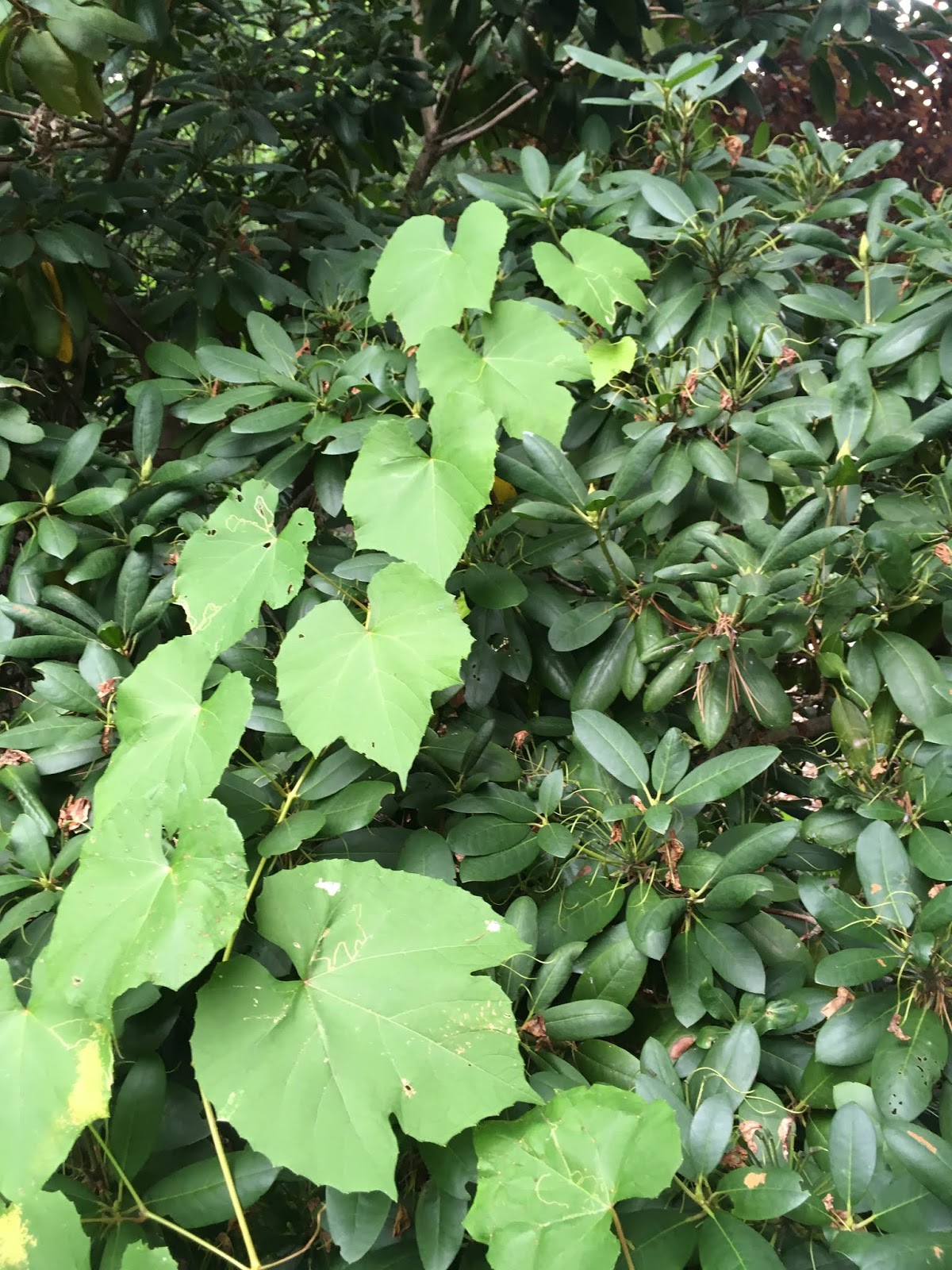
    Two other members of the grape family have also found a place in the yard. I recently spent some sweaty hours pulling wild grape canes (Vitis vinifera subsp. sylvestris) off the shrubs that overhang another section of the same fence. The vines had rooted behind a neighbor’s shed. 


Wild grapes climbing a truck-sized Catawba rhododendron

By the time I noticed them on an infrequent visit to check for places a new puppy could tunnel under the fence, they’d reached far over my head. I had to cut back the leatherleaf viburnum branches (Viburnum rhytidophyllum) that supported them and pull and hack off the vines that came down with them. 

    Wild grapes are nice looking, but I didn’t want their shade to kill the shrubs, and they were bidding fair to take over a large section of the canopy in our yard. Like Boston ivy, they’re imports, in this case from the Mediterranean, and like it they’re spread by birds. I’ll have to remember to be vigilant about checking every year to cut them back as they continue venturing over the fence.


    The third grape relative I’ve found in the garden is Virginia creeper (Parthenocissus quinquefolia, named for the five leaflets that make up its leaves), a cousin of Boston ivy. So far I’m only seeing little patches in uncultivated spots. 


Virginia creeper getting started in a shady area

I welcome this vine because it’s a native and because I love its bright red fall color. When we replace a rotting wooden fence with chain link later this month, I could move one of the young vines to the fence line to create some quick visual screening.

Virginia creeperr's autumn splendor-photo Moralist

Want to see the vines in their fall colors? Sign up here with Newton Community Education for a hands-on sustainable gardening course in my yard Saturdays October 26 and November 2.

Sunday, September 8, 2019

Pollinator-friendly container plantings

Every spring I fill 10 or 12 large containers with flowers and foliage plants for summer enjoyment. At this time of year, there’s a pause in the garden action. Foliage is looking shopworn and dull. A few flowering plants whose growth shut down during the hottest days are coming back to life, preparing for an autumn round of bloom. 

Phlox and a few zinnias are blooming in the late summer lull

Buds are swelling on the New England asters (Symphyotrichum novae-angliae), but few have opened yet. This seems like a good time to evaluate how the container plantings have turned out.

    My favorite pot this year was inspired by advice from reader Patricia McGinnis. Two years ago, Patricia pointed out that instead of neonicotinoid-treated annuals from the garden center, I could fill my pots with divisions of perennials from the garden. What a breakthrough!


    Last fall I’d potted some unneeded perennials with thoughts of passing them on to students at my spring sustainable gardening course (If you’d like to attend the fall course in my garden on Saturdays October 26 and November 2, you can register here through Newton Community Education). Some didn’t find a new home, so I used them to design a pot for a prominent position in the front yard.


Perennial divisions fill out a front yard container

    A purple-leaved heuchera, a nativar, makes a solid mass in this arrangement. Nonnatives provide contrasting foliage: a hosta with chartreuse leaves banded with blue-green and a Japanese forest grass (Hakonechloa macra) with similar yellow-gold coloring. I bought an ostrich fern (Matteuccia struthiopteris) to add some height and added white-flowered wax begonias to bloom nonstop through the season. The begonias' shiny round leaves add another texture to the composition. I knew the fern and begonias were neonic-free, because I’d gotten them at a local farm and garden center that promises untreated plants.


    My next favorite container plantings this summer feature nonnative combinations I’ve been repeating over the years. The “thriller” in these pots is Canna ‘Bengal Tiger’. 


Yellow-striped leaves make Canna 'Bengal Tiger' stand out

I store the roots in the basement through the winter, so I don’t have to worry about neonic-treated replacements. I do the same with the giant tuberous roots of elephant ears (Colcasia esculenta). 

Like cannas, elephant ears need their roots stored indoors in winter

The canna has orange blooms, but I usually cut off the flower stalks so top-heavy plants won’t tip over in a heavy wind. To fill in around the canna stems in a pot that’s located in shade, I added white-flowered impatiens. In two pots on the deck that get afternoon sun, I combined the cannas with cobalt-blue lobelia (Lobelia erinus). 

    This year I’ve had success with another conventional flower choice: a big pot full of apple-blossom pink geraniums. 


Taking a break on a geranium flower. Is it a cricket?

I’d bought three of these plants at a pesticide-free garden center two years ago. I’ve kept subsequent generations alive by taking cuttings in fall. This way I don’t have to search every spring for neonic-free geraniums.

    These are the adaptations that have allowed me to keep neonics out of my pollinator-friendly garden. I’m also happy that my peat-free potting mix is succeeding in providing sustenance for the container plantings.


Coleus thriving in potting mix made from compost and coconut fiber

Sunday, September 1, 2019

Corralling climbers

As a garden fills up at ground level, it’s tempting to go for vertical growing space by adding vines. I’ve done my share of this in recent years. I’ve learned that their vitality and vaulting ambition can be either a boon or a disaster.


Honeysuckle can be a pleasure or a monster, depending on conditions

    Take hardy kiwi (Actinidia arguta). I’d received a specimen of its variegated cousin, Actinidia kolomikta, as a membership bonus from the Arnold Arboretum.


Variegated hardy kiwi-photo David J. Stang

It grew moderately where I planted it against a north-facing wall along the driveway. I thought another member of the genus would be similarly docile, and I ordered male and female seedlings so that hardy kiwi could produce grape-sized kiwi fruit.

'Weiki' hardy kiwi
 
     Too bad I didn’t investigate the vines’ growth habits, because both hardy kiwis grew far too vigorously for my purposes. They quickly grabbed low-hanging spruce branches, and they looked ready to conquer the 40-foot spruce within a season. In the wilds of East Asia, they can reach 100 feet by scaling tall trees.

Hardy kiwi reaching for the sky-Jo Zimny photos

    My climbing hydrangea (Hydrangea petiolaris) is the apple of my eye. But it too was a lot more ambitious than I expected. In its first 10 years, the vine got a firm hold on an adjacent oak. It began producing its romantic clouds of white flowers in June. 


Climbing hydrangea in bloom

Instead of twining like the kiwis, climbing hydrangea attaches to its supports with adhesive disks called holdfasts. While covering more of the trunk every year with flowers, it’s also formed a mat on the metal garage roof, creating a microenvironment where Oriental bittersweet (Celastrus orbiculatus), a nonnative invasive vine, has found a foothold. 

At 20 years, the climbing hydrangea has taken over the garage as well as the oak trunk

     Birds must have dropped bittersweet seeds on the roof, and now bittersweet wands are reaching for oak branches. 

Bittersweet berries attract birds, as well as makers of holiday centerpieces

These strangling vines really could kill the tree. I think the only definitive solution will be to cut the hydrangea vine off the roof to eliminate the trap for leaf litter that incubates bittersweet seedlings.

    Less vigorous are the many varieties of clematis I’ve planted. Their flowers are so enticing that I can’t resist buying new ones. Clematis are reputed to prefer having their heads in the sun and their feet in the shade. I’ve found that they also need a minimum of competition and plenty of coddling. I’ve had best luck with an old-fashioned variety, Clematis ‘Jackmanii’. 


Clematis 'Jackmanii'-photo k yamada

It flowers reliably in a sunny spot along the driveway. More recently I’ve tried training clematis up trees and shrubs. They hold on by wrapping their petioles (leaf stalks) around twigs, so they don’t kill supporting plants. 

    As with so many plants in my yard, the controlling factor for my vines is how much sun they get. A clematis growing in sun on a tuteur in the insectary bed produces bounteous elegant blue flowers in May.


Clematis in its happy place

Other clematis vines grow lots of stems and foliage but not many flowers as they climb under the shade of supporting trees. Those too-shaded clematis may not flower profusely, but they don’t try to take over. It’s a delicate balance.

Would you like to see how the sausage is made? I'm offering a fall gardening course in my yard on Saturdays October 26 and November 2. You can sign up through Newton Community Education here.


Sunday, August 25, 2019

Making themselves at home

This August I’m keeping an eye on native plants I’ve recently added to the garden. I have to admit that not every native I’ve brought home has settled in easily. But an inventory of the newish plantings under the shade of our dawn redwood (Metasequoia glyptostroboides) shows that some are chugging along.

Before recent additions: shade-tolerant plants under the dawn redwood

    I have high hopes for New York ironweed (Vernonia noveboracensis). This will grow to a shrub-sized perennial, up to 6 feet high and 4 feet wide, with purple flowers in late summer and fall. 


New York ironweed blooming last fall

Doug Tallamy’s Bringing Nature Home web site notes that ironweed is a caterpillar host plant for 18 species of moths and butterflies in my area. So far it’s only about a foot tall, but it has pleasing feathery foliage. When the sheet composting area decomposes enough for planting, I might move the ironweed forward away from the tree, since it grows in sun in the wild.

    I love the dark reddish-brown flowers of Carolina allspice (Calycanthus floridus), a beetle-pollinated magnolia relative also known by the common name of sweetshrub for its flowers’ fruity scent. 


Carolina allspice flowering in Central Park

I first planted this shrub in significant shade next to a Japanese stewartia (Stewartia pseudocamellia). It has survived and flowered, but it’s not making many branches. When we took down the hemlocks near the dawn redwood, a sunnier patch opened up. I took the opportunity to try Carolina allspice again.

    Another native shrub that seems to be thriving is coastal doghobble (Leucothoe axillaris). Its best feature is its low, arching sprays of shiny leaves. Native plant expert William Cullina explains that the common name describes the tangled thickets leucothoe creates in the wild that even a dog can’t wriggle through.


Shiny foliage of coastal doghobble


     Leucothoe is often recommended with other broadleaf evergreens for foundation plantings. I inherited lots of those: rhododendrons (Rhododendron spp.), mountain laurels (Kalmia latifolia), and Japanese pieris (Pieris japonica), but I’d never grown leucothoe until I realized it was a native that might do well under the shade of the dawn redwood, and so it has. Those leaves are still shiny and pristine in August, which is more than I can say for most of the foliage in the yard. I haven’t seen any flowers yet. They’re going to be little dangling white bells.

    By the way, neither Carolina allspice nor the leucothoe is actually native in the Northeast. They’re both from the Southeast, but since they can grow here, I’ve decided to give them a try. We each get to decide how native our natives are going to be. If I were a true purist, I’d restrict myself to plants from my ecoregion, the Boston Basin. So far I’m not willing to be that exact.


The Boston Basin is my ecoregion

    A true New England native is already established next to the dawn redwood: winterberry (Ilex verticillata). This has grown into a small double-stemmed tree and produces masses of red berries that birds eat during the fall and winter. I’m glad to know that it also provides caterpillar forage for 42 moth and butterfly species.


Winterberry fruit in late fall
 

Sunday, August 18, 2019

Shrinking the lawn

Evelyn Hadden’s book Beautiful No-Mow Yards recently reminded me that I still have a grassy lawn. The book spotlights gardeners around the country who have dispensed with lawn, replacing it with options ranging from groundcover beds to meadow gardens to paths leading between garden “rooms” full of beautiful perennials, shrubs and small trees.

Native perennials replace lawn in Robin Wilkerson's garden in Lincoln, MA

    While I’ve long aimed to eliminate lawn, I realized that I’m not ready to give up grass completely. What I’d like would be to reduce it to an area of transition between beds. I still like the look of the visually quiet mowed surface as a foreground for other more exciting plants.


Lawn makes a nice foreground

    Even a low-input lawn like ours is environmentally undesirable. Our lawn uses fossil fuels for mowing, but it’s getting by without fertilizer, weed-killers, or extra water. It’s still a pretty barren habitat for native insects and birds, compared to other ways garden space can be used.


    My lawn-reduction effort started back in the 1980s when I replaced a part of the front lawn with vinca (Vinca minor, also called periwinkle). That wasn’t so much a principled choice as an acknowledgment that grass wasn’t going to grow under the shade of the Norway maple street trees. The groundcover bed has proved to very low-maintenance, needing only occasional weeding to remove maple seedlings.


Vinca groundcover beds are neat and easy to maintain

    Next I dug out some grass around a fish pond we’d installed in a circle of lawn in the backyard. I planted perennials and dwarf trees instead, including two dwarf blue spruces (Picea pungens) that I particularly like. As they slowly enlarge, I’ll need to decide whether to move them and choose something smaller. Meanwhile, they’re doing their part by filling what would otherwise be lawn and offering shelter for moths and butterflies.


Perennials and blue spruce replace some lawn

    Two years ago I took out a big chunk of lawn when I created two perennial beds off the back deck. That and a bluestone path eliminated about 600 square feet of grass. While we had school-age kids, we wanted an open space outside the back door where they and their friends could run around. Now it’s nicer to turn that space over to flowers and pollinators, especially because it’s one of the sections of the yard that gets the most sun.


New beds and path where lawn used to be

    Last March I added to a bed with a sheet-composting project. As you can see, the mound of wood chips and compost is starting to settle. With continuing decomposition, after two years, it should sink to the level of the surrounding lawn. Then it will provide a rich environment for flowering perennials. I’m planning to move some there from places that have gotten too shady. If there’s space left, I can add new ones too.


Sheet composting mound is subsiding

    My next plan is to repurpose some lawn space across from the sheet composting. Outside the vegetable garden fence, I could create a cutting garden. It would be nice to grow dahlias, zinnias, and snapdragons just for enjoying indoors in a vase. Why not?


Wouldn't flowers look better?