My book and web site

Check out my book, The Sustainable-Enough Garden, available on Amazon, and the book's web site at www.thesustainable-enoughgarden.com. See more plant photos on Instagram.

Sunday, June 26, 2016

Life after pesticides

Two years ago I resolved to make a break with pesticides. Well, not a total break, because my hemlocks are still sprayed with horticultural oil for nonnative woolly adelgid, and I still spray for winter moth with spinosad, a natural product derived from bacteria. That was supposed to be all.

    Since I made that decision, I’ve reminded Lueders, the company that does the spraying, that I don’t want horticultural oil sprayed on anything but the hemlocks, and I want them sprayed only in early spring, when insects other than the adelgids are dormant and not in danger of being suffocated by the oil.


White adelgid egg sacs along hemlock twigs. These insects will kill a tree within 5 years

    I convinced myself that I wasn’t going to notice any difference when they stopped spraying other shrubs and trees with the horticultural oil. My reading told me that native insects I’d been spraying for were not going to kill the shrubs and trees. I imagined that the damage they’d do if untrammeled would hardly be noticeable. 


    It’s not turning out to be quite that simple. I’ve already noticed discolored and dying leaves on boxwood. I pruned out some of the worst-looking branches. A few weeks later, more leaves show dots and discoloration. 


Boxwood foliage is yellower than normal, and leaves are stippled with bites

I’d imagined that box (Buxus sempervirens) grew healthily in my garden. More accurately, it looked healthy as long as it got annual spraying.

    With a sinking heart, I noticed last week that scale insects are back on the undersides of the leaves of a variegated kiwi vine (Actinidia kolomikta). I knew they were there last year and hoped I’d eliminated them by swabbing them off the leaves with rubbing alcohol.


White cottony covering protects scale insect on kiwi leaves

    Lueders inspected in March and warned that scale was also affecting two magnolias. I’d noticed black staining on the branches, probably from mold that grew on the insects’ honeydew secretions. 


    So now what? Lueders recommends spraying more horticultural oil. They’d resume treating the magnolias and boxwood in early spring as they used to do, and they’d add a second oil application to the boxwood shrubs in fall.


    The problem is that I’m trying to enable a full population of insects to live in my yard, finding their own balance between leaf-eaters such as the mites and scale and their insect predators. If I keep interfering by applying insecticides, beneficial insect predators won’t be attracted to the garden. 


Dragonflies help maintain balance by eating other insects

Spraying in fall when lots of insects are active would also kill bystanders that are needed as part of the full food web.

    For a start, I think I’ll remove the kiwi vine and replace it with something else that can grow on a north-facing wall. I could try replacing boxwood shrubs with native inkberry (Ilex glabra), which has similar small, shiny evergreen leaves. I’ll hold off on making a decision about the magnolias. 


     I’m thinking of this period as analogous to the transition from conventional to organic farming. It could take a few seasons for a natural balance to be established.

    Here’s hoping that won’t mean losing those lovely magnolias whose flowers raise our spirits in early spring.


Star magnolia (Magnolia stellata) in late April
 

Tuesday, June 21, 2016

Volunteers

The gardening world calls plants that show up spontaneously where we want them “volunteers,” in contradistinction to their evil cousins, weeds, which show up where we don’t want them. There’s no bright line between the two categories—weediness is in the eye of the beholder.

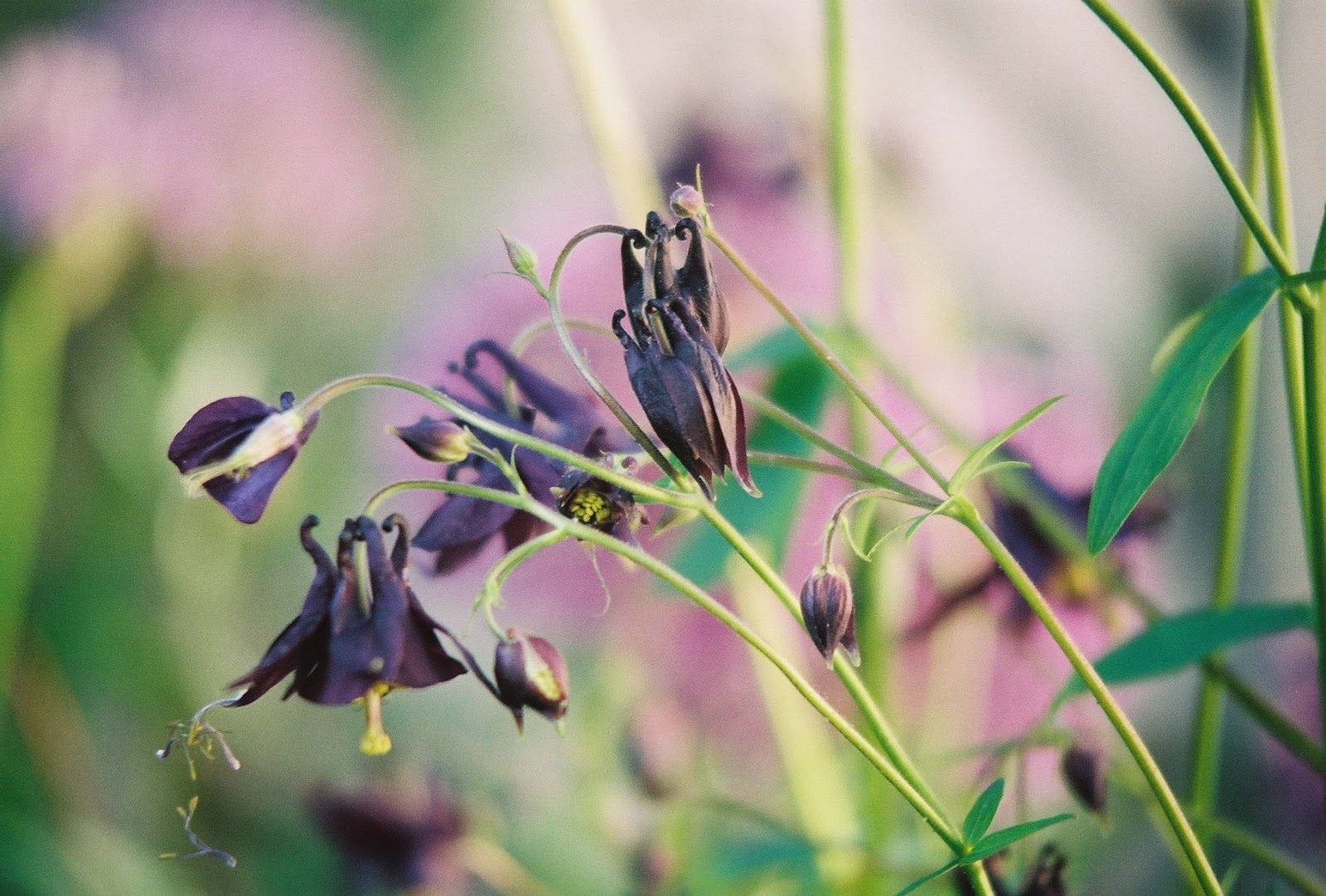
    This week I’m admiring the volunteer efforts of some plants that pop up around the garden and open lovely flowers in new spots. One of my favorites is columbine (Aquilegia spp.): 


     Over the years I’ve planted several members of this genus. I’ve learned that although they seem to keep coming back every year, what I’m seeing is a series of short-lived plants that leave behind offspring to bloom in their places.

    Columbines are known for crossing promiscuously. I can’t predict which flower colors I’ll see the next spring. I’ve planted varieties with blooms ranging from deep plum to blue to pink. One persistent flower color that emerged from the genetic mix is a pink so pale pink that it’s almost white. Many of this year’s columbine flowers were gorgeous blues.


    I like the fact that I don’t have to buy new columbines at this point, thus avoiding the environmental cost of shipping young plants from perennial farms in Latin America. When seed pods form, I let them ripen and just bend the stems back to drop their seeds on the surrounding soil. I can count on a crop of new columbines the next year.


Columbine seeds forming


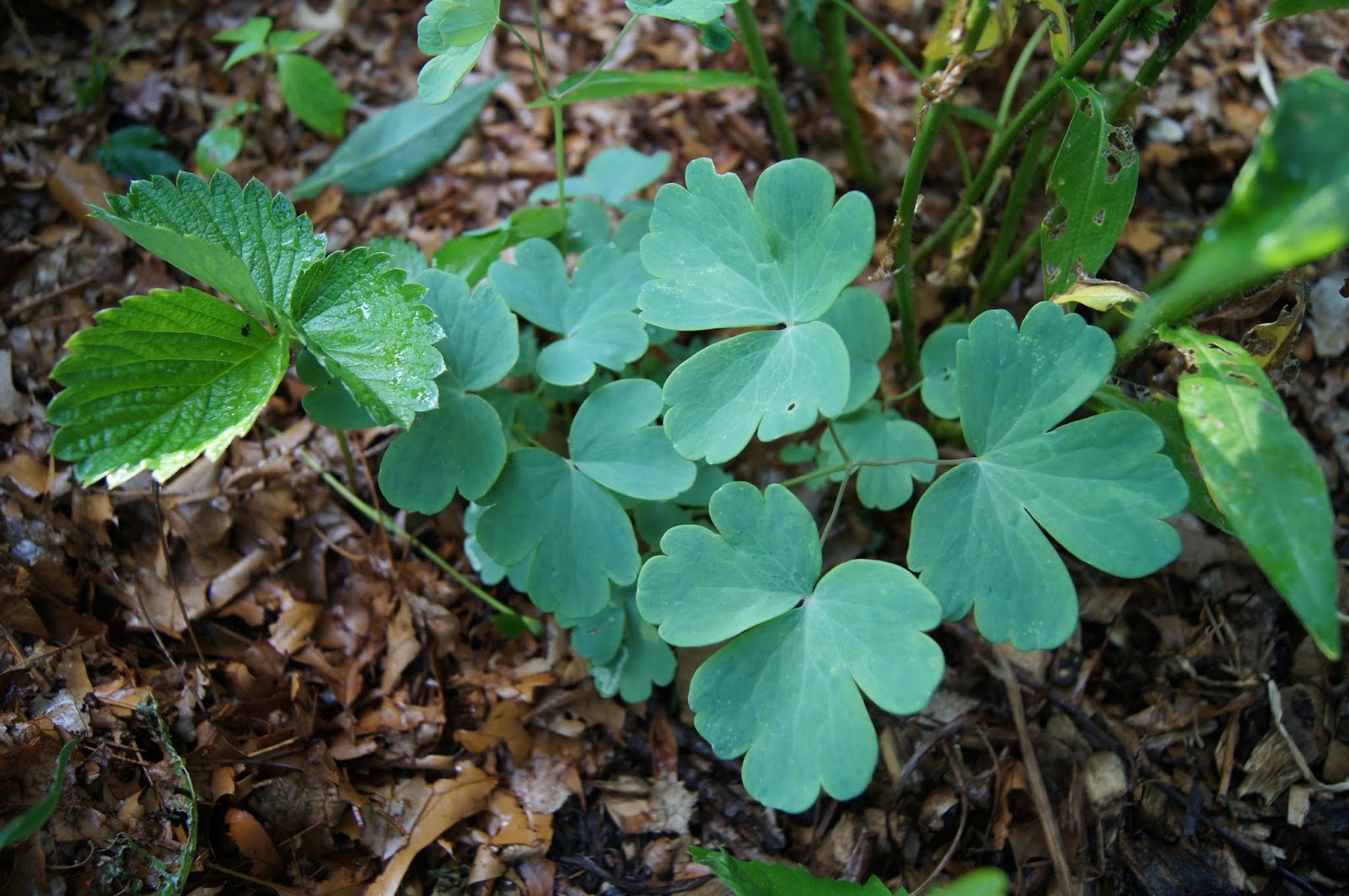
    Some seeds must hitchhike in compost, because young columbines often sprout in the vegetable bed. When they do, I transplant them to an area where they’re needed or pot them to pass on to a friend.


This young columbine emerged next to a strawberry plant

    I’ve been trying to encourage some purple coneflowers (Echinacea purpurea) to volunteer in a new spot. 


Prominent central discs give coneflowers their name

Back when my trees were young, I planted a bed of these deep pink flowers with some ornamental grasses and sedums. Successive generations of coneflowers gradually migrated to the very edge of the lawn, following the disappearing sunlight as the trees around the bed got wider and taller.

    Last year I gave up on growing those poor coneflowers in deepening shade. When seeds formed in the central discs, I cut the flowers and spread them around the front of a nearby bed that gets afternoon sun. My hope was that the seeds would start a new colony.


    This May a few seedlings appeared, and this week they’re burgeoning. I foresee blooms later this summer. You could say I sowed the seeds, although the work on my part was minimal. So maybe these plants are draftees rather than volunteers.


Coneflower seedling

     Like many daisy-shaped composite flowers, coneflowers are popular with birds and beneficial insects. I expect to find butterflies, native flies and bees, and possibly hummingbirds and goldfinches visiting the plants’ first flowers.

Tuesday, June 14, 2016

Bird BNB

Last week I mourned a clematis that’s not leafing out. I’d like to cut back the dead gray stems and trim off spent peony blossoms nearby. The reason I don’t is that a cardinal couple has built their nest two feet from the lattice supporting the now-dead vine. I don’t want to trespass on their territory.

    It’s a thrill to see birds nesting near the house this year. I like to think they’re choosing our yard because of hospitable conditions. I spotted the male cardinal flying back and forth near the garage and wondered where his nest was. 


     One day I was standing at the kitchen sink gazing absently out the window and realized I was looking right into a nest of small twigs built at eye level next to the trunk of a Hinoki cypress (Chamaecyparis obtusa). 

The nest of twigs near this trunk is well hidden by foliage

    I can see why this shrub was a good choice, because its evergreen scales grow densely, making an excellent shelter. Now I sometimes see the heads of the baby cardinals with their mouths open wide, waiting for their father to stuff in some food. 


    The other nest I’m aware of belongs to robins. It sits on top of a security light mounted under the eaves of the house along the driveway. I first became aware that nesting action was going on when I started finding dried stalks of smooth Solomon’s seal (Polygonatum biflorum) lying on the asphalt. 


Dry smooth Solomon's seal stems make good nesting material

    Looking up, I saw a new nest constructed from stalks and mud sitting on top of the leftover base from a previous effort. 


Robin's nest

Two weeks later I found a piece of blue eggshell on the ground under the nest. The chicks were hatching!


    The robin father won’t stay on the nest when I’m around, so I’m not able to capture his portrait. 


The best shot I could get by hiding in my car

This makes me think that those stake-outs you see on TV, where a detective sits in a car taking plentiful photos of an unsuspecting criminal with a whirring telephoto lens, may possibly be unrealistic, or at least would be if the suspect were a bird parent. 

Not fooling any robins

    This robin flies away to a fence post or the peak of the garage roof when he notices me getting near, increasing my admiration for real wildlife photographers. He’s clearly on the job feeding the chicks, though, because I see their little beaks poking out above the rim of the nest, and they’re growing fast.


    Looking for some background information, I learned that American robins and northern cardinals do good work in the garden. They eat lots of insects, as well as fruits (robins) and seeds (cardinals). Robins are among the few birds that feed on grubs and worms they find in lawns, which is why they’re so visible in suburban landscapes. 


    I found out that the mother birds in both species often move on once the eggs hatch, building another nest and producing and incubating another clutch of eggs in the same season. The fathers do the work of feeding the nestlings. Who knew male birds were so evolved?

Sunday, June 5, 2016

Body count

I recently heard a gardener present her horticultural credentials by saying, “I’ve killed a lot of plants.” I could definitely relate. This is the time of year when I have to admit that while some plants are going strong, others that were growing in the garden last year just aren’t coming back.

    Dead, or close to it, is my poor mountain clematis (Clematis montana var. rubens 'Odorata'). This vine has adorned a small pergola over the garden gate since 1997. 


This is how the clematis looked last spring
 
Most of its stems are still bare long after they should be sporting not just leaves but flower buds. 

Rose canes are alive, but the clematis stems are dead

I suspect the clematis was killed back by cold spells last winter without snow for insulation. One green shoot is coming up from the base. I’ll have to cut down the gray stems and hope the plant will have the strength to send up more. It’s done it before.

    On the other hand, some newer inhabitants of the garden are showing promise. I’m glad to see that an oakleaf hydrangea (Hydrangea quercifolia) I planted last fall at the front of the house made it through the winter, leafed out handsomely, and is getting ready to flower. I wasn’t sure it could deal with the shade and root competition of an aged Japanese andromeda (Pieris japonica).


Oakleaf hydrangea looking promising


    I’d almost given up on the switchgrass (Panicum virgatum ‘Shenandoah’) I hoped would survive near the dryer vent outflow. Finally last week it sent up new leaves. What a brave performer! 


The switch grass has come back to life


    Some bearded irises I was ready to send out with the yard waste got one more chance, and they’ve seized the opportunity. I moved them from a partly shady bed where they barely flowered to a sunny spot in front of the fish pond. Each fan of leaves has sent up at least one stalk of elegant blue flowers.


Bearded iris (possibly Iris 'Codicil') looking its spring best


    Time will tell whether the iris foliage will die a conspicuous death later in the season, turning brown and rotting at the base from attacks of iris borers. If so, out they go. I’m not willing to resort to pesticides to keep these irises looking good. 


    My American cranberrybush (Viburnum opulus var. americanum) is finally filling out in its third season in the garden. This was the first shrub I intentionally planted to feed leaf-eating insects. They’re back this spring chewing on the leaves. 


In the past I would have viewed the leaf damage as unsightly, but now I see it as a good thing. Those herbivorous bugs provide nourishment for insect predators, birds, and other animals I want to attract to the garden.

    Some plants find their niche here and live happily. Others don’t find what they need in the soil, or the light conditions, or the water availability, or the weather, or the animal inhabitants. Late spring is the time to mourn the ones that dwindled or didn’t survive. Then I get to make plans for rehabilitating or replacing them.

Sunday, May 22, 2016

Wedding white

Dear friends,
I apologize for infrequent posts. I’m absorbed with a happy event, my son’s wedding next weekend. I’ll be back with another post in June. Here’s something I hope you’ll enjoy for the end of May:


White flowers signify innocence, purity, honesty, perfection--and weddings. Whatever the occasion, May’s white flowers are especially beautiful. 

    Before we assume that flowers are white for a biological purpose, we have to bear in mind that from the plant’s point of view, human vision is beside the point. Flowers evolve mostly to attract pollinators. 


    Bee vision, for example, differs from ours. Bees can’t see at the red end of the visible light spectrum, but they see ultraviolet light that’s invisible to us. A flower that looks white to us could show a bee ultraviolet runway stripes (nectar guides) or bullseyes to mark the landing area, holding up a sign that says “Get your nectar and pollen here!”


Visible nectar guides--stripes on this iris--guide bumblebees to pollen. Photo by Al Schneider


    Each of my white flowers has a different strategy for getting its flowers pollinated and reproducing itself.


    Sweet woodruff (Galium odoratum) is a hermaphrodite pollinated by bees, flies, or itself—no wonder it spreads so fast. 


    Double-file viburnum (Viburnum plicatum var. tomentosum ‘Shasta’) has been fooling visitors this spring into thinking it’s a dogwood because of its horizontal rows of glowing white flowers. These attract insects and humans first with larger, sterile flowers that resemble the “petals” on flowering dogwoods (in fact those are adapted leaves called bracts).


The inner fertile flowers of the viburnum open a few days later.  

    Lily-of-the-valley (Convallaria majalis) is flowering profusely this week. Last year must have been a good one for this plant, because as its leaves emerge this spring, I’m finding it has expanded into new territory. The tiny bells on its flower stalks are pollinated by honeybees and bumblebees.


Each lily-of-the valley needs to cross with a genetically distinct plant to make fruit, one red berry per plant. But anyone who lives with this determined shade grower knows it does plenty of vegetative spreading even without fruit.

    The flowers of dwarf fothergilla (Fothergilla gardenii) have both male and female parts but no petals. I read that they’re pollinated by honeybees. Offering such easy access to nectar, they must attract other insects too. 


Bottlebrush flowers of dwarf fothergilla


    Bleeding heart, a member of the poppy family (Papaveraceae), offers pollen but not nectar to visiting insects. 


White bleeding heart, Dicentra spectabilis 'Alba'

Once the seed develops, bleeding heart has an interesting method for spreading it around. Each seed is attached to an elaiosome, a white fleshy blob rich in lipids that ants like to eat. 

Bleeding heart seeds with attached elaiosomes

Ants carry the seed back to their anthills and eat the elaiosome without damaging the seed. In return, the seed gets a free ride to a location farther from its parent plant than it could otherwise travel.

Sunday, May 8, 2016

Quick and dirty

This weekend I potted up my tender perennials using homemade non-peat potting mix. I store dahlias, cannas, elephant ears (Colcasia esculenta), and South American anise-scented sage (Salvia guaranitica) in the basement through the winter and wake them up in spring to flower another season. 

Salvia guaranitica 'Black and Blue'

They’re plants from warmer latitudes that can’t tolerate New England winters outdoors. Because of their large fleshy roots, they can survive out of the ground until spring.

Dahlia tubers after a winter in the basement

     Making this happen is supposed to be more complicated than I’ve found it. For example, my old copy of The Reader’s Digest Illustrated Guide to Gardening prescribes many steps for winter storage of dahlia tubers. The reader is instructed to wait until frost blackens the foliage, cut off stems at 6 inches, carefully lift the roots from the soil without damaging them, use a blunt stick to clear loose soil from the tubers, hang the plants upside down for two weeks to dry, dust them with sulfur to prevent fungal infections, and store them in trays of dry sand or peat moss in a cool greenhouse or dry cellar at 40 to 45 degrees.


    This idea that houses contain rooms or outbuildings that stay at 40 to 45 degrees during the winter seems to be a throwback to English gardening. With central heating and effective insulation, I can’t imagine there are many houses in the northeastern US that offer these special conditions for plant storage.


    I tried the Reader’s Digest authors’ approach one winter (admittedly leaving out the sulfur sprinkling). By spring my tubers had dried up, shriveled and died.


    Instead, I stumbled on a much simpler approach for over-wintering tender perennials. In late fall I cut the stems and dig up the plant, leaving plenty of soil around the roots. I place each plant, soil and all, in a brown paper grocery bag. I enclose this in a plastic drawstring kitchen-size trash bag, tie the top closed, and store it in the basement on wire shelving. There the plants go dormant in darkness and cool-enough temperatures.


    Cultivating dahlias for the biggest, showiest flowers is a special skill that I haven’t acquired. However, I can count on my stored dahlia tubers and other tender perennials to stay hydrated enough to sprout indoors when I replant them in pots in May. I let them grow indoors for a month.


Potted and ready to go inside to sprout in a sunny spot

As the weather warms, I move them outdoors during the day and back inside at night. After Memorial Day I can plant them in the garden or in large containers, where they flower again for another summer.

Elephant ears in July
Dahlias in September

I used to consume many bags of commercial potting mix for this process. Now I get good results with a peat-free mix of half coir (coconut fiber) and half screened compost from my compost piles. I’m glad to leave the peat in its bogs, where it sequesters carbon.

I mix screened compost and coir right where I'll pot the stored plants


Monday, May 2, 2016

Lawn grass--threat or menace?

Why do some plants grow well only where you don’t want them? Lawn grass in my garden keeps reminding me of this question.

    A few years ago, the water department replaced our old cast iron main water pipe, leaving a big trench in the front yard that city contractors thoughtfully filled with topsoil. Apparently they didn’t notice that the shady area they’d dug up was not lawn—it had already been converted to a bed of periwinkle (Vinca minor). 


Periwinkle replaced our sorry front lawn

Following standard practice, they sprinkled grass seed on the new soil.

    I was amazed at how well that grass grew. I tried to scoop the seed up immediately and replace it with more periwinkle seedlings, but grass still sprouted. It was several seasons before I could weed it out, plant by plant. 


    I noticed the same with grass that showed up in a perennial bed in the backyard. It migrated from the lawn by sending out underground stems toward the bed, and once it established a foothold, it was quite hard to pull out.


Wandering lawn grass  peaking from under a meadow rue

    In contrast, the grass seed I planted in the backyard barely made an effort. Each spring and fall I’d hopefully over-seed my lackluster lawn with expensive seed mixes. To help the new grass plants along, I watered frequently with a hose or rotating sprinkler. One year I even put down a wet slurry of shredded newsprint, fertilizer, and grass seed that was supposed to keep the seed moist until it could sprout in bare patches of the lawn. 


    Each time I planted, a few young blades of grass would sprout, only to die away in the heat of the summer or disappear by the next spring.


    Why was this happening? Was it just my lack of diligence in caring for the young grass? If lawn grass could co-exist happily with periwinkle and coreopsis in planting beds, why couldn’t it also compete successfully with other species in the lawn?
    .
    First, nature abhors a monoculture. I’d watched neighbors completely remove their lawns and reseed. After a year or two, unless they used weed-killers, they were back to the same mix of crabgrass and other weeds that made up my lawn.


The view from our deck--more weeds than lawn grass

    Second, my lawn’s soil is not hospitable. I don’t pamper it with compost or shredded leaves, we compact it by walking on it, and new grass sprouts don’t have the luxury of shelter from taller plants in their early days. They have little chance to establish a root system before investing energy in leaves.


    Lawn grass is the hardest plant for me to grow. I’m ready to give up. Moss thrives in our acidic soil in the shadier parts of the lawn. It looks quite nice. 


Moss is taking over a shady section of lawn

Bluestone pavers and low-growing perennials would look even better. 


In future I see more bluestone, less grass