My book and web site

Check out my book, The Sustainable-Enough Garden, available on Amazon, and the book's web site at www.thesustainable-enoughgarden.com. See more plant photos on Instagram.
Showing posts with label habitat loss. Show all posts

Sunday, April 12, 2020

Putting the toothpaste back in the tube

At a time when we’re wondering whether what’s broken can ever be fixed, it’s nice to hear some good news about planting for pollinators. A team of scientists in Munich recently published results of their study of urban flower strips, 1,000-square-meter wildflower gardens planted in the city as part of the European Union’s initiative to improve foraging opportunities for bees and other flower-visiting insects. They found these plantings surprisingly effective.

Urban flower strip, Fockenstinstrasse, Munich

    The team undertook their study when the flower strips, sown with a mix of locally native flowering plants, were only a year old. They hypothesized that these mini-meadows would draw mostly bees that are common in Munich and can gather pollen from a broad range of flowers. They didn’t expect these beds to be much of a resource for oligolectic bees, ones that need food from a few native plants. They got a surprise. 


Dogwood andrena bee specializes on dogwood flowers-photo Beatriz Moisset

    In the first year, 61 percent of the bee species known to live in Munich found the flower strips. Most were the common polylectic types, the bees that aren’t picky foragers. But the proportion of specialist  bees that needed particular flowers was nearly the same as in Munich's general insect population. They also found that the urban flower strips increased bee populations in surrounding areas, as far as 1500 meters away.


European dark bee-photo SJ Richards

    By the way, were any bees killed in the process? I was glad to hear that this was a catch and release program. The scientists swept the air with insect nets, put the bees on ice for 10 minutes, and when the bees entered “cold rigor,” they measured and photographed them on site. Within two to three minutes, when the bees had warmed up and awakened, they released them to continue foraging.


    As I prepare to plant native perennials to attract pollinators, this study gives me confidence that my efforts can be effective. Germany’s situation is a lot like ours. The scientists noted that Germany had lost about 10 percent of its meadows between 1991 and 2019. We too are losing open space at a great rate, estimated by the US Forest Service at 6,000 acres every day, or 4 acres per minute. 


Goldenrod provides insect forage in a Maine meadow

     What’s left may be so altered by human activity that it doesn’t offer much of what native insects need. We know that insect populations are plunging. Our government lags behind the European Union’s in addressing this. That’s why there’s such an urgent need for home gardeners to plant for flower-visiting insects.


Pollinator garden at the Smithsonian's National Museum of Natural History

    But can we really replace the rich biodiversity of what’s lost?  I worry that my small effort will offer too little too late. This study suggests that our pollinator gardens can make a meaningful contribution toward rehabilitating impoverished landscapes. I’m hoping my new bed of native pollinator plants will be attractive and full of insect life. It would be nice if it also drew not just the toughest survivors, but also the insect species that need the most help.


Spotted beebalm in my pollinator bed should support native insects-photo Judy Gallagher

Monday, July 3, 2017

Back from the edge

Did you know that the Kirtland’s warbler is now a candidate for de-listing as an endangered species because its population has recovered from 167 breeding pairs in 1974 to more than 2,000 today? The news of this conservation success came to me via Living Bird, the magazine of the Cornell Lab of Ornithology.

Singing male Kirtland's warbler--photo USFWS


    The story of this 15-gram bird and its restored summer habitat in northern Michigan is a heartening tale of good will and sound science producing results. It could also be read as a parable for our time.


    The Kirtland’s warbler can only build its nest on the ground beneath young jack pines (Pinus banksiana) no higher than around 12 feet. 


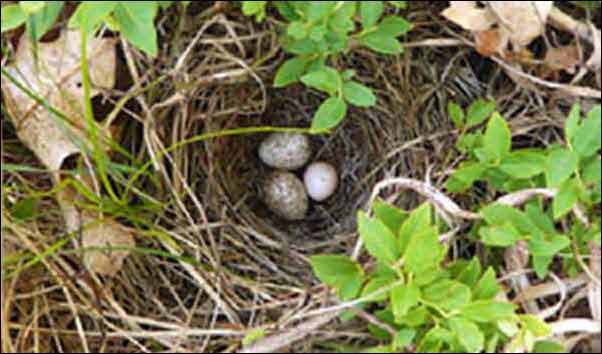
Ground-level warbler nest--photo USFWS

Fires caused by lightning or intentionally set by Native Americans used to result in a steady supply of young trees. Then in the twentieth century, settlers started suppressing wildfire, so the supply of young trees shrank.

    As you can imagine, nesting at ground level means the warblers lose a lot of their young to predators such as squirrels, chipmunks, snakes, feral cats and blue jays. They also can’t tell the difference between their own nestlings and young brown-headed cowbirds.


The cowbird is much bigger than a warbler--photo www.naturespicsonline.com

     The cowbird mother lays her eggs in other birds’ nests, tricking them into raising her young. Cowbird chicks are bigger than baby warblers and hog the food. Often the little warblers don’t survive. Cowbirds have spread from Midwest grasslands to places like the warblers’ home territory as humans have cleared land and built towns.


Cowbird egg in an Eastern Phoebe nest--photo Galawebdesign

    Heroic conservation efforts started in the 1950s and intensified when the Kirtland’s warbler became one of the first species protected under the Endangered Species Act. Federal and state biologists had to take drastic steps to restore the warblers’ habitat—controlled burns, then thousands of acres of jack pines cut and replanted. They also undertook a major program of trapping cowbirds, so that now few cowbird eggs are found in warbler nests. 


    So these are birds that need to build their nests and lay their eggs at the base of only one species of tree and that can’t tell their own babies from usurpers who scarf down all the insects they bring to feed their young. A set-up for evolutionary failure? At least we can say they were no match for the rapidly occurring changes in their surroundings caused by modern humans.


Human habitat, warbler desert--photo bpbailey


    What can we learn from this? I see two warnings. First, as climate change progresses, we’re going to need to adapt. Extraterrestrials observing us from another planet could draw an analogy between Americans and the warblers. The birds can’t live without jack pines; we seem to think we can’t live without a massive fossil fuel budget. If we can’t adjust to a new way of living, might we join the extinction wave? 


Can we find another way?

     Second, we’ve made radical changes in the natural world, just by expanding our population and taking over land for what we regard as normal, benign purposes. We’re going to need to find a way to make a smaller footprint.