One gardener’s spectabilis is another’s horribilis.
When flowering plants make viable seeds that spread around the garden to
germinate next year, you may think it’s a blessing or a curse.
Remember
that primary school unit about how seeds travel? I have examples of all the
strategies in my garden this month, from burrs to wind-catching silky parachutes
to fruits that co-opt birds to carry the seed to new locations. We plant for
flowers, but the plants’ goal is to pass on their genes to another generation.
Usually
I like having the surprise of little seedlings popping up here and there in
spring. This is the time of year when I have to decide who shall live and who shall
die (or at least reproduce)--which seedheads to leave alone and which to clip
out before they can drop their seeds.
Some
of my favorite purchases have turned out to be self-seeders, especially white
bleeding heart (Dicentra spectabilis ‘Alba’).
Spectabilis translates as “worth
looking at,” and that perfectly describes the glowing heart-shaped flowers when
they bloom in my May garden.
 |
| White bleeding heart--worth looking at |
Other enthusiastic self-seeders I enjoy include
columbine (various species of Aquilegia),
dwarf goatsbeard (Aruncus aethusifolius),
and forget-me-not (several species of Myosotis).
When these sprout in unexpected locations, I let some grow, pull some out, move
others to better spots, and pot a few to give away.
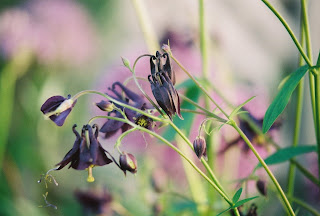 |
| Columbines sometimes cross-breed, changing flower colors in the offspring, but this dark purple has stayed true. |
Then
there’s tall verbena, Verbena bonariensis,
whose seedlings are legion in my vegetable beds. This odd South American self-seeder
sends up a single 3- to 4-foot stem with a small lilac purple compound flower
at the top. It’s a prolific producer of seeds considered invasive in the South,
but not in Massachusetts yet. I bought some from a mail order nursery ten years
ago, and new volunteers sprout every year.
I
keep some of the seedlings because migrating monarch butterflies used to touch down
on the flowers to refuel. I haven’t seen the monarchs for a couple of years,
perhaps because their population has declined drastically due to habitat loss
and the use of herbicides that eradicate the milkweed their caterpillars need
for food.
 | ||
| Instead of monarchs, nonnative cabbage white butterflies (Pieris rapae) are visiting the tall verbena this year. |
 |
| Seeds of swamp milkweed (Asclepias incarnata) getting ready to float on silky floss |


