My book and web site

Check out my book, The Sustainable-Enough Garden, available on Amazon, and the book's web site at www.thesustainable-enoughgarden.com. See more plant photos on Instagram.

Sunday, September 20, 2015

Seed capital


One gardener’s spectabilis is another’s horribilis. When flowering plants make viable seeds that spread around the garden to germinate next year, you may think it’s a blessing or a curse.
            Remember that primary school unit about how seeds travel? I have examples of all the strategies in my garden this month, from burrs to wind-catching silky parachutes to fruits that co-opt birds to carry the seed to new locations. We plant for flowers, but the plants’ goal is to pass on their genes to another generation.
            Usually I like having the surprise of little seedlings popping up here and there in spring. This is the time of year when I have to decide who shall live and who shall die (or at least reproduce)--which seedheads to leave alone and which to clip out before they can drop their seeds.
            Some of my favorite purchases have turned out to be self-seeders, especially white bleeding heart (Dicentra spectabilis ‘Alba’). Spectabilis translates as “worth looking at,” and that perfectly describes the glowing heart-shaped flowers when they bloom in my May garden. 
White bleeding heart--worth looking at
Other enthusiastic self-seeders I enjoy include columbine (various species of Aquilegia), dwarf goatsbeard (Aruncus aethusifolius), and forget-me-not (several species of Myosotis). When these sprout in unexpected locations, I let some grow, pull some out, move others to better spots, and pot a few to give away.   
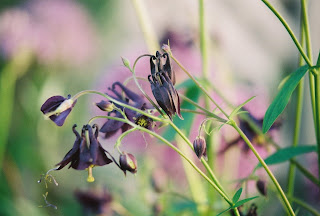
Columbines sometimes cross-breed, changing flower colors in the offspring, but this dark purple has stayed true.
             Then there’s tall verbena, Verbena bonariensis, whose seedlings are legion in my vegetable beds. This odd South American self-seeder sends up a single 3- to 4-foot stem with a small lilac purple compound flower at the top. It’s a prolific producer of seeds considered invasive in the South, but not in Massachusetts yet. I bought some from a mail order nursery ten years ago, and new volunteers sprout every year.
            I keep some of the seedlings because migrating monarch butterflies used to touch down on the flowers to refuel. I haven’t seen the monarchs for a couple of years, perhaps because their population has declined drastically due to habitat loss and the use of herbicides that eradicate the milkweed their caterpillars need for food. 
Instead of monarchs, nonnative cabbage white butterflies (Pieris rapae) are visiting the tall verbena this year.

I’m growing some milkweed now in hopes the monarchs will return.
Seeds of swamp milkweed (Asclepias incarnata) getting ready to float on silky floss
            Because I patrol the beds each growing season deciding which seedlings to coddle, which to tear out and which to relocate, I maintain something close to the balance I prefer. Like ground covers that can spread unmanageably, self-seeders can be so effective that they take over the garden. At least with the self-seeders, I can say no to future spread with diligent dead-heading in late summer and fall, removing spent flowers before they set seed.

Monday, September 7, 2015

A butterfly is born!

An eastern black swallowtail butterfly, Papilio polyxenes asterius, has emerged on my potted parsley! This summer has been very encouraging. Apparently if you plant what native insects want, they'll come.

     I planted some parsley in the vegetable garden and some in a big pot on the deck, hoping to create reproductive space for this butterfly, as well to harvest some garnish. I noticed the mature larva, a large, elegant caterpillar, two week ago.

It transformed into a pupa soon afterward.
 
When I got back from vacation, it had hatched.

I saw what could have been the hatchling flying around the garden today. It declined to stay still long enough to have its picture taken, but here's a file photo showing what it looked like:
Adult female eastern black swallowtail, Papilio polyxenes asterius (Stoll), with wings closed.
Adult female. Photograph by Donald Hall, University of Florida.

Wednesday, August 26, 2015

Policing or editing?


Where should weeding stop? I confess I have trouble stopping myself from pulling out certain weeds, even when they’re not on my property.
One I missed this spring
            My number one target is Norway maple (Acer platanoides). Starting in April thousands of its offspring peek through the groundcover in front of the house, sprout in the compost pile, and even poke up in compacted areas of the lawn. As I move around the garden in spring, I clutch an expanding bouquet of the little seedlings. If I miss them their first year, they’ll be back the next spring woodier and harder to pull out.
            Cities chose Norway maples as street trees because they can tolerate urban conditions. Can they ever! Fence lines and hedges around the neighborhood bear witness to what happens if you ignore their seedlings for a few years—they soon grow tall and out-compete everything below, blocking the sun, hogging the water, and spreading their phytotoxins, chemicals they exude that prevent other plants from growing. 

            I find it hard to keep my hands off the multitudes of Norway maple seedlings I pass in other people’s front yards as I walk my dog. Ailanthus altissima 
(tree of heaven, the tree that grew in Brooklyn), another rapacious grower, also makes me want to yank it out. 
            But how would I feel if someone else weeded my garden without my permission? Outraged and insulted. So I try to hold back. I don’t always succeed.
            All this weeding makes me ask whether I’m trying to police the world. Gardeners reserve the prerogative to decide what grows in their gardens. Outside the garden gates, though, should we stay out of it and let the strong survive? 
            Roger Swain, whom you may remember as the host of the PBS show The Victory Garden, wrote about “editing” a patch of woods on his New Hampshire farm. He subtracted trees and shrubs in March to incline the population toward the native plants he wanted to foster. This seems like a sane approach to the plant world. But when he was in Lexington to film the TV show, I wonder if he found himself twitching out Norway maple seedlings.


Sunday, August 23, 2015

Learning to love shade


When I moved into a new house in 1985 and started my garden, I was disappointed to find that my fifth of an acre lot was mostly shady. The Norway maples in the curb strip effectively shaded our small front yard. In back, we had mature trees to the west, north and south, leaving a patch of lawn between the back fence and the house that got sun in the middle of the day. My first attempt to grow flowers was in that patch of sunnier ground. 
I wanted to grow roses and sun perennials. It took a long time to recognize that I was gardening in shade, whether I liked it or not.
            Some of the trees around the yard were on our property, so we could have cut them down. For each, there was a reason why we chose not to. A line of droopy Norway spruces blocked our southern exposure, but they also created a privacy barrier between our yard and our neighbor’s house. Next to the garage stood a red oak that an arborist guessed was at least 100 years old. Was I really going to evict every creature that depended on that venerable tree? Behind the fence to our west was a thicket of Norway maples rapidly growing from seed on our neighbor’s land.
            So shade gardening was my fate. I learned to love a lot of woodland plants and to seek out attractive leaf forms, textures and variegations. 
 Then we got a surprising opportunity to expand our lot to a third of an acre by buying some land from the neighbors behind us. After we cut down the Norway maples around the perimeter of our new land, I had something I’d never expected—a place to garden in almost full sun.
            But instead of putting in those English-style deep perennial borders full of sun-lovers, I went out and planted a lot more trees. We wanted a visual barrier along the back of the new lot, so we built a berm and planted evergreens including white pines, a balsam fir, and a blue spruce. I really wanted a gingko and a dawn redwood. For understory trees I had to have a stewartia, magnolias, redbuds, shadbushes, and witch hazels. By the time all that planting was done and the trees put on some height, my sunny garden area was mostly gone.
            I enjoy the variety of foliage that my shady garden offers. Later I learned about some other advantages of shade. Those Norway spruces along the south side of the yard shade our house in summer, decreasing our air conditioning bill. The berm to our west planted with now-tall evergreens shelters us from winter winds. A lot of New England’s worst invasive plants don’t prefer shade, so I have less of a battle keeping them at bay. The plants I grow in shade need less maintenance than sun-lovers would. And I’m certainly providing lots of shelter for animals, from insects on up to mammals. 


Monday, August 17, 2015

Kicking the peat habit


Mom, apple pie and peat moss? If you thought, as I used to, that peat moss is a renewable natural product, I’ve got some bad news for you. It’s time to break with peat-based potting soil.
            Peat moss was part of my gardening life from early on. It was the main ingredient of every growing medium I bought. But it turns out that we’re using it up, and contributing to climate change in the process. It wasn’t until I read Sarah Reichard’s book The Conscientious Gardener that I learned the sad truth.
            The problem with harvesting peat is that it's created so slowly. Peat comes from wetland plants—sphagnum moss but also sedges, grasses and reeds-- decomposing very slowly in oxygen-poor water. In peat bogs, peat forms at less than a millimeter per year; the peat we garden with took thousands of years to form. It’s hard to imagine sustainable harvesting given that rate of growth. 

Sphagnum moss growing at Eagle Hill Bog, Campobello Island, New Brunswick
Peat sequesters one third of the world’s soil carbon, more than all the trees in the world. When the peat is harvested, the carbon is released and the carbon sink it provides is eliminated.
            Swarthmore College, whose campus includes Scott Arboretum, has stopped using peat-based potting soil and switched to a mix of coir, or coconut fibers, worm castings, mushroom compost, and rice hulls. Eventually peat-free potting soil will be widely available in the US. In Britain it's already mainstream.  
            Until we catch up, I decided to make my own peat-free mix, using a basic combination of one part coir to one part screened compost from my own yard. A local hydroponic gardening shop provided bagged coir. A by-product of coconut husk processing, coir is the pith left over after separating out longer fibers for use as bristles, filaments, mats, padding, and biodegradable textiles.
            Right away I could see why this material would make a plausible substitute for peat. It’s almost the same color and consistency, a little redder and coarser. Combining coir and compost yielded a handsome, fluffy rich brown mix that already looked absorbent. I used it to pot up annuals, cannas, and elephant ears. One thing was immediately evident: my potting mix was not sterile or weed-free. My compost hadn’t heated up enough to kill weed seeds. In every pot, sprouts began to surface, but the weeds were easy to pull out.   
            By the end of the growing season, I was convinced that my containers had done just as well using the coir and compost mix as they had in previous years with commercial potting soils. I don’t miss peat, because the new mix seems to work fine.