My book and web site

Check out my book, The Sustainable-Enough Garden, available on Amazon, and the book's web site at www.thesustainable-enoughgarden.com. See more plant photos on Instagram.
Showing posts with label global warming. Show all posts

Monday, May 25, 2020

Watering smarter

On warm days this week, I’ve resumed one of summer’s tasks: watering. Back when my garden was young and all the plants were new, I was grateful to have a computerized irrigation system to keep them lush. Over the years, though, I’ve become increasingly conscious of using too much water. 


Automatic sprinkler watering the lawn and nearby beds

One of the environmental downsides to using purified drinking water in the garden, as I do, is its energy cost. Water utilities consume 3 percent of the energy generated in the United States. By cutting back on automatic irrigation, I can make a small contribution to the fight against global warming.

Clean drinking water comes with a carbon cost

Our sprinkler irrigation system was typical for our area when it was installed in 1997. It divides the yard into twelve watering zones, and it’s controlled by a computer in the basement. An attached rain gauge prevents watering after a storm. In retrospect, I could have saved a lot of water by choosing drip irrigation instead of sprinklers. 

Drip irrigation in an almond orchard. Emitters deliver water only to the trees' root zones

A drip system for trees and shrubs would direct water to exactly where it’s needed. Sprinklers inevitably lose water to evaporation. I cringe a bit when I see sprinklers in the neighborhood running in the middle of the day. To minimize that evaporative loss, I program the sprinklers to run after midnight, when it's dark and cool. That’s still less efficient than drip emitters would be. 


Another wasteful feature: our system’s watering zones were laid out when the garden was new. Sprinkler heads placed to water sections of lawn now cover a mix of grass and young and old shrubs and perennials. I don’t have the flexibility to target just the new plantings within a zone. 


Some environmentally-minded gardeners water only by hand, even in the relatively wet Northeast. A lovely garden I visited last summer is maintained without an irrigation system. The homeowner and garden designer explained that most of her garden gets no supplemental watering. When she needs to water new plants, she fills a bucket or watering can from one of her rain barrels.


Water from barrels at downspouts is sufficient for Joanne's native plant garden


At this stage, most of my garden is comprised of established trees, shrubs and perennials. They’ve spread their roots far and wide to find water when soil is dry. New England plants have adapted to survive our summer dry spells, even without the kind of Xeriscaping that’s appropriate to arid parts of the country. A lot of the irrigation I’ve been doing is probably unnecessary at this point.

It's pretty in May, but sweet woodruff is taking over, maybe because of steady moisture from irrigation.

The bold move would be to cut off irrigation to those older plants, at least until I see that they’re really suffering from drought. New plants will still need two years of watering to get established. That’s where watering cans and hose wands come in.
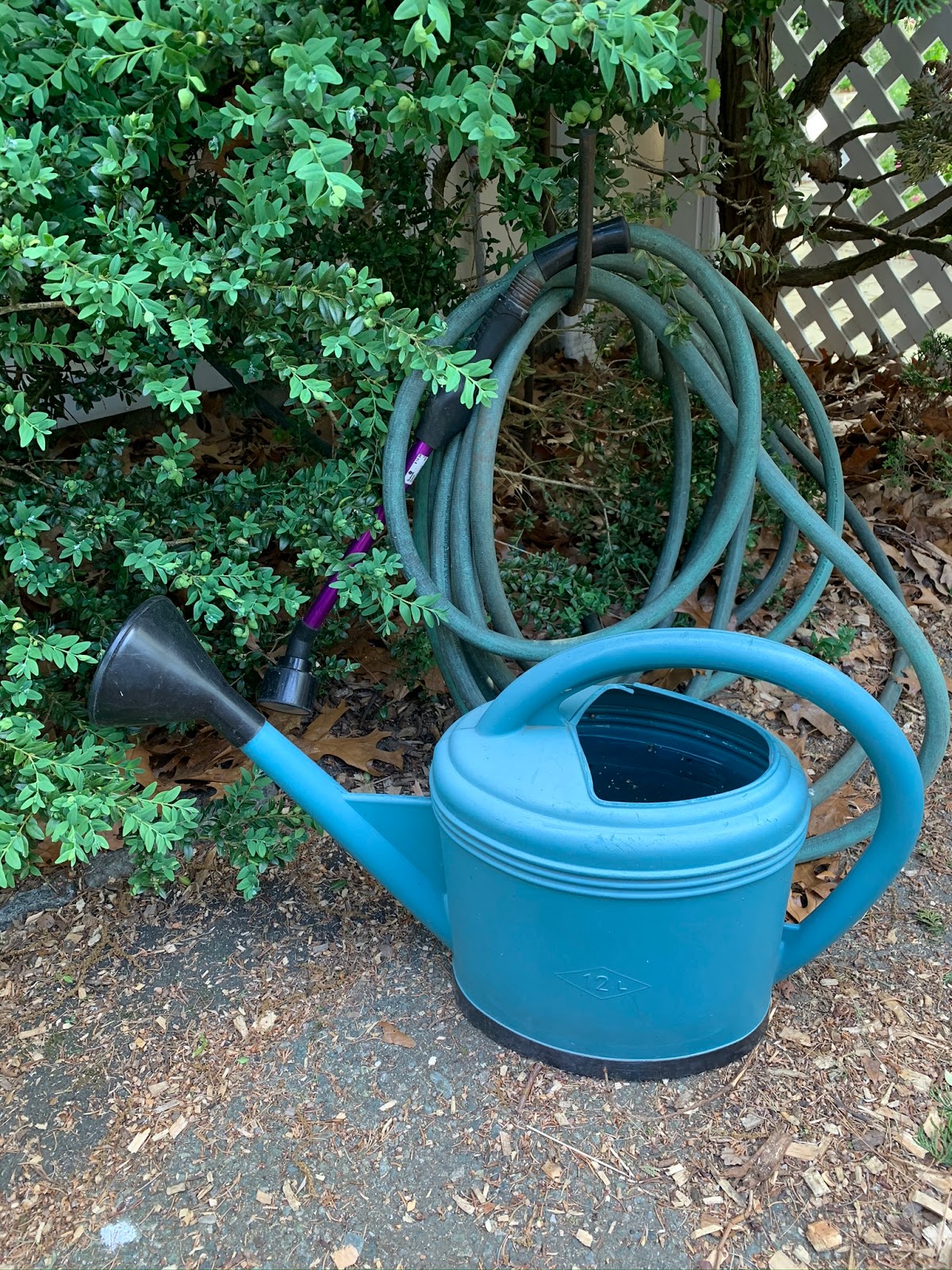

Ready for summer

Hand watering has its pleasures, especially in summer’s soft morning and evening light. That’s often when I truly see these new arrivals to the garden. I notice the unique patterns of new leaves and register the weeds emerging alongside. I’m looking forward to observing more closely this summer.


Monday, January 20, 2020

Uncomfortably warm

We had record high temperatures last weekend, up to 74 degrees at Logan Airport on Sunday, the warmest January temperature ever recorded in Boston. For us humans, it was a pleasant break from winter cold. Scientists in town for the American Meteorological Society’s annual meeting linked the freakish weather to the trend toward global warming.

    After my friend Amy noticed that some blue vinca flowers (Vinca minor) had opened, I checked and found some in my front yard too. 


Vinca flower looking peaked after Friday's cold

My Asian witch hazel (Hamamelis mollis) is in full bloom in the backyard. The danger is that these early bloomers started up their spring metabolism too soon, and they’ll suffer for it. By Friday, we were back to a windchill of 5°F.

So far the witch hazel flowers are holding up

    I’m hoping that despite the White House’s attempts to deny what everyone else knows, we’re finally squaring up to serious action to address global warming. Meanwhile, though, we’re warned that even if we immediately reduced carbon pollution radically, we’d still have to expect climate effects that have already been set in motion.


    In the garden, I’m afraid this doesn’t mean I’ll be picking mangoes and pineapples. 


We could end up with waterfront property due to sea level rise, but the palm trees are unlikely

Instead, I’m expecting more winter warm spells alternating with vicious cold without snow cover. That’s already been happening in recent winters, and it’s especially hard on my shrubs and vines.

    I particularly notice the effects of uneven winter temperatures on a climbing rose that grows near the house on the garage and an adjacent pergola over the garden gate. 


    When I started the garden thirty years ago, I planted Rose ‘New Dawn,’ in this spot. I learned later that some garden designers regarded ‘New Dawn’ as a boring cliché, but to me it was the epitome of rose charm. I pictured a romantic cloud of blush pink roses spilling over the gateway. 


'New Dawn' is my idea of a romantic climber

After a few years, that did happen—sometimes. A winter warm spell followed by a cold snap could kill back even this tough survivor.

Rose canes exposed to chilling winds. Cross-vine leaves are still clinging on in January.

    At first the vine bounced back, quickly sending up new canes to replace killed ones. In the last couple of years, it seems to be struggling just to survive, and flowering has been sparse. ‘New Dawn’ is rated as hardy to Zone 5, meaning that it can bear the cold down to -20 F, lower than what we get in this area. I think it’s the cold, drying wind when there’s no insulating snow that’s depleting the vine’s reserves as the assault is repeated year after year. It’s got only so much stored energy for repairs.


    To help ‘New Dawn’ and my other favorites survive the new climate reality, I’m resolving to surround their bases with some compost and composted cow manure next spring to help them store up energy during the warm season. To me, shrubs wrapped in burlap through the winter are an eyesore. 


Poor thing!

But I might break down next fall and pile up some leaves or soil around shrub and vine crowns for a little extra insulation. As I post this, there's snow on the ground again, thank goodness!

Monday, October 21, 2019

Climate action in the garden

It’s been a discouraging month of environmental news. The UN climate summit confirmed that there’s not a lot of time left for international action to prevent catastrophic climate change, but national governments, notably ours, are not making adequate commitments. 

Unlike polar bears, we humans do have the power to combat climate change-photo Gerard van der Leun

A group of ornithological organizations published a study estimating that we’ve lost 3 billion birds--29 percent of the bird population of the US and Canada--since 1970. Leading causes cited included habitat loss and widespread use of pesticides. The Audubon Society reported that by 2080, 389 out of 604 North American bird species will find most of their current ranges unlivable if the climate remains on track to rise by 3 degrees Celsius.

No more loons on US lakes unless we clean up our act-photo Bert de Tilly

    While our national leaders are dragging their feet, what can we gardeners do to address climate change? Collectively our gardening choices can make a real difference. We can do our part by holding carbon in soil and plants, planting strategically to reduce our homes’ energy needs, and choosing materials with less embedded carbon cost.


    You’ve undoubtedly heard that saving trees—for example not burning down the Amazon rainforest or clearcutting Forest Service land in the Northwest—can help combat climate change. The same principle operates in our backyards. Trees hold carbon and keep it out of the atmosphere for as long as they live. Perennial plants also contribute.


Big trees sequester lots of carbon-photo ukgardenphotos

    But you don’t have to hem in your yard with big trees. We can also help by following Earth-friendly gardening practices. Soil sequesters carbon, and the more organic material you add to it, the more carbon it will hold. That means keeping fallen leaves on your property makes even more sense. 


It's not waste, it's precious organic material

    If you’re planting a sizable tree, you can help even more by positioning it to reduce your energy use for heating and air conditioning. Deciduous trees shading the house in summer can provide substantial cooling, and in winter when leaves are down, they allow warming sunshine through. Evergreens that block winter winds can reduce energy needs too.


Trees shading the house save energy-photo American Society of Landscape Architects

    When we’re shopping for materials to use in the garden, we have a chance to avoid high embedded carbon costs. For example, did you know that those little white pellets of lightweight perlite that you see in bagged potting mix come to us from the Greek island of Milos, where volcanic glass is mined and heated to 1600 degrees Fahrenheit to puff like Rice Krispies? Meanwhile, stripping peat bogs for the peat moss in that commercial potting mix releases carbon into the atmosphere and eliminates the carbon sink they provided. 


Mer Bleue peat bog, Ontario

    Instead of buying bags of this environmentally costly stuff, you can make your own potting medium at home. Or you can choose Organic Mechanics potting mix, which is made from compost and coconut fiber, or coir.


Making peat-free potting mix at home

    If you’d like scientifically informed straight talk on how to make shrewd gardening choices that will help combat global warming, check out The Climate Conscious Gardener, published by Brooklyn Botanic Garden.


Sign for the April 2017 Climate March in Washington, DC

Monday, June 17, 2019

Missing snow

The vinca groundcover in our front yard emerged from this year’s mild winter looking ragged around the edges. Vinca (Vinca minor) leaves typically stay shiny and green through the winter, but this year some turned an unsightly brown. I’m guessing that this was due to lack of snow cover. With no snow to insulate them, the usually evergreen leaves dried up and died.

Last winter brought less than our usual snow accumulation

    Meanwhile, back in the vegetable bed, we lost two 21-year-old lavenders (Lavandula angustifolia). Despite their Mediterranean ancestry, they’d proven their ability to survive cold winters. What did them in, I think, was too little snow.


All that's left of a lamented lavender

    A blanket of snow keeps the temperature around plants relatively stable and protects them from desiccation. Plants that survive New England winters have adaptations that enable them to endure the cold. But frigid, drying winds can overwhelm their defenses when there’s no snow cover.


Consistent snow cover insulates plants

    I know we shouldn’t confuse weather with climate. One mild winter with little snow doesn’t prove a trend. In winter 2017-18 the nearby town of Milford recorded 87 inches of snow, in contrast to 47 inches this year. But we know there’s a change underway due to global warming. The Fourth National Climate Assessment, released in 2018, predicted that by 2035, the Northeast will be more than 3.6°F (2°C) warmer on average than during the preindustrial era.


Cairn in Snow, Caspar David Friedrich, 1807

     This compilation of government research also predicts less snow and a shorter snow season in our region. That won't be the worst effect of climate change, but it'll be one that gardeners will regret.

    I’ll replace the lavender plants that died with a variety such as 'Munstead' that reportedly survives winters north of us in USDA hardiness zone 4—we’re in zone 6b. 


Lavender 'Munstead'

But that won’t mean they’re safe without snow. If I want them to survive, I’ll have to remember to cover them with leaves or straw and then wrap them in burlap for the winter months. That’s more work than I had in mind, and it looks bad. I’m not a fan of burlap-swaddled lumps in the winter landscape.

I don't find this decorative

    The vinca in the front yard is on its own. There’s no way I can cover it up without creating an eyesore or sending mulch material blowing all over my neighbors’ lawns. Fortunately by May, this winter’s dead brown leaves had fallen off and been replaced by new foliage. I hope that will keep happening.


The vinca bounced back

    Garden plants’ tolerance for cold and heat are rated on two useful scales. The USDA Plant Hardiness Zone Map focuses on the lowest temperatures in an area. The American Horticultural Society’s Plant Heat Zone Map ranks areas according to the number of “heat days” over 86 degrees. For example, right now ‘Munstead’ lavender can grow in USDA hardiness zones 4 to 9 and AHS heat zones 5 to 8. 


     Who knows how a warming regional climate will change these facts of plant life? Maybe New Englanders will also need to learn to rate plants’ tolerance for winters without snow.

Sunday, March 12, 2017

The endangered EPA

It’s been a big week for climate change deniers and polluters. First Scott Pruitt, the new leader of the Environmental Protection Agency, opined that carbon dioxide from human activity isn’t causing global warming. Then Florida Congressman Matt Gaetz sponsored a bill to eliminate the EPA altogether. Meanwhile, the Trump administration proposes to cut EPA funding by 25 percent.

    Where would we be if the EPA hadn’t been at work since 1970? Without it, gardens would be in poor shape for so many reasons.


As spring flowers open, I'm grateful to the EPA for protecting the garden environment

    Remember acid rain? Sulfur dioxide and nitrogen oxides from Midwest power plants used to drift eastward, damaging northeastern forests. The big oak tree that anchors my garden would likely have succumbed to this toxic mix, along with many of its fellows. Instead, thanks to air pollution standards, New England forests rebounded. 


    Back when America was “great,” lead from gasoline routinely accumulated in garden soil. Our lot is small; no part of it is far from roads and car exhaust. If it weren’t for the EPA’s phase-out of leaded gas, we might not be able to eat vegetables from our own yard without risking brain damage from lead poisoning.


With lead in soil from exhaust, we'd have to skip the home-grown tomatoes

    I can thank the EPA for keeping me in shape to garden. Mental health used to be a smoky job, with many of our patients chain-smoking. EPA insisted on the link between secondhand smoke and cancer, lung and heart disease. Clinical encounters are now smoke-free. If I’d breathed secondhand smoke for 40 years, would I still be able to wield a shovel or a rake?


    The EPA has banned or restricted toxic chemicals we formerly used in our landscapes, starting with DDT. In 1972, many bird populations were dangerously low, poisoned by DDT as it concentrated up the food chain. Now bald eagles are back, and healthy native birds visit my yard.


Bald eagles chicks, safe without DDT

    Businesses chafe at EPA regulations that prevent them from exploiting our natural resources and sticking the rest of us with the externalized costs in money, health, and environmental damage. That seems to be the motivation for Pruitt’s long career of suing the EPA and his current mission to destroy it.


     Now more than ever, we need the government scientists who’ve been supplying the data on climate change that the Trump team plans to ignore or shred. I can only imagine how sad and infuriating it would be to see your life’s work heading for the electronic recycle bin.


Berkeley data hack saving NASA and DOE research--photo by Jamie Lyons

Because of that data and much more from climate scientists around the world, the previous administration forged ahead on regulations like the Clean Power Plan, which restricted carbon dioxide emissions from power plants, directing us toward renewable energy sources. 

     If climate change continues to accelerate, gardeners can expect more extreme weather and increases in flooding and drought. For the sake of our gardens and our life on Earth, I hope we’ll benefit from the EPA’s protection for many years to come.