My book and web site

Check out my book, The Sustainable-Enough Garden, available on Amazon, and the book's web site at www.thesustainable-enoughgarden.com. See more plant photos on Instagram.
Showing posts with label invasive plants. Show all posts

Sunday, August 9, 2020

Fighting fire with fire

 One of the techniques I’m using to control invasive plants in the garden is planting vigorous growers, preferably natives, to claim their space. Invasives love disturbed ground. If I pull them out and leave the soil open to falling seeds or probing roots, I’ll have to do the same job over again. Rather than spending my gardening time fighting off invaders, I prefer to fill the garden with so many successful plants that invasives can’t find a foothold. At least that’s the theory.


    I’m trying this competitive approach to keep out Japanese knotweed (Polygonum cuspidatum). Wherever there’s a patch of bare soil, this highly successful nonnative forms tall thickets that crowd out native plant communities.

Japanese knotweed is the ultimate opportunist

     In my yard, Japanese knotweed pops up along the fence line every year, and I do my best to root it out. This will never be a permanent solution, because no one’s trying to eradicate it from the yards that abut mine. Rhizomes will keep spreading under the fence.
Knotweed multiplies by creating a thick, rapidly expanding mat of roots. If I cut the roots without removing the whole stand of knotweed, I’m actually stimulating more growth.


    This spring I decided to fight fire with fire. I planted a coralberry (Symphoricarpos orbiculatus) next to where knotweed keeps emerging along the back fence.

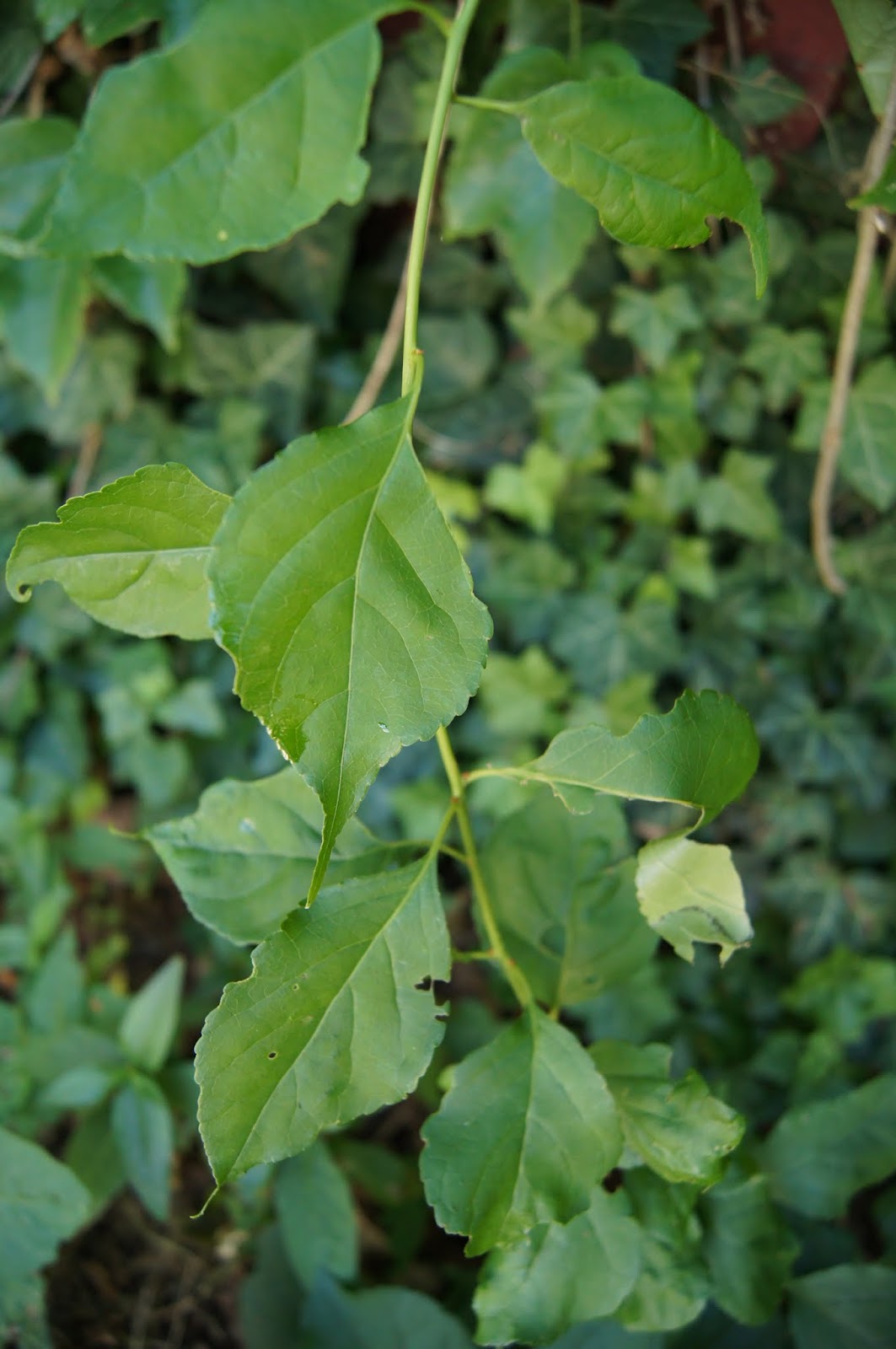
Coralberry-photo Severnjc
 

This native shrub is known as a suckering spreader. Most write-ups focus on how to keep it in check rather than how to coax it to grow. I’ll encourage coralberry to form a thicket to keep the knotweed from pushing its way into the yard. This summer the young coralberry is slowly expanding, despite being shaded by the fence and some giant pokeweeds (Phytolacca americana).
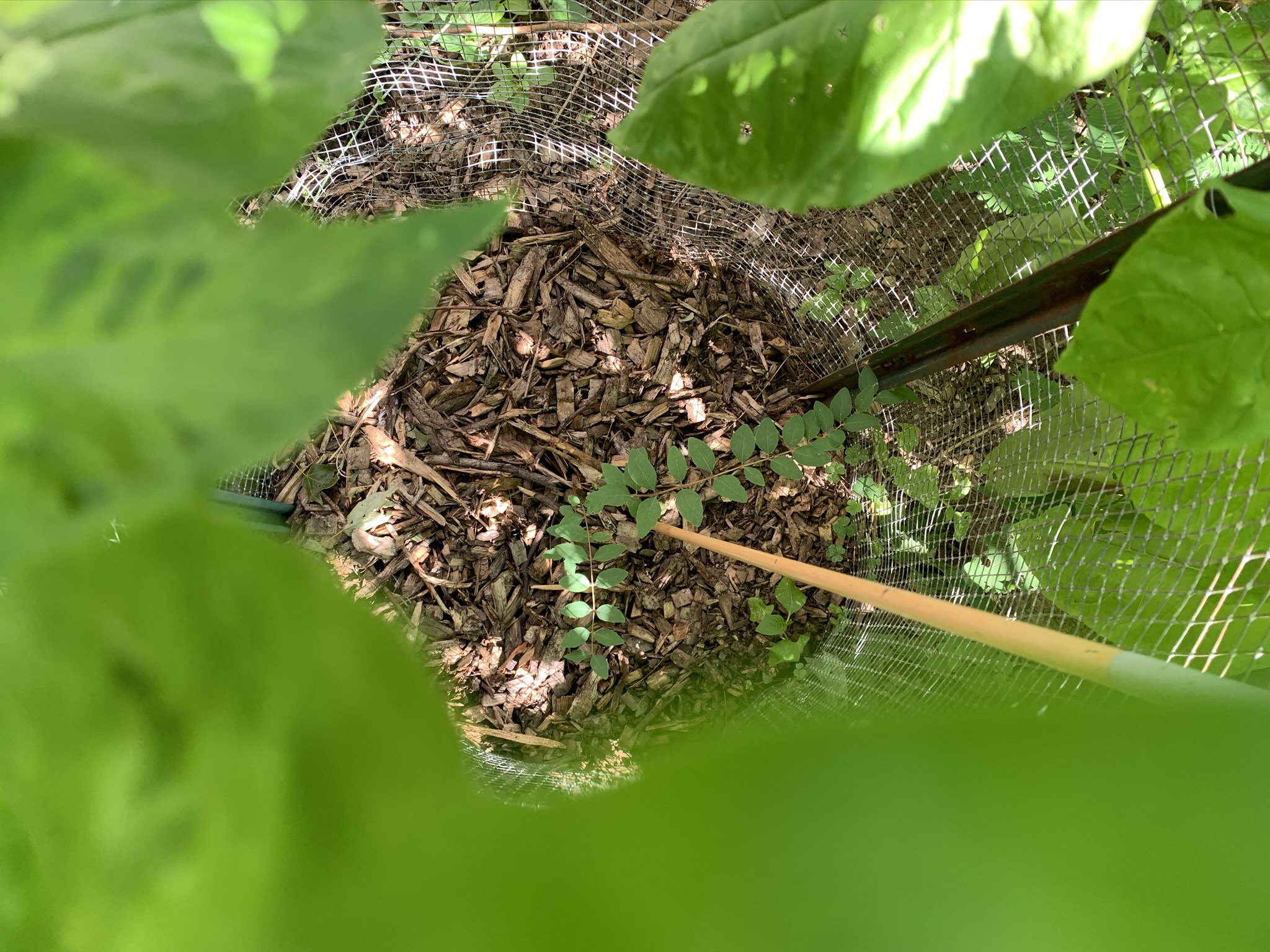
 

Coralberry guarded by tall pokeweeds

 
     Not all the aggressive growers that I need to beat back are state-certified nonnative invasive plants. Those are certainly a problem, but some of the too-vigorous plants in my yard are natives, such as smooth Solomon’s seal (Polygonatum biflorum). Native plants can range from shy to aggressive too, just like imported plants, as I learned the hard way.

Smooth Solomon's seal taking over
 
     I chose smooth Solomon’s seal because it was recommended for shade. Thirty years later, it’s taken over large areas in the shade of large trees and shrubs. It doesn’t do this in every garden; it’s just found growing conditions in my yard that suit it all too well.


      I’m making a start at reducing the smooth Solomon’s seal population by pulling out its thick storage roots and planting vigorous growers in their place. I’ve had modest success encouraging preexisting clumps of a less-aggressive European cousin, variegated Solomon’s seal (Polygonatum odoratum var. pluriflorum ‘Variegatum’), to take over where the native had been king.

This variegated version is a nice alternative to aggressive smooth Solomon's seal. I'm ignoring the lilies of the valley, also spreading aggressively.
 
     A spreading clump of pawpaw (Asimina triloba), a small native tree, is shading out some of the smooth Solomon’s seal, with the side benefit of producing delicious edible fruit. Under the pawpaw’s shade, smooth Solomon’s seal isn’t sending up so many new plants. Now how to keep the pawpaw from taking over?

The pawpaw is forming a growing patch, worth it for the fruit

,

Monday, May 13, 2019

Groundcover throwdown

Last fall I wrote about uprooting smooth Solomon’s seal (Polygonatum biflorum) under a crabapple that occupies a very visible spot in our landscape. This native plant has spread widely in my yard. I brought home three as a groundcover for shade, and now 25 years later, their descendants are taking over every shady spot in the yard. They may be beneficiaries of our sprinkler irrigation system, which keeps the soil from drying out in the summer, unintentionally catering to smooth Solomon’s seal’s preference.


Smooth Solomon's seal shows up in every shady spot

    This spring I wasn’t surprised to see new shoots of the plant emerging in the section I’d tried to clear last year. It’s hard to remove every scrap of the white rhizomes. What’s needed, I realized, was something to compete with smooth Solomon’s seal. I should choose a shade-loving plant that would be tough enough to hold its ground, but not so aggressive that it would become a problem. Easier said than done. Smooth Solomon’s seal, along with some other unfortunate choices, has taught me that plants can take years to reach a critical population mass that enables a bid for hegemony.


Will fragrant Solomon's seal also turn into a thug? Time will tell

    To avoid bringing home neonicotinoid-treated plants, I’ve learned to look around the garden for things to transplant before heading out to the garden center. I could certainly move some Canadian wild ginger (Asarum canadense) to the area under the crabapple. Its round matte leaves stay clean and fresh-looking through the season. There’s already a lot of it in the yard, though, and its foliage is quite similar to that of bloodroot (Sanguinaria canadensis), which is already growing along the path that delineates the bed. I was hoping for a new look.


What can succeed in territory temporarily cleared of smooth Solomon's seal?

    European ginger (Asarum europaeum), another in the same genus, might also work. While smooth Solomon’s seal claimed territory in the yard over the years, clumps of European ginger have slowly expanded, and now new volunteers are popping up and forming colonies on their own, a sign that the species is finally feeling at home in the garden. I love its shiny round leaves with their subtle pattern of lighter-colored veins. I can dig some clumps from a bed along the driveway to try their luck under the crabapple.


European ginger making itself at home next to the garage

    At the Massachusetts Horticultural Society’s Garden Fair last weekend, I spotted an interesting option, Carex siderosticha ‘Snow Cap,’ with leaves that are almost all white. 

Easy to see why this broad-leaved sedge was named 'Snow Cap'

The volunteer who sold it to me warned that it needs lots of shade, and that’s exactly what it’ll get under the crabapple. With no competition, this rhizomatous, creeping sedge might make a bid for world domination. Let’s hope the energy it expends holding back smooth Solomon’s seal will keep it in check. With so little green leaf surface, it can’t be a photosynthetic powerhouse.

    I’m planning to start with those two and any wandering bloodroot seedlings that I can find and transplant. It’ll be interesting to see what happens under the crabapple once these plants go in. I suspect a guide and referee may be needed.


European ginger and bloodroot coexisting elbow to elbow

Monday, October 30, 2017

Beware of Greeks bearing gifts

One of my biggest gardening mistakes was planting smooth Solomon’s seal (Polygonatum biflorum). This seemingly modest woodland plant aims for world domination. Now I’m trying to beat back its onslaught.

Smooth Solomon's seal emerges in spring

    I first encountered smooth Solomon's seal in the shade plant section of my favorite garden center. At the time I was coming to grips with the fact that I was gardening in shade. I was delighted to discover lots of plants with pretty foliage in a shady corner at the far side of the sales area. Smooth Solomon’s seal caught my eye because of its arching stems, shiny leaves, and pendant cream-colored flowers. 

Seemed like an understated, elegant woodland plant--photo Peter Gorman

I didn’t seek out native plants at that time, but since it was a North American native, that must mean it wouldn’t run wild, right?

    For several years I thought I’d picked an excellent plant for shady areas where nothing else wanted to grow. About ten years in, though, I noticed that smooth Solomon’s seal was showing up in every shady part of the yard—and that’s most of my garden. Its little blue fruits must have been making their way to new territory. In retrospect, I might have been safer with an attractive Eurasian cousin, fragrant Solomon's seal (Polygonatum odoratum ‘Variegatum’), which has a pretty chartreuse border around its leaves and seems to be less spreading—so far.


A more sedate Solomon's seal? Or crouching to spring

    It’s not too hard to dig out smooth Solomon’s seal. When you do, one reason for its success in dry soil becomes obvious. It has big fleshy rhizomes, underground storage organs that look capable of storing plenty of water and nutrients. 


Rhizomes store supplies for hard times

I’ve learned not to throw these or the blue fruits on the compost pile, because both produce new plants. Moving compost around, I may have unknowingly carried them to new areas of the yard. 

Fertile fruits of smooth Solomon's seal

Instead I now send them out as yard waste, to be cooked at weed-killing high temperatures at the municipal composting site.

    There’s a crabapple tree that I look at every day from our kitchen windows. I’d sure like to grow other shady woodland flowers under it, not just smooth Solomon’s seal. 


A pot of elephant ears attempts to disguise rampant smooth Solomon's seal under the crabapple

What holds me back from ripping it all out is the fear that I’ll kill the tree in the process. I once read a sad story about a man who killed a beloved dogwood by digging among its roots to surround it with daffodil bulbs, and I think I executed a venerable Japanese andromeda (Pieris japonica) when I pounded plastic edging through its root zone.

     So I’m removing the unwanted smooth Solomon’s seal cautiously, bit by bit. Last spring I dug out a wedge-shaped patch of it from the tree trunk to the drip line. This fall I did the same in a slightly larger wedge, arguing that the tree was ready for this because of our wet summer. Time will tell whether I went too far.

A section cleared of smooth Solomon's seal-- for now

    The main remedy will be to plant something else that can stand up for itself in place of the plants I tore out. Smooth Solomon’s seal abhors a vacuum.


Attention friends: I'll be speaking at the Massachusetts Horticultural Society's Ecological Gardening Symposium on November 8 at Elm Bank in Wellesley, MA. Here's a link to the program information. I'd love to see you there.

Sunday, October 1, 2017

Not all the perfumes of Arabia can wash this little leaf clean

At a meeting of the Wayland Garden Club last month, a gardener reported tar spot fungus on her Norway maple leaves and concluded that this meant she had to remove all the leaves from her property. She reasoned that they couldn’t be used for compost or mulch for fear of spreading the fungus to her lawn and garden. 

Are leaves infected with fungus harmful to other plants?

    You too may have noticed that Norway maple leaves have developed black spots, turned brown and started to fall much earlier than usual. 


Black tar spots on Norway maple leaves

You could imagine that the trees are dying. Fortunately or unfortunately, the fungal infection is just cosmetic. This year’s very wet spring gave a boost to various fungi, including those that cause both tar spot and anthracnose, another fungal condition that causes leaves to brown and drop off, but the trees will leaf out again next spring. 

This Norway maple's leaves have prematurely turned brown and started to drop off

You don’t have to protect other plants from contact with the infected leaves.

    I say fortunately or unfortunately because I’m ambivalent about harm to the Norway maples that line our streets. Like many cities, mine used to favor tall, graceful elms as street trees. 


American elms in Central park

Dutch elm disease, another much more lethal fungal disorder originally from Asia, arrived in New England in 1928 and burst out of control during World War II, when attention to containing its spread was diverted to war efforts. To replace the dying elms, the cities planted Norway maples. They were tough enough to thrive in urban conditions. What could go wrong?     

     Eighty years later, we’re dealing with the consequences of this decision. Free of the competitors they faced in their native range in Europe and western Asia, these trees have become invasive in North America. 

Norway maple in flower, its prettiest time-photo Daniel Case

Since 2009 it’s been illegal to sell or plant them in Massachusetts.

    When we moved into our house in 1985, we had Norway maples as street trees (still present), large specimens stood in neighbors’ yards, and a volunteer thicket of them grew behind the back fence. Now there are fewer Norway maples around us, but I still pull hundreds of their seedlings from my planting beds every spring.


Norway maple seedlings: there are always more coming


    Norway maple has long been my most hated tree. I’ve often wondered how I’d feel if a pest finally came along that could kill them all. The Asian long-horned beetle, which enjoys munching maples, looked like a good candidate. 


Asian long-horned beetles on a maple. This menace hasn't reached my yard yet-photo USDA.

I admit it’s a thrill to see the tar spots inflicting Norway maples and bypassing red maples, a near relative that is native, non-invasive, and less susceptible to the fungus.

Red maple leaves free of fungus


    Call me a wimp, but I can’t wish all those Norway maples dead. They’re a menace, but they’re still providing us with “environmental services” such as sequestering carbon and cooling and cleaning the air. Their dense shade is a bane for gardeners but very welcome to drivers seeking parking places on hot days. Let’s say they have the defects of their qualities. They’re tough, hardy, and good at reproduction. Can we, who planted them, hold them responsible?


Winged maple seeds are called samaras
 

Sunday, February 26, 2017

The emperor is partially clothed

As garlic mustard leaves start to show among patches of melting snow, I’m revisiting the issue of nonnative invasive plants. Garlic mustard takes over the North American forest floor by producing chemicals to suppress mycorrhizal fungi other plants’ roots needs. Garlic mustard pulls make plausible community projects, because the plant is small, distinctive, and easy to uproot. 

Garlic mustard in flower

    Before we pour more volunteer power into fighting nonnatives, though, I think we should take a more nuanced look at the ideology behind this effort. 


    Of course, part of the reason that gardeners are concerned about nonnatives is that native animals, including the many insects we need near the base of the food web, haven’t evolved to live off these plants. One of the most eloquent spokesmen for this concern is Doug Tallamy, whose book Bringing Nature Home inspired many gardeners to choose native plants for our backyards. I’m on board with his recommendations, and I’m prioritizing natives when space opens up in my garden.


Native flowers feed native insects


    But it turns out that the science regarding nonnatives is not as simple as “natives good, exotics bad.” Recently I’ve read two fascinating books on this subject, The Rambunctious Garden: Saving Nature in a Post-Wild World, by Emma Marris, and Where Do Camels Belong: Why Invasive Species Aren’t All Bad, by Ken Thompson. Both provide many fascinating examples that illuminate the contradictions inherent in the simplistic strategy of making war on nonnative plants (sort of analogous to the problems with blaming human immigrants for our nation’s problems). 


    Two principles I’ve learned from these authors have changed my perceptions of imported plants and animals. First there’s the issue of baseline. What’s Year One for deciding who’s native and should be protected? In the US, many conservationists would choose 1492, assuming that introduction of new species to North America started with European settlement.


Plant migrations didn't start with the Pilgrims or even Columbus

     That presumes that Native Americans didn’t alter the landscape, which is completely untrue. It also ignores the climate shifts and changes in geography that have occurred over geologic time. Different plants grew in Massachusetts in warmer epochs than when glaciers advanced southward. We humans have a problem with historical perspective.

    Second, when introduced plants take over, it’s usually in response to human-caused changes in habitat. We’re blaming the plants for the results of our own action.


I was surprised to learn that purple loosestrife is not reducing biodiversity in our wetlands

    How ever you come down on this highly emotional issue, there’s little chance of wiping out introduced plant species except in very special circumstances, such as on islands. We might pull all the garlic mustard from a beloved park, but seeds would be left behind in the soil, and plants don’t respect park boundaries. It’s a permanent commitment to moving a mountain with a teaspoon. 


     We’re just starting to understand invasion biology. Before we add more nonnative plants to our enemies list, let’s get more scientific evidence about how plant populations really work and save some energy for combating climate change, the biggest challenge of all for plants in the wild.


Plants can't migrate as fast as the climate is warming

Sunday, July 24, 2016

Invasives are here to stay

I hate to say this, because I think it will make some people mad, but I don’t think there’s any hope we can eradicate invasive nonnative plants from our landscape.

    This is an area of hot controversy. Many admirable volunteers spend their weekends pulling out invasive plants that grow on public land. 


Volunteer at a garlic mustard pull in Washington state

These are plants that cause environmental damage, out-competing natives and endangering local insects and animals because they don’t provide them with food and shelter they need.

    People who devote their time to eradicating invasives reject tolerating these plants. But there is another perspective. As Hope Jahren points out in Lab Girl, “Humans are actively creating a world where only weeds can live and then feigning shock and outrage upon finding so many.” Cities are hotter, dryer and windier than the countryside they replace, and we keep tearing up the ground with new building projects. No wonder only the toughest plants survive.


    Even if public land were cleansed of invasives, it doesn’t exist in a vacuum. At the Garden Bloggers Fling in Minneapolis, I heard that the Eloise Butler Wildflower Garden  had to have volunteers scour garlic mustard (
Alliaria petiolata) from a buffer zone around the 15-acre garden to keep it from migrating into the reserve. Yet every year their staff still has to patrol the property for garlic mustard seedlings. 

 
Native black-eyed Susans and bee balm at Eloise Butler Wildflower Garden


    Garlic mustard crowds out other herbaceous plants and excretes antifungal chemicals that disrupt connections between soil fungi and native plants, suppressing growth. 


Garlic mustard in bloom

What is the chance that every Newton homeowner will police her property and catch every garlic mustard plant before it sets seed? Not since Maoist China has social engineering on that scale been feasible.

    Here’s a case in point. Across the street from my house, a neighbor’s fence runs parallel to the sidewalk. In the few inches of soil between the fence and the pavement, a panoply of invasives has taken root. There’s garlic mustard, Oriental bittersweet (
Celastrus orbiculatus), Norway maple (Acer platanoides), and black swallowwort (Cynanchum louiseae). Yes, I uproot them as I walk by. But all over town the same situation is occurring, and in most places no one notices or cares.

Oriental bittersweet

Norway maple
Black swallowwort
So if we can’t kill all the invasives, what are we supposed to do? Are we willing to let them take over and accept simplified landscapes without the biodiversity needed to maintain native animals? 

Actually we already have. A stroll in any local park confirms the presence of large populations of invasives. 
    
     I may be unrealistic, but I prefer to think that by planting natives in our own yards and fostering their growth on public lands, we can restore some balance between natives and aggressive nonnatives. If not, we’re going to spend all our gardening time at war, and that’s a condition I can’t accept.


Native red oak in my yard. This is a popular host plant for native insects

Sunday, January 31, 2016

An attractive menace

On July 14, I wrote about doubting I could keep my potentially invasive silk tree (Albizia julibrissin, also known in the US as mimosa) from spreading. Now that looks even more unlikely.

    With last weekend’s snowfall mostly melted, I notice many silk tree seed pods lying on the grass. Some are empty, and some still contain their brown seeds.


    Silk tree is a native of Asia that was imported to North America in 1745. It's a pretty tree with delicate, feathery foliage that makes pink puffs of flowers in July in my yard. 


This is a photo from Texas. Mine don't flower this densely


Silk tree spreads especially in disturbed ground and is now invasive in the southeast US. It has a number of characteristics that enable invasiveness: it produces a lot of seeds, it’s a legume, so it can extract nitrogen from low-nutrient soil, and if reproducing by seeds fails, it can also spread vegetatively from root fragments. 

     Its seeds require scarification (breaking through the seed coat mechanically, chemically or with heat or cold) to sprout and without this can stay dormant for many years before germinating, which allows them to seize growth opportunities when they arise. The seeds are efficiently dispersed, initially by gravity, secondarily by wind, water and animals. 

    That may explain why I’m finding the pods farther and farther from the tree, some at least 50 yards away on the other side of the house. More ominously, I see some have left our property and made it to neighbors’ lawns. I’ve found clusters near tree trunks, so it may be that squirrels or birds are carrying the pods away to eat the seeds and are dropping pods on the ground under the branches. 


    In this weekend’s thaw I’m picking up as many of the pods as I can and throwing them in the trash—I won’t compost them, because that would probably just distribute viable seeds wherever I spread compost. 


     I’ll be sorry to lose this pretty tree, but next spring I think I’ll have to cut it down.

Beautiful but damned
 

Tuesday, September 29, 2015

It takes a plant community


Sometimes it feels like we’ll never get ahead of opportunistic nonnative plants. Especially with woody plants like Japanese knotweed (Fallopia japonica), it seems once they’re in your garden, you may never see the end of them. 
            In his book Gaia’s Garden, Toby Hemenway argues that opportunistic plants grow where we’ve given them an opening in disturbed ground and will naturally die off as stable plant communities take over (Hemenway prefers the term opportunistic to invasive, which he considers too emotionally loaded. I’m using his terminology). This is a nice idea, but considering how much Japanese knotweed I see in the course of a week’s driving, I wondered how likely Hemenway’s scenario was in my area.
This Japanese knotweed's underground rhizomes could be as much as 60 feet long. It propagates by seeds but is also capable of regenerating from root or stem fragments.
          
          This week I was pruning dead branches out of a dwarf mugo pine, (Pinus mugo 'Paul's Dwarf') planted eighteen years ago that is now partially shaded by a nearby magnolia. It occurred to me that this could be an example of Hemenway’s point. The branches that were in full shade were dead, with clinging brown needles, whereas the side of the little tree that was still in sun was looking good and producing green needles. I hadn’t shaded out this pine on purpose, I’d just failed to imagine how big the two trees were going to grow and planted them too close together.
Mugo pine reaching for sunlight outside the shade of a taller magnolia

            If the magnolia had cast its shade over an unwanted shrub like Japanese knotweed, I suppose it too would have dwindled. The problem, Hemenway points out, is that suburban landscapes, even our parks, offer so many sunny edges that favor fast-growing plants like the knotweed.
            Of course, shade isn’t the only condition that discourages opportunistic plants. The goal is to replace a plant that you don’t want with one, or ideally some, that you do. If you just remove the offender, you leave open soil for opportunists to take over again. Growing together, a group of native plants that have evolved to cooperate can succeed in grabbing the resources an opportunist needs to survive, not just sunlight but also water, soil nutrients, and room to grow.
            While I wait for my growing collection of native plants to knit themselves into anti-opportunist communities, I’m still cutting a couple of knotweeds at the fence line to the ground every couple of weeks, hoping they’ll eventually run out of stored energy and give up.
I cut it down, but this deceptively frail-looking Japanese knotweed, center, keeps coming back up. Will encroaching smooth Solomon's seal help to curb its growth?