My book and web site

Check out my book, The Sustainable-Enough Garden, available on Amazon, and the book's web site at www.thesustainable-enoughgarden.com. See more plant photos on Instagram.
Showing posts with label organic ornamental plants. Show all posts

Monday, December 17, 2018

Insect-friendly in 2019

Judging by last year, seed catalogs will start arriving this month. I’m beginning to think about how to keep neonicotinoid insecticides out of next year’s garden.

Seed catalogs should be arriving soon

    Evidence is piling up that “neonics,” widely used in agriculture, are ubiquitous in the environment and the food supply. This class of chemicals was developed in the 1980s to replace earlier pesticides that were more toxic to humans. In the years since, they’ve played a part in a massive insect die-off. Neonics persist in plant tissues and kill or disable non-target insects, traveling by wind and water to affect untreated wild and cultivated areas.


Neonics kill and disable bees

    The problem goes beyond pollination. Insects also play a crucial role at the base of the food web and do essential work recycling waste through decomposition. Without insects, Earth wouldn’t support much human life (My thanks to reader Patricia McGinnis, who forwarded a revealing New York Times Magazine piece on this subject).


    In the midst of this gloom, I got some good news recently when I phoned a local garden center, Allandale Farm, to ask about their practices. I knew that the farm uses only organic controls on their site. The grower I spoke with reassured me that they also don’t buy any plants that have been treated with neonics. They’ve been able to find smaller nurseries that don't use these pesticides, she said. I was delighted to hear it. 


May plant shopping is a fun tradition


My lingering doubts about buying perennials at the farm were dispelled. Because garden centers source some of their stock from other growers, I’d feared that the farm might be selling neonic-treated plants from elsewhere. Now that I know their plants are neonic-free, I can enjoy a shopping spree in May. It’s great to hear that there are small wholesalers out there producing neonic-free plants. I hope they prosper!

    I feel good about shopping at local garden centers like Allandale Farm. At the other end of the scale of plant retailing, Home Depot promised in 2015 that they would phase out neonic-treated plants by the end of 2018. In the interim, they required their suppliers to attach a warning label to plants exposed to the chemicals. This is all progress, but I don’t see any statement on Home Depot’s web site announcing that the neonic phase-out is complete. Let’s hope that will be forthcoming next spring.


    Meanwhile, I’ve developed a short list of seed catalogs that offer organic seed. Conventional growers use treated seed to introduce neonics into a plant’s life cycle; organic growers don’t. Unfortunately it’s much easier to find pesticide-free seed for starting vegetables than for flowers.


Organic basil seeds weren't hard to find last year

     There’s still not enough consumer demand for organically grown ornamental plants. As one grower said to me, “You’re not going to eat them, so what’s the point?” The point is that we want to protect the soil and the creatures that live around us!

Here’s my list so far of catalogs that offer some organic alternatives: 


*Natural Gardening Company 
Johnny’s Selected Seeds
Renee’s Garden
*Adaptive Seeds

Botanical Interests
*Seeds of Change
Burpee

                        *organics only

Sunday, May 7, 2017

Breakthrough!

Things are looking up for my quest to avoid neonics. This week, to my delight, I encountered some new plant sources for ornamental plants that aren’t treated with pesticides.

I want to keep pollinators healthy in my garden

     I made the one-hour drive to Salem, Massachusetts to check out a place I found through a Google search, Thomson’s Garden Center. The owner, Scott Thomson, explained that all his food plants are organic. Despite his motivation, even Scott hasn’t been able to find organic seedlings for some annuals, but his flowers are pesticide-free. 


May offers lots of flowers. Insects need something in bloom through the season.

     That’s the key point for me, because my main goal at this point is to use only plants that are safe for insects in my garden, including pollinators such as bees, leaf-eaters that provide food for birds and other animals, and beneficial insects that keep the garden’s insect population in balance. Thomson’s web site includes a link to an excellent TV segment on WCVB’s Chronicle, featuring Scott as a source, about why neonicotinoid insecticides are a problem for bees and how to make gardens that are bee-friendly.


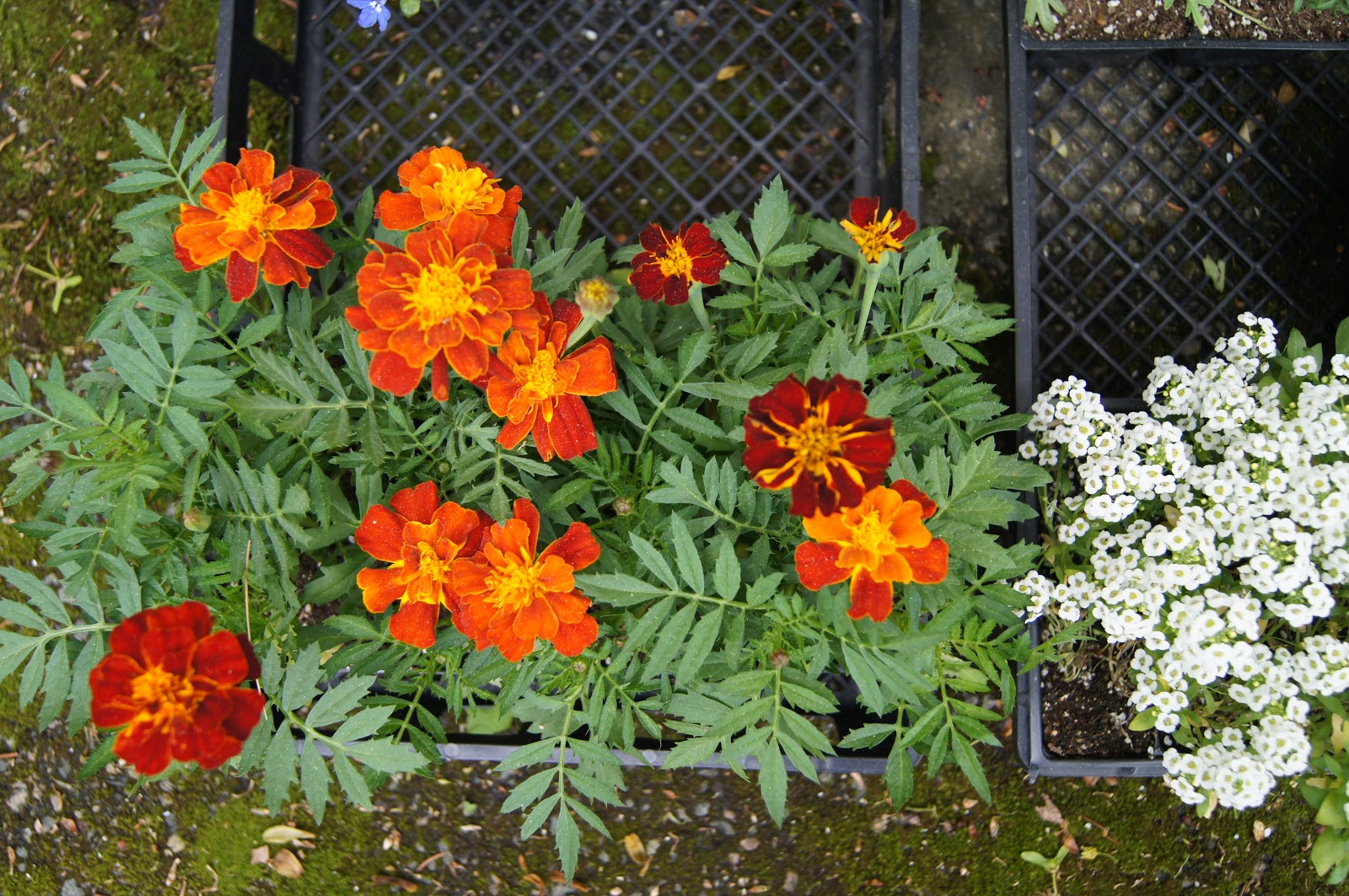
     Thomson’s seedlings were beautiful, clearly well-grown and healthy. This wasn’t even the full inventory, which Scott said will be coming in later this month. He sources his plants locally. His organic herbs came from Gilbertie's Herbs in Westport, Connecticut, another outlet I’d like to visit. I bought herbs and also pesticide-free marigolds, geraniums, dahlias, cosmos, lobelias, and alyssum.


Marigolds and alyssum, annuals I'd been hoping for


    The next day I scored some more annuals and some vegetable seedlings—tomatoes, lettuce, and cucumbers--also grown without pesticides, at the seedling sale of the Waltham Community Farm, one town over. With these purchases, I’ll be able to plant out almost all my usual annuals.


Annuals will supplement perennials in the pollinator garden

     What I won’t be doing this year is making a big purchase at my favorite local garden center, which shall remain nameless. It’s a bigger place than Thomson’s with a wide selection of gorgeous perennials, annuals, and vegetables and some shrubs and trees. I love going there. My May shopping trip has long been one of the high points of my year.


Anise-scented sage, Salvia guaranitica, a treasure from my favorite garden center

    But what’s the point of a pollinator garden that kills pollinators? Until this business can certify that their plants are neonic-free, I don’t feel right shopping there. I’ve sent them a letter explaining why. I hope that as customers raise this issue, garden centers will follow the lead of the big box stores that have yielded to pressure and promised to phase out neonics.


     When consumers got interested in planting for pollinators, sellers jumped on the bandwagon, touting plants for pollinator gardens. They just didn’t mention that the plants were treated with chemicals harmful to those same pollinators. Scott Thomson’s attractive stock confirms that marketable plants can be produced without these synthetic chemicals.


Geraniums from Thomson's

     Garden centers understand why consumers want organic food plants. Now we want organic—or at least pesticide-free—ornamental plants too. I’m happy to know that a few growers and retailers are out there supplying them.