My book and web site

Check out my book, The Sustainable-Enough Garden, available on Amazon, and the book's web site at www.thesustainable-enoughgarden.com. See more plant photos on Instagram.
Showing posts with label pesticides. Show all posts

Monday, June 15, 2020

Thinking without the box

In 1997, when my garden took on the bone structure it has today, I chose common box (Buxus sempervirens) as an evergreen presence in several spots. 

Common box in the garden

This popular shrub is not a North American native; it comes from Southern Europe, western Asia and northern Africa. We planted a line of boxwood shrubs parallel to the side of the house to hide the bulkhead that leads to the basement. We placed one in the front yard where the driveway meets the sidewalk. We dotted three others around the property. I’ve enjoyed the boxwoods over the years, but now I’m seeing their downside.

    It’s nice to have evergreens to look at in the winter. With their small shiny leaves, the boxwoods stand out against the conifers around the periphery of the yard. If I were designing the garden today, though, I’d skip common box and use inkberry (Ilex glabra), instead. Inkberry is a native evergreen holly. Like box, it has small leaves and a dense growth habit that makes a good visual barrier. 


This inkberry is thriving in a back corner

A couple of years ago I planted two inkberry shrubs at the back corner of the yard after we took down an adelgid-infested hemlock. I’m impressed with how well they’re doing with benign neglect.

    This spring I’m reminded again that box without pesticide spraying is not pest-free. This year’s new leaves are shiny and unmarked. The older foliage, though, is stippled with tiny dots from insect activity. The bugs don’t kill the shrubs, and maybe no one notices the leaf damage but me.


Boxwood psyllids at work
 
    I’m willing to wash off chewing insects occasionally with a blast from the hose, but I’m not willing to resume spraying dormant oil to smother these leaf-eaters. I gave that up when I realized it was sure to kill insect bystanders as well as the target pests. The collateral damage became too high a price to pay.

I'm not willing to sacrifice bumblebees to keep boxwood foliage perfect


    So shall I accept the less-than-clean-looking box foliage as a cost of avoiding pesticides? My perspective on boxwood and other key nonnative players in the yard has begun to shift. I value native plants and insects more now, and I’ve come to accept the possibility that these large boxwoods, more than 20 years old, may not stay forever. It would take a long time for inkberry bushes to reach the same height and bulk, but the sooner they start, the sooner they’ll get there.


    It’s been interesting to observe how giving priority to native plants for native insects has gradually shifted my gardening choices and goals. I inched into this new commitment in 2011 thinking that I’d keep all my nonnative plants, especially trees and shrubs, and just add natives when they seemed right to replace something that dwindled or died. 


Native tickseed shoehorned in under day lilies

As the seasons pass, I find I’m increasingly populating the garden with native plants.

Monday, November 25, 2019

Post-pesticide paradise?

It’s been three years since I stopped authorizing pesticide spraying on our property. As this year's gardening season ends, I’m assessing the effects of that decision.


    After I pulled the plug, the garden wasn’t reduced to stubble by a plague of leaf-chewing insects. But neither did it remain unchanged. I'd sort of hoped that spraying all those years might have done so little that the garden wouldn’t look different without it.

Lush and green in 2013--but with pesticide spraying

    I started the spraying back in the 1990s when I noticed pinpoint white speckles on the leaves of Japanese pieris (Pieris japonica), an elegant early-blooming evergreen shrub. 

Marked leaves of Japanese pieris

A technician from Lueders Environmental diagnosed pieris lacebug, a tiny sap-sucking insect that originated in Japan and has spread around the gardening world. Decades of spraying kept the pieris leaves clean. When we stopped the spraying, the lacebugs came back. New foliage emerging the next spring was shiny and unmarked, but by the end of the growing season, all the pieris foliage was speckled again. 

    After we stopped spraying our many boxwoods (Buxus sempervirens) for psyllids, their leaves too weren’t as well formed and healthy-looking as they’d been with chemical protection. 


Psyllids have inscribed and curled these boxwood leaves

I’d thought the nonnative boxwood shrubs were problem-free. That was a false impression created by pesticide spraying.

    I’d agreed to use pesticides thinking I was protecting my trees and shrubs. Later we added dormant oil spray for hemlock woolly adelgid and Spinosad, a naturally derived insecticide, for winter moth. Those were nonnative insects with no local predators, I argued. I feared that they’d decimate my yard if they weren’t stopped.


A bleak scene: hemlocks dying from woolly adelgid infestation

    Around 2011 I started to get uncomfortable with this approach. Yes, I was targeting problem insects with each pesticide, and the chemicals had each been chosen for least toxicity for humans, mammals and birds. But my newfound concern for the native insects in the yard shifted the frame. I came to realize that no matter how carefully they were applied, these pesticides would always cause collateral damage, killing native insect bystanders that could be leaf-eaters, pollinators, or beneficial insect predators that I wanted to foster and encourage.

 
I didn't want to kill beneficial insects such as this ladybug, seen here eating an aphid

    After gradually cutting down on spraying, in 2016 I finally decided it was time to make a total break with garden pesticides. Regretfully, we had our hemlocks cut down so we wouldn’t need to spray for hemlock woolly adelgid, a particularly pernicious nonnative pest.


The fluffy white balls along these hemlock twigs are woolly adelgid egg cases

    Probably no one but me noticed when, without pesticide treatment, the leaf damage reappeared on the pieris and boxwood leaves. The leaves didn’t change color or drop off. The subtle damage just made me worry that worse was to come.


     Instead, this year the infestations seem less comprehensive. That could mean that without pesticides, the garden ecosystem is rebounding. In a healthy ecosystem, there’s a balance between leaf eaters and their predators. 


Dragonfly on St. John's wort: one of the predators I want to welcome

There’s also plenty of redundancy, so that if one population of insects has a hard year, there are others to fill their role in the community. I’d love to think that’s the ecosystem we’re building here.


Sunday, August 4, 2019

A bit of progress on neonics

This week I planted a sunflower that I’d bought at Home Depot. My reason for shopping at a big box store instead of a local garden center was the progress Home Depot has made toward phasing out neonicotinoid insecticides from their plant offerings.

Sources of neonic-free plants can be hard to find

    Thanks to a campaign by Friends of the Earth and others, Home Depot yielded to pressure and promised that plants they sold would be neonic-free by 2019. Neonics are systemic pesticides that are used to promote growth and keep plants on retail benches looking fresh and unchewed. The problem is that they also kill or disable bees and other pollinators.


Neonics can kill bees that visit treated plants

     Once a seed or plant has been treated, neonics persist in plant tissues for years and can even be transmitted to nearby plants through soil and water contamination. In 2014, Friends of the Earth found neonics in more than half of bee-attracting commercial nursery plants bought at a broad sample of garden centers and big box stores in the United States and Canada. 

    As they worked on purging neonics from their supply chain, Home Depot took the interim step of labeling neonic-treated plants they sold. 


Home Depot's spin on neonic labeling

They got some negative responses to this practice, because it raised awareness of the danger. Meanwhile, other sellers continued selling treated plants without the warning. This year Home Depot says that 98 percent of the plants they sell are untreated. They attribute the remaining 2 percent to state regulations requiring neonic treatment of certain plants. 

    Meanwhile, I’ve failed totally at growing sunflowers from seed in my garden. When I plant seeds, something bites off the seedlings as they emerge. I imagine this is a squirrel who likes the taste of sunflower sprouts. I’ve tried starting the sunflowers indoors and transplanting young seedlings to the garden. These young plants too have been irresistible to hungry wildlife. That’s why I decided to buy a husky sunflower whose stems are already tough enough to withstand squirrels’ teeth. 


    I bought what was offered: ‘Sunfinity,’ a hybrid that grows to only 3 feet and produces multiple 3- to 4-inch flowers through the season. This plant won’t offer seeds for the birds. It produces nectar for beneficial insects, but it’s sterile, with no pollen. 


Sunflower 'Sunfinity'

This is not the sunflower of my dreams. I’d envisioned something taller with a few dinner-plate-sized blooms packed with seeds. Planting so late, though, I’ve got a chance of seeing the flowers bloom.

    When I encountered the plant, it was showing some flowers. I took care of that by planting it in the vegetable bed, where something quickly bit off the young blooms. 


Stripped
 Undeterred, the plant put out some more buds that are now opening. I imagine that this back and forth will continue into the fall.

Trying again

    I wish Home Depot offered some unhybridized sunflowers, straight Helianthus annuus. Those would do more for pollinators and birds in the garden. But I’m glad to know that my Sunfinity is neonic-free. There’s no point in a pollinator garden that kills pollinators.


First do no harm

Sunday, January 27, 2019

Hard choices

A garden club member recently asked me how I would deal with an infestation of gypsy moth caterpillars on a mugo pine (Pinus mugo). Last summer her tree was crawling with them. 

Nonnative gypsy moth caterpillars can cause massive defoliation

Would I use pesticides in this situation? Fortunately gypsy moth populations wax and wane on a predictable cycle. In wet years, like the one we just had, a fungus that kills the caterpillars surges. We can expect minimal gypsy moth damage this summer, so her tree should get a break. Her question raises a larger issue, though. When is it right to use pesticides?

    I was recently disillusioned to learn that the Arnold Arboretum is using a neonicotinoid pesticide to control massively destructive hemlock woolly adelgids in its vast collection of eastern hemlocks (Tsuga canadensis).


White cottony masses on this hemlock are adelgid egg cases
Following the lead of Great Smoky Mountains National Park managers, they’re taking a two-pronged approach to this nonnative pest. They’re spraying the trees with horticultural oil, which smothers the insects, and they’re drenching the soil around the trees with imidacloprid, which attacks their nervous system.

Gray trees in this view of the Smokies are hemlocks killed by adelgids-photo NPS

     In the Smokies, this treatment is reducing adelgid damage and even resulting in regrowth of some hemlock foliage (When it’s not applied to soil, the pesticide is injected into the tree’s bark). Hemlocks are foundational species in the park. Park managers decided that losing them all was unacceptable.

Drenching soil with pesticide-photo NPS

    I sympathize with their dilemma and the Arboretum’s. We resolve to limit our use of pesticides or ban them outright. Then a threat to a plant we can’t bear to lose makes us break our promise to ourselves. As an Arboretum staffer writes, “. . . we are an essential resource for a large urban population that for over 150 years has enjoyed . . . a majestic hemlock-dominated forest.”


Hemlock forest

    The problem, of course, is that all pesticides cause collateral damage. I stopped spraying hemlocks in my yard with horticultural oil for hemlock woolly adelgid two years ago when I realized that even spraying in early spring was killing some insect bystanders that I didn’t want to lose. 


Spraying for adelgids could kill bumblebees and other early foragers-photo Ivtorov

The USDA acknowledges that in the Smokies, imidacloprid affects insects in tree canopies and in the soil at their feet.

    It was human activity that brought the adelgid from Japan to North America. It has no natural predators here. Some human response seems to be needed before all our hemlocks succumb, but what should it be? Applying a pollinator-killing neonicotinoid seems like an unhappy choice. 


     One hopeful development in the Southeast: introduction of natural predators from Japan that eat only adelgids. 

Biocontrol beetle eating adelgids

Tiny beetles in the genus Laricobius have been released in the forest and succeeded in decreasing the adelgid presence without affecting native insects. The hope is that a new balance will develop between these predators and their adelgid prey. Foresters in some areas have been able to stop the chemical treatments. 

     The beetles will never kill every last adelgid, but they may allow hemlocks to survive. Was it worth using pesticides before the beetles became available? I guess so.

Monday, December 17, 2018

Insect-friendly in 2019

Judging by last year, seed catalogs will start arriving this month. I’m beginning to think about how to keep neonicotinoid insecticides out of next year’s garden.

Seed catalogs should be arriving soon

    Evidence is piling up that “neonics,” widely used in agriculture, are ubiquitous in the environment and the food supply. This class of chemicals was developed in the 1980s to replace earlier pesticides that were more toxic to humans. In the years since, they’ve played a part in a massive insect die-off. Neonics persist in plant tissues and kill or disable non-target insects, traveling by wind and water to affect untreated wild and cultivated areas.


Neonics kill and disable bees

    The problem goes beyond pollination. Insects also play a crucial role at the base of the food web and do essential work recycling waste through decomposition. Without insects, Earth wouldn’t support much human life (My thanks to reader Patricia McGinnis, who forwarded a revealing New York Times Magazine piece on this subject).


    In the midst of this gloom, I got some good news recently when I phoned a local garden center, Allandale Farm, to ask about their practices. I knew that the farm uses only organic controls on their site. The grower I spoke with reassured me that they also don’t buy any plants that have been treated with neonics. They’ve been able to find smaller nurseries that don't use these pesticides, she said. I was delighted to hear it. 


May plant shopping is a fun tradition


My lingering doubts about buying perennials at the farm were dispelled. Because garden centers source some of their stock from other growers, I’d feared that the farm might be selling neonic-treated plants from elsewhere. Now that I know their plants are neonic-free, I can enjoy a shopping spree in May. It’s great to hear that there are small wholesalers out there producing neonic-free plants. I hope they prosper!

    I feel good about shopping at local garden centers like Allandale Farm. At the other end of the scale of plant retailing, Home Depot promised in 2015 that they would phase out neonic-treated plants by the end of 2018. In the interim, they required their suppliers to attach a warning label to plants exposed to the chemicals. This is all progress, but I don’t see any statement on Home Depot’s web site announcing that the neonic phase-out is complete. Let’s hope that will be forthcoming next spring.


    Meanwhile, I’ve developed a short list of seed catalogs that offer organic seed. Conventional growers use treated seed to introduce neonics into a plant’s life cycle; organic growers don’t. Unfortunately it’s much easier to find pesticide-free seed for starting vegetables than for flowers.


Organic basil seeds weren't hard to find last year

     There’s still not enough consumer demand for organically grown ornamental plants. As one grower said to me, “You’re not going to eat them, so what’s the point?” The point is that we want to protect the soil and the creatures that live around us!

Here’s my list so far of catalogs that offer some organic alternatives: 


*Natural Gardening Company 
Johnny’s Selected Seeds
Renee’s Garden
*Adaptive Seeds

Botanical Interests
*Seeds of Change
Burpee

                        *organics only

Sunday, August 5, 2018

Neonics' notoriety

Evidence keeps piling up against widespread use of neonicotinoid insecticides. Reacting to a critical review by its scientific branch, the European Union recently banned the use of the chemicals except in closed greenhouses.

Neonics harm bumblebees

Some of the bad news:
•    Populations not just of honeybees, but also bumblebees and solitary bees, important pollinators, are declining in many countries where neonics are widely used. If they don’t die, exposed bees have fewer queens and may be neurologically impaired, losing their navigational ability.
•    Neonics are found in water, soil, and wildflowers near fields of treated crops. Insects can contact the pesticides without visiting the crop plants.
•    Three out of four honey samples from around the world and 86 percent in North America contained neonicotinoids.
•    Neonics have been found in food, and claims that they’re harmless to vertebrates are losing conviction; for example, exposed sparrows lost weight and got lost during migration.


This swallowtail caterpillar's food could be contaminated

As with climate change, the science is complicated, and the pesticide industry is still saying there isn’t enough evidence that neonics are causing the bee die-off. An alarm sounded when a German study showed a 75 percent decrease in flying insects over a 25-year period, but this wasn’t attributed to neonics alone. Analysts opined that habitat loss and widespread use of pesticides were both major determinants. In the US, it’s thought that neonics may weaken insects’ immune systems, making them susceptible to epidemics caused by fungi and mites.


Honeybee on a black-eyed Susan

    What’s to be done? New systemic pesticides are already being introduced, but that hardly seems like a solution. Farmers in the UK objected to the European Union’s ban, saying the pests they needed chemicals for are still around. I hope farmers will transition toward methods that minimize pesticides and preserve insect habitat.


    On my tiny scale, I’m still trying to keep neonics out of my garden but recognize that I’m not fully succeeding. I bought only untreated seed this year—treated seed is the way neonics are often introduced into the commercial growing process, and they persist in tissues as the plants grow. My favorite garden center promises that they don’t use pesticides, but does that mean their plants are neonic free throughout the life cycle? In today’s nursery trade, seedlings change hands repeatedly.


I can't be certain this 5-year-old caryopteris is neonic-free

    I’ve fallen back on reproducing my own plants by spreading seed or making cuttings or divisions.  I got a new generation of purple coneflowers (Echinacea purpurea) by cutting off the flower heads of some organically grown plants in fall and scattering them in an area where I wanted more plants. Two years later, many new coneflowers are blooming.


Purple coneflowers are popular with bees

    To make my new bed, I dug out and transplanted wedges or whole offspring from existing perennials: variegated iris (Iris pallida), columbines (Aquilegia spp), dwarf goat’s beard (Aruncus aethusifolium), and goldenrod (Solidago spp). I’m growing some new bearberry (Arctostaphylos uva-ursi) from cuttings.


This hoverfly is another hardworking pollinator at risk

    Making new stock from my yard’s plants would exclude pesticides if I’m right that the plants started out untreated, but if not, I’m just perpetuating contamination.
   

Sunday, May 7, 2017

Breakthrough!

Things are looking up for my quest to avoid neonics. This week, to my delight, I encountered some new plant sources for ornamental plants that aren’t treated with pesticides.

I want to keep pollinators healthy in my garden

     I made the one-hour drive to Salem, Massachusetts to check out a place I found through a Google search, Thomson’s Garden Center. The owner, Scott Thomson, explained that all his food plants are organic. Despite his motivation, even Scott hasn’t been able to find organic seedlings for some annuals, but his flowers are pesticide-free. 


May offers lots of flowers. Insects need something in bloom through the season.

     That’s the key point for me, because my main goal at this point is to use only plants that are safe for insects in my garden, including pollinators such as bees, leaf-eaters that provide food for birds and other animals, and beneficial insects that keep the garden’s insect population in balance. Thomson’s web site includes a link to an excellent TV segment on WCVB’s Chronicle, featuring Scott as a source, about why neonicotinoid insecticides are a problem for bees and how to make gardens that are bee-friendly.


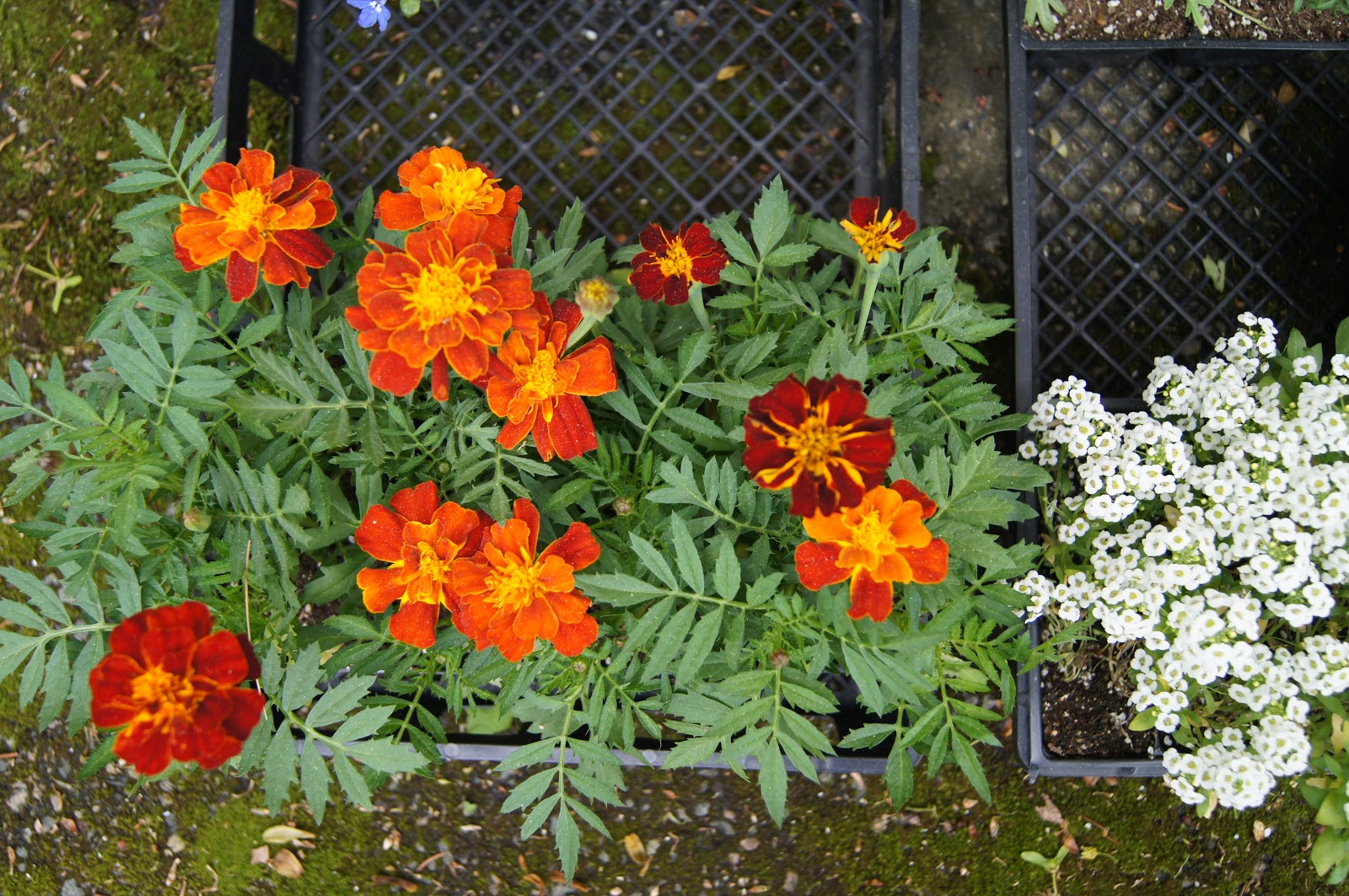
     Thomson’s seedlings were beautiful, clearly well-grown and healthy. This wasn’t even the full inventory, which Scott said will be coming in later this month. He sources his plants locally. His organic herbs came from Gilbertie's Herbs in Westport, Connecticut, another outlet I’d like to visit. I bought herbs and also pesticide-free marigolds, geraniums, dahlias, cosmos, lobelias, and alyssum.


Marigolds and alyssum, annuals I'd been hoping for


    The next day I scored some more annuals and some vegetable seedlings—tomatoes, lettuce, and cucumbers--also grown without pesticides, at the seedling sale of the Waltham Community Farm, one town over. With these purchases, I’ll be able to plant out almost all my usual annuals.


Annuals will supplement perennials in the pollinator garden

     What I won’t be doing this year is making a big purchase at my favorite local garden center, which shall remain nameless. It’s a bigger place than Thomson’s with a wide selection of gorgeous perennials, annuals, and vegetables and some shrubs and trees. I love going there. My May shopping trip has long been one of the high points of my year.


Anise-scented sage, Salvia guaranitica, a treasure from my favorite garden center

    But what’s the point of a pollinator garden that kills pollinators? Until this business can certify that their plants are neonic-free, I don’t feel right shopping there. I’ve sent them a letter explaining why. I hope that as customers raise this issue, garden centers will follow the lead of the big box stores that have yielded to pressure and promised to phase out neonics.


     When consumers got interested in planting for pollinators, sellers jumped on the bandwagon, touting plants for pollinator gardens. They just didn’t mention that the plants were treated with chemicals harmful to those same pollinators. Scott Thomson’s attractive stock confirms that marketable plants can be produced without these synthetic chemicals.


Geraniums from Thomson's

     Garden centers understand why consumers want organic food plants. Now we want organic—or at least pesticide-free—ornamental plants too. I’m happy to know that a few growers and retailers are out there supplying them.

Sunday, January 22, 2017

A reprieve for bees?

The clouds may be parting for gardeners who have been unknowingly poisoning bees and other insects. The bad news is that many of the flowers we buy to help pollinators may be treated with pesticides that poison them. The good news is that a campaign to stop this practice is bearing fruit.
This cosmos attracted a bee to my garden

     In 2014, Gardeners Beware, a report from Friends of the Earth, showed well-documented proof that insecticides called neonicotinoids (“neonics”) were present in more than half of bee-attracting commercial nursery plants bought at a broad sample of garden centers and big box stores in the United States and Canada.


     At commonly used concentrations, neonics kill bees. At lower levels, they cause neurotoxicity. Picture a bee that can’t remember how to get back to her hive. Friends of the Earth concluded, “. . . the chance of purchasing a plant contaminated with neonicotinoids is high. Therefore, many home gardens have likely become a source of exposure for bees.” 


Poisonous for bees?

     Growers treat annuals and perennials with the neonics in order to display plants unmarked by insects. The chemicals persist for years in plant tissues, including flowers, pollen, and nectar that bees touch. 


    I take this very personally. I don’t buy pesticides or spray them on my annuals or perennials. It’s upsetting that plants I used to create my insectary bed could have been killing insects rather than providing them with safe food as I intended.


I planted black-eyed Susans to feed insects, not poison them

    The good news is that thanks to pressure from activists, some major retailers have agreed to phase out neonics and plants treated with them. BJ’s Wholesale Clubs was the first major United States outlet to respond, requiring that its suppliers label plants treated with neonics and stop using them by the end of 2014. Home Depot has committed to stop selling treated plants by 2018 and Lowe’s by spring 2019. These retailers are way ahead of the Environmental Protection Agency, which still hasn’t put a moratorium on use of neonics while it reconsiders their registration for use in the US.


    Predictably, the chemical companies that make these pesticides, including Bayer and Ortho, blame the drastic bee population decline on diseases and non-native pests. The burden of scientific evidence now indicates these are less serious problems for bees than neonic toxicity. Restrictions on neonic use in France, Germany and Italy have sharply curtailed bee colony losses.


    I don’t know whether I’ve been buying neonic-treated plants at my favorite garden center. That will be my first question the next time I’m there.


     Marigolds, which I buy every year, tested positive at three quarters of the Massachusetts sites in the Friends of the Earth study. 

Marigold seedlings are fun and easy--but are they safe for bees?

Young annuals change hands several times from germination to sale. If any one of those handlers treats them with neonics, my bees are in trouble. 

    If I can’t get full assurances that plants I buy are safe for pollinators, I’ll have to go to Plan B (so to speak). That will be to buy only organically grown plants or seeds until this issue is fully resolved.


Monday, July 4, 2016

Front yards that time forgot

I live in a suburb with a firm code for front yard landscaping. The norm is evergreen foundation plantings—yews, hemlocks, rhododendrons, azaleas—with a well-tended lawn flowing toward the street, and possibly a privet hedge along the sidewalk.


    From the point of view of sustainable gardening, this traditional approach poses a lot of problems. Most of those evergreen shrubs are species imported from Asia that won’t provide native insects with food they need. 


    The lawn is a monocultural desert, especially if it’s fertilized and treated with pesticides and broadleaf herbicides to keep it green and weed-free. Over-fertilizing is all too easy, leading to accumulation of excess nitrates and phosphates in ponds and rivers via stormwater runoff. Pesticides and herbicides reduce biological diversity and interfere with the full functioning of the food web—not to mention the risk many of these chemicals pose to human health.


    Mowing the lawn is another environmental “don’t,”  because gas-powered lawnmowers are heavy polluters and inefficient users of fossil fuels.


    Then there’s the privet hedge. Privet (Ligustrum species) is a nonnative genus of shrubs introduced to North America as early as the sixteenth century. It’s popular because it takes well to shearing, and its leaves contain a chemical that inhibits insects’ digestion. 


A privet hedge marks the boundary of this property

Birds eat the black fruit and distribute the seeds, allowing privet to escape into the wild, crowding out native plants in fields and forest gaps.

    People are still installing this classic formula of lawn and nonnative shrubs, but there’s a trend toward a more sustainable approach. One of my neighbors, Doris Lewis, is a front yard revolutionary. There’s no lawn in front of her house at all. When the house was built, she designed a beautiful combination of trees, shrubs, perennials and groundcovers that make a lovely vista for passersby. It’s much lower maintenance than a grass lawn and doesn’t require mowing, chemical fertilizer, or pesticides. 


Doris incorporated roses and small trees in her front yard design

    Short of Doris’ radical rethink, there’s an incremental, sustainable-enough approach to the front yard that I’ve tried to embrace. It involves minimizing lawn, avoiding use of landscape chemicals, and planting native substitutes for problematic nonnatives such as privet. At present I have no front lawn, and I’m starting to integrate some native plants to liven up the boring shrubs in front of the house. 


An oak leaf hydrangea (Hydrangea quercifolia) is a new addition to the front yard

I notice that some neighbors are trimming away lawn to plant insect-friendly perennials and shrubs too.

    If your front yard is sunny, there’s another way to go. A friend who was part of the local food movement told me that when she saw a front lawn, she thought of it as wasted space for growing vegetables. I’m not aware of front yard vegetable gardens in my neighborhood, but I know they’re thriving in other areas. 


Raised beds in front of the Becker School in Austin, Texas

I recently heard a determined urban gardener describe successfully growing cucumbers right next to her parking spot at the front of her house, inspired by what she considered the outrageous price of organic cukes at Whole Foods. That's the wave of the future.