My book and web site

Check out my book, The Sustainable-Enough Garden, available on Amazon, and the book's web site at www.thesustainable-enoughgarden.com. See more plant photos on Instagram.
Showing posts with label perennials. Show all posts

Sunday, November 14, 2021

Leave the leaves

What used to be a far-out, novel idea is now joining the mainstream: “Leave the leaves.” To support biodiversity and especially to provide protection for native insects, gardeners are changing our fall routine. For the past three years, I’ve been letting whole leaves lie on my garden beds.  


Whole leaves work as mulch

    This change allows me to do a lot less work. I used to spend many hours in late October and early November raking leaves to a spot at the back of the house where I could plug in my leaf shredder. I’d feed as many leaves as possible into the machine--basically a string trimmer in a drum—to make shredded leaf mulch for my perennials. 


Leaf shredder: effective but labor intensive

Now I just gather leaves from the driveway, the sidewalk, and the roadway along our block, rake them onto a tarp, and drag the tarp into the backyard. There I dump the leaves on whatever bed seems to need a blanket of mulch. 


    The concept behind this time-saving approach is that lots of native insects overwinter in fallen leaves, whether as eggs, larvae, nymphs, or adult insects. When I chop up leaves in the shredder, I’m chopping up those insects, reducing next year’s population of native insects in my yard. That’s working against myself, because I need a balanced population of leaf eaters, pollinators, and beneficial insects—the predators that keep leaf eaters in check—to keep my garden ecosystem healthy.


I want to host beneficials like this lacewing
 
    While environmentalists and proponents of sustainable gardening advocate for leaving the leaves, I’m disappointed to notice that some of my favorite garden writers are pushing back. I’ve read warnings that a cold-season mat of whole leaves will damage turf grass. Yes, we all knew that! Another worry is that perennials won’t thrive under a blanket of leaves. The thought is that plants from Mediterranean climates may need breathing room and a drier environment.


    All I can say is that these commentators must be gardening very differently than I do. Most of what used to be turf grass in our yard is now covered with wood chips that have no trouble accommodating a layer of fall leaves. And my perennials are ones that have proven tough enough to survive the conditions in the yard—sandy soil, rabbits, varying degrees of shade, humid summers with periods of drought and, increasingly, cold snaps in winter without snow cover for protection. If perennials needed pampering, they’ve long since died out in my garden.


Lavender toughs it out in the garden without special treatment
 
    Given my limited perennial-growing ambitions, I’ve had no trouble with leaving the leaves. Increasing numbers of birds visiting the yard suggest we’ve got more native insects than we used to.


    In spring I do like to peel back the matted leaves from the newest perennial bed off the back deck. It’s quick work to dump them in the wheelbarrow and move them to the compost piles. If I’ve got some dry fall leaves in bags in the garage, I’ll shred them at that time to replace the mulch I’m taking away. Moderation in all things.

Dwarf crested iris, another survivor


Sunday, May 23, 2021

Protecting pollinators

There’s good and bad news about neonicotinoid pesticides during this spring’s plant shopping season. A Vanderbilt study that exposed honey bees to low doses of neonics found that after three days, the bees were sleeping half as long as normal. That’s bad news, because sleep-deprived bees have trouble finding their way back to the hive and may starve and die. 


Neonic-exposed sleep-deprived bees can't navigate

    Bees memorize visual cues for short flights, but when they’re farther from the hive, they navigate by using their circadian clock and their position in relation to the sun. Neonics disrupt bees’ circadian rhythms and throw off this navigation process.


    We seem to be accumulating more and more evidence that these pesticides harm pollinators, but the Environmental Protection Agency still hasn’t made up its mind to ban them or restrict their use, as the European Union has done. A ruling is due this year.


    As I made my plant shopping lists, I had to decide again whether to buy from my favorite garden centers. Could I trust them not to sell neonic-treated plants? I got some good news from two sources. A nearby farm stand with a large garden shop told me that most of their seedlings are started on site, and they don’t use neonics. They’ve switched to biological controls. This opens up a good source for common annuals I buy every year, such as lobelias, marigolds, alyssum, and coleus.

Pollinator-friendly marigolds and Mexican sunflowers, neonic-free

    Jack Russell, the owner of Russell’s Garden Center in nearby Wayland, called back in response to my inquiry about whether plant offerings at Russell’s are neonic-treated. I was relieved to hear his qualified no. Jack said their vegetable plants are neonic-free. For perennials and annuals, he said, they try not to sell anything treated with neonics. 


    The problem for Russell’s and other garden centers is the number of stops plants make on their way to market. Russell’s can certify that their suppliers aren’t using the insecticides, but they can’t be sure that seedlings or seeds weren’t treated before they got to those wholesale producers. Unfortunately, neonics persist for years in plant tissues.

Before planting, I want to be sure native moss phlox doesn't carry poisonous neonics
 
    Some of the suppliers whose plants I buy at places like Russell’s have made a strong commitment not to use neonics. Proven Winners, which produces many of my annuals, has vowed not to treat their plants, although they don’t quite admit that neonics harm bees. Most of the herbs offered at garden centers that I frequent are produced organically at Gilbertie’s Herb Gardens in Connecticut, so I know they’re neonic-free.

 
    In general, edible plants are less likely to be treated than ornamentals. Apparently sellers understand that consumers want pesticide-free food, but they’re slower to grasp how concerned we are about poisoning pollinators.

It's a relief to be able to source neonic-free annuals


    The good news is that the retail market is gradually catching up with ecological gardeners’ preferences regarding neonics. I’m delighted to be able to revisit my favorite plant shopping venues. Now if the EPA issues a ban, we’ll really feel sure that our gardens are safe for pollinators.

Alyssum that's safe for pollinators


Sunday, September 30, 2018

Dying to be reborn

The autumnal equinox has passed, and leaves are starting to turn yellow, curl up, and brown at the edges, beginning the process that will end in their dropping off. Are shorter days and colder nights killing them? Yes and no.

Bleeding heart (Dicentra spectabilis) winding down

    Right in front of my kitchen window, a large pot of cucumber vines was burgeoning until two weeks ago, opening new yellow flowers and forming perfect little fruits that grew into delicious cucumbers much tastier than the waxed, store-bought versions.


July: cucumber vine flowering

Last week the leaves started to shrivel. One morning I looked out and saw the plants had turned completely brown. Was it because of a night temperature in the 40s, or was it just time? How do plants know when to die?


September: the season for cucumbers has ended

    Like us, plants need to maximize their utility, acquiring as much as they can of life’s necessities—in their case, water, sunlight, nutrients, and space to grow. They can’t chase after these things. But unlike us, they can add to their bodies, growing new roots and shoots all their lives. Plants don’t just grow randomly. To respond to surrounding conditions, they make adjustments to their growth mediated by hormones carrying chemical messages from roots to leaves and back. 


    Each plant makes unsentimental decisions minute to minute about which parts will get more resources and which have to go. The plant is continuously gathering feedback from its extremities and expecting each unit to pull its weight. It needs each root to bring in enough water and nutrients to make it worth “paying for” with sugars made through photosynthesis in the leaves. Similarly, it needs each leaf to produce enough of those carbohydrates to support the roots in their mission.


One cranesbill leaf too many

    I learned that there are two kinds of plant senescence, the ways plant tissues die. There’s stress-related senescence. That's what happens when I forget to water a container plant and some leaves turn yellow and die because the plant didn’t have enough water to support them. Those leaves became too expensive to support in drought conditions.


Elephant ear leaf saying, "Why didn't you water me?"

    The other way of plant death is pre-programmed for the end of the growing season. My cucumber vines (Cucumis sativus) are annuals, born to die about 70 days from planting, soon after they finish producing fruit. This strategy allows an annual species to put all its energy into preserving genetic diversity. As leaves get ready to drop, the plant pulls back nutrients they held and uses those nutrients to produce lots of seeds, each with a mix of genes from its parents. 


    Shrubs, trees, and perennials such as bloodroot (Sanguinaria canadensis) have chosen another option. 


Yellowing bloodroot leaves sending resources back to the roots

They store nutrients in roots and stems to use later. That gives them a jump on the annuals when spring comes. They’re poised to send up new shoots, push out new leaves and roots, and get the most from the early spring sunlight.

 
Bloodroot leaves and flowers opening in April


    I hate to see winter coming and the garden season ending, but it’s great to picture the plants laying up stores for next spring.


Sunday, July 29, 2018

To deadhead or not to deadhead

Lots of flowers in my new bed means lots of decisions about whether to deadhead, or remove spent blossoms. 

Ox-eye sunflower and butterfly weed

Conventional garden wisdom rates deadheading as a necessity. It neatens up the garden, and more importantly, it’s intended to trigger the plant to make more flowers instead of channeling its energy into transforming fertilized flowers into seeds.

    As the flat yellow yarrow blossoms (Achillea ‘Coronation Gold’) turn brown, should I leave them to go to seed? 


Yarrow flowers this week

A trusted reference on perennials, Tracy DiSatabo-Aust’s The Well-Tended Perennial Garden, firmly dictates deadheading these flowers and promises they’ll be followed by new blooms from lateral buds and possibly from the plant’s base too.

Deadheading-photo Helen Harrop/Flickr through a Creative Commons license

    More flowers will provide more pollen for native insects. Jessica Walliser, in her book Attracting Beneficial Bugs, explains that native common yarrow (Achillea millefolium) is favored by lacewings, ladybugs, syrphid flies, parasitic wasps, and damsel flies—all predators that consume leaf-eating insects, keeping the garden’s insect population in balance.


Green lacewing, a beneficial predator

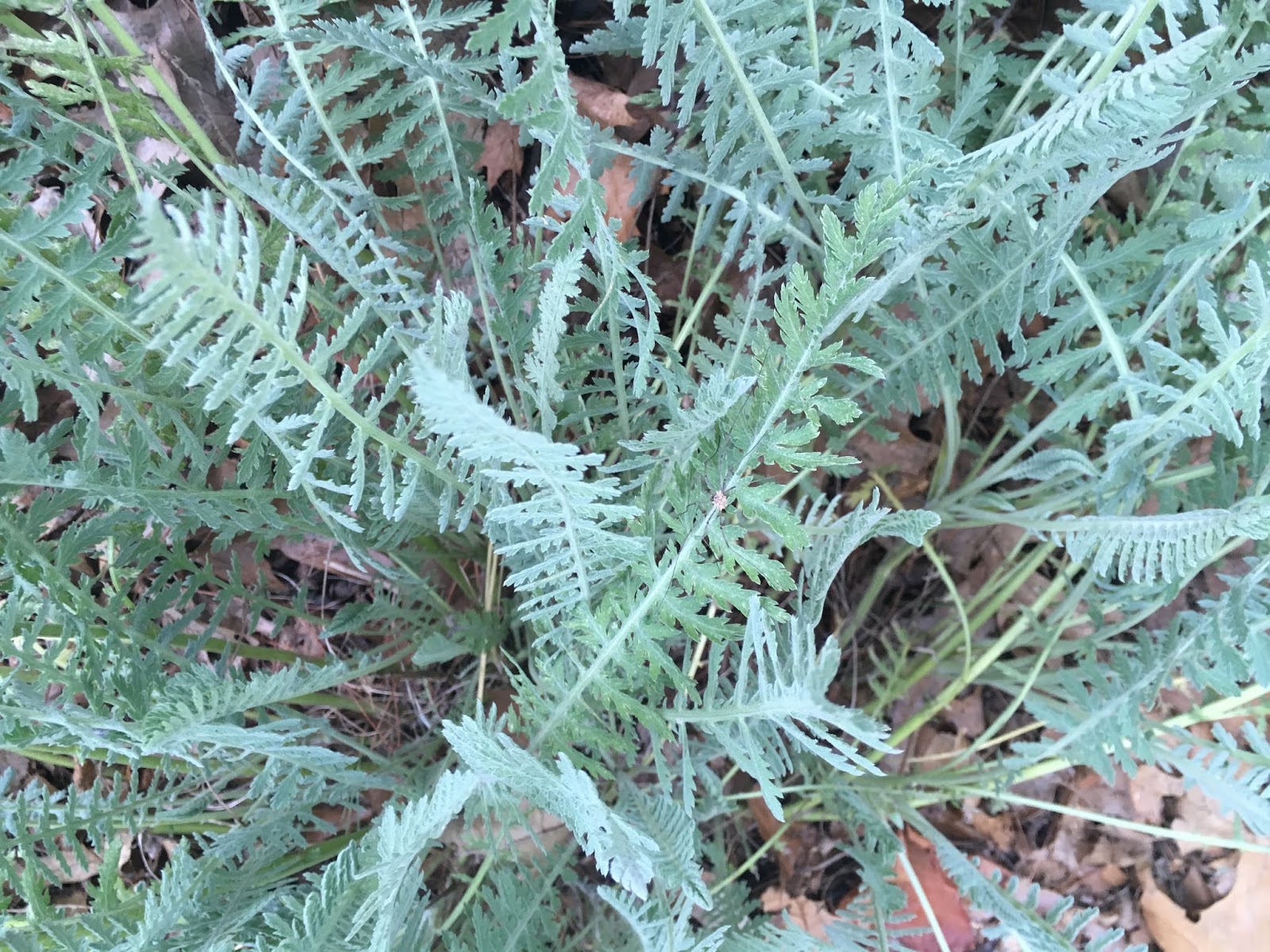
     My yarrow is related to fern-leaf yarrow, a European introduction (Achillea filipendula). I hope it attracts most of the same bugs as the native. Jess observes minute pirate bugs, very active predators, living in the flowers of this cultivar. Insects benefiting from the flowers add reasons to go ahead and deadhead the yarrow in hopes the plants will flower again.

    On the other hand, in Gardening for the Birds, George Adams writes that many birds eat the seeds of common yarrow. He adds that some cavity-nesting birds harvest its foliage to line their nests. It seems that the strongly scented foliage repels parasites, so by making this choice, the birds as “self-medicating.” 


My yarrow's fern-like leaves

    But George Adams also notes that birds feed on the insects that are drawn to yarrow flowers. This summer and last, following his advice, I’ve put a moratorium on filling bird feeders with seed. This way birds are supposed to turn their attention to eating seeds and insects they find in the yard, rather than just birdseed I put out.


    Last summer I noticed that birds continued to visit the yard without finding seed in the feeders. One side benefit was the disappearance of European house sparrows, nonnative birds notorious for muscling aside native species and hogging all the food. I guess the sparrows aren’t interested in foraging for food and prefer to go where the pickings are lusher.


European house sparrow

    This is one of those environmental decisions with pros and cons on both sides. I can deadhead to offer more flowers for the insects, or let the flowers go to seed for the birds. If I deadhead, I should get to enjoy some more of the pretty yarrow flowers.


'Coronation Gold'

     You can probably tell which way I’m leaning. I think I’ll deadhead now and call it a scientific experiment. I'll see how many more blooms I get after deadheading. I’ll plan to let the flowers go to seed at the end of the summer, leave them standing, and see if I spot birds eating the seeds. That way we all win.

Common yarrow

Monday, July 2, 2018

Summer gold

To my eyes, pink flowers look best in the soft light of spring. When summer sets in, I enjoy yellow and orange flowers more. I chose a yellow and blue color scheme for my new sunny perennial bed, with most of the flowering happening in June and thereafter. I’m admiring how the yellow flowers look in bright summer sun.

    The first yellow flowers of Rose ‘Kolorscape Yellow Fizz’ and cinquefoil (Potentilla atrosanguinea) have come and gone already, giving way to the deeper yellow of yarrow (Achillea ‘Coronation Gold’). 


Yarrow leaning over the deck

I’m happy to see these flowering profusely, showing that they’re getting enough sun in this location. The flat blooms are easy to see from the house as they lean away from the trees that overhang the far side of the bed. 

    Some extra color warmth is provided by the chartreuse flowers of lady’s mantle (Alchemilla mollis). I grow this plant mostly for its handsome round leaves, but the sprays of tiny flowers are charming too.


Lady's mantle has lots of small flowers

A spurge (Euphorbia x martinii ‘Ascot Rainbow’) adds its green and yellow bracts and yellow-rimmed leaves to the picture. While I wait for the perennials in this bed to fill in, I’m planning to use some of the open space to grow patty pan squash, which will also contribute yellow flowers. Meanwhile, on the deck I’m growing cucumbers, 

Squash flowers will be like these cucumber blossoms

black-eyed Susans (Rudbeckia hirta) to attract pollinators, and Mexican mint marigold (Tagetes lucida) for edible flowers.

I like black-eyed Susans, and pollinators do too

    One of my favorite weeds has volunteered again to add drama in several areas of the garden. Mullein (Verbascum thapsus) is a native of Europe, northern Africa and Asia that came to North America with European settlers and was adopted by Native Americans for medicinal uses. 


Young mullein getting ready to flower

If you’re in need of a poultice, this plant reportedly makes a good one, and it can also be used in remedies for colds, earaches, and asthma. I just enjoy its statuesque presence. In starts out as a rosette of woolly leaves, sending up a tall stalk of yellow flowers in its second year. 

Yellow mullein flowers opening along the tall stalk

Mullein pops up in disturbed ground, moving on when other plants settle in, so it’s never become a problem.

    Not everyone loves them, but I enjoy daylilies (Hemerocallis cvs). The first to bloom in my yard are yellow. 


An early daylily

I’ve planted a mix of colors in a narrow bed along the driveway where they get plenty of sun. Over the years they’ve formed fat clumps, and now we get lots of flowers through July and partway into August.

    A true orange flower is finally blooming in my insectary bed next to the vegetable garden. 


Butterfly weed, flowering at last

I’ve been trying for several years to grow butterfly weed (Asclepias tuberosa), but the plants dwindled, probably not getting enough water. Last year one took hold, and this spring it came back strong, grew bushy, and set flowers. Its cousin common milkweed (Asclepias syriaca) has also survived in another sunny spot. Between the two of them, I hope to provide food for monarch butterfly caterpillars.

Monday, June 4, 2018

To cram or not to cram

My new perennial bed is approaching its first birthday, and I’m taking the opportunity to assess how it’s doing. Just about all of the plants made it through the winter, probably because the project was blessed with adequate rainfall in fall and spring and good snow cover during the winter. 


Bulking up for summer

I’d like to believe that letting a thick layer of whole leaves lie on the bed through the winter also helped the young plants.

    Now I’m seeing flowers on the new perennials and low shrubs. A yellow shrub rose (‘Kolorscape Yellow Fizz’) is blooming, 


and blue-eyed grass (Sisyrinchium angustifolium ‘Lucerne’)is covered with purple flowers.


Yarrow (Achillea ‘Coronation Gold’) is covered with buds that are about to open. One of the things I love about this new bed is its relatively sunny exposure. There are few spots in the yard that get as much sun as this area right off the back deck. I was able to choose species that need direct sun for at least part of the day, and they’re getting enough sun to flower generously.

    I tried to restrain myself from planting this new bed too densely. In the past, I’ve often crammed in so many plants that they suffered from lack of space. The more aggressive growers tended to take over, shading out the timid or out-competing them for root space and access to water. That’s one way I learned what will grow in my yard and what won’t. What’s here now is what survived.


    Over-crowding is hard to resist, because there are so many plants I’d like to grow and only limited space to put them in. This time, though, I tried to think about the mature size of the plants as I placed them in the bed. As a result, they’re currently surrounded by lots of open space. They should fill in by their third summer.


More mulch than foliage this May

    Thomas Rainer and Claudia West, on the cutting edge of landscape design, advocate a different approach to plant spacing in their book Planting in a Post-Wild World. They argue for cultivated landscapes that evoke archetypal natural plant communities, such as grasslands, shrublands and forests. Instead of making the soil and site hospitable to a list of favored plants, they match plants to existing site conditions.


    There are no open mulched areas between plants under their scheme, and there's no bare soil. Their herbaceous layer, which features perennials and grasses, is surrounded by low, spreading species that fill in all the gaps, both above ground and in the root zone. By allowing each type of plant its niche, they achieve a landscape as dense as a patch of weeds. Some plant uses every inch of soil.


All niches are filled as this lawn returns to nature

    As it happens, I did choose some low-growing native species for my bed: bearberry (Arctostaphylos uva-ursi), American cranberry (Vaccinium macrocarpon), and three-leaved stonecrop (Sedum ternatum ‘Larinem Park’).  


Who knew cranberry plants were so pretty?

I’m watching to see which will grow best. Perhaps they’ll weave themselves into the kind of tapestry Rainer and West describe.

Bearberry reaching out to surround taller perennials
 

Sunday, March 4, 2018

Best of 2017

I thought I’d take this still wintry week to review some of my favorite plants of 2017. These are plants I love for their flowers, their pretty foliage, or their shape or texture. They’re easy to grow. Some but not all are native plants with the added advantage of providing food and shelter for native animals, especially insects.

     Bloodroot (Sanguinaria canadensis) is an early bloomer, a native plant classified as a spring ephemeral. It first sends up elegant curled gray-green irregularly indented leaves. 


Bloodroot unfurling in April

The glowing white flowers last for two weeks if the weather stays cool. Bloodroot confirms that spring is really coming.

     White bleeding heart (Dicentra [now Lamprocapnos] spectabilis ‘Alba’, flowering soon after bloodroot, is one of my long-time favorites. I bought some from White Flower Farm years ago as a concession to gardening in shade. I find the flowers unfailingly beautiful. 


White bleeding heart in May

It’s a self-seeder that pops up in shady spots and forms new colonies. If there are more seedlings than I want to keep, I pot them and give them away. There are native bleeding hearts, but this isn’t one of them.

     For summer, there’s borage (Borago officinalis). This persistent self-seeder, originally from Europe, has furry leaves and azure blue flowers. 


Borage volunteering in the vegetable garden

I first planted it in my vegetable bed because it was listed as a beneficial plant. It’s come up every year since. Its specific epithet officinalis indicates that it was once used by apothecaries as a medicine. Borage is popular with pollinators, easy and vigorous but not pushy.

     Recently I’ve been very pleased with parsley, dill and fennel I’ve planted for pollinators. The only one we eat much of is the parsley, but all three grow tall fronds and panicles of flowers that bees and other insects like. I think they look romantic in a corner of the vegetable bed.


Fennel flowers for pollinators

     Among shrubs, one of my all-time favorites is doublefile viburnum (Viburnum plicatum f. tomentosum ‘Mariesii’). It’s not a native, but May wouldn’t be the same without it. The graceful white flowers open along the tops of horizontal branches.


Doublefile viburnum in May

     I think our native highbush blueberries (Vaccinium corymbosum) are underused as ornamental plants. They could easily take the place of privet, a nonnative that turns out to be invasive. I’ve got several blueberry shrubs mixed into shady beds. The spring flowers are pretty, the berries are popular with birds, and the red fall foliage is very handsome. 


Blueberries' fall color

I’m going to prune them this spring in hopes they can grow more densely in areas where I’ve let in more light.

     One of my favorite trees is white pine (Pinus strobus), a New England native that makes a feathery background for several of my garden prospects. 


White pine in the background

White pines lose limbs to heavy winds and heavy snow. Fortunately they just keep growing; the gaps are soon filled in.

     Most of these favorites aren’t new in my garden. They’ve stood the test of time. It’ll be interesting to see whether new additions will prove to be even better garden citizens.


A March favorite, witch hazel


Monday, May 1, 2017

Paradigm shift for pots

In response to my question about which perennials to use as fillers in containers, Patricia McGinnis, an astute reader, wrote suggesting that bigroot geranium (Geranium macrorrhizum) would be a good choice. As she points out, it has attractive multi-lobed leaves that turn red in fall, and it spreads moderately.


Bigroot geranium this week

  Patricia’s email opened my eyes, and now I’m spotting any number of perennials I can use in containers to replace the impatiens and coleus I’ve been buying for years. The impetus for this search is to avoid nursery plants that have been sprayed with pollinator-lethal “neonics,” neonicotinoid insecticides that persist in plant tissues.


No point in attracting insects and then poisoning them

     In case you’re not familiar with the expression, “fillers” refers to a popular dictum for container designs: include “thrillers, fillers, and spillers.” Tender perennials with big bold leaves are my usual thrillers, and I like to balance them with mid-sized fillers. 


Canna with calibrocha filler last July. Lobelia had already melted in the heat.


Ideally I include something that blooms for a long season, but distinctive leaf shapes, colors or textures work too.

     Just about any vigorous perennial of low to moderate height could be a candidate, I see now. If a plant is spreading, I won’t feel bad about digging up a few rooted sections to use in pots. Some perennial clumps are due for dividing. That will be an opportunity to use a piece in a container. If a plant’s showing aggressive tendencies, that’s all the more reason to wrench some out, pop it into a pot, and let it die at the end of the season.


     In the moderately spreading category, I can picture using wild ginger (Asarum canadense), which has large matte green leaves that stay fresh-looking all summer. 


Wild ginger stays elegant through the summer

I could also use its imported cousin European ginger (Asarum europaeum). The shiny round subtly variegated leaves of this groundcover captivated me back when I started my garden. After very slowly increasing for 30 years, it’s starting to pop up in unexpected places, and I have enough to spare for potting. Maybe I could replant it in fall after a sojourn in a summer container.

European ginger this week

     Some hostas and hellebores that I planted too close to shrubs are now looking crowded and unhappy. They could provide some chunky mass to balance the giant leaves of cannas and elephant ears in pots.


A mature hellebore can be quite bulky

     As for groundcovers with invasive predilections, golden creeping Jenny (Lysimachia nummularia ‘Aurea’) is expanding wildly. Its near-yellow color could provide an interesting contrast, and it might drop stems gracefully over the side of a container.


Golden creeping jenny: don't be fooled, there's no stopping it.

     People often stick something with thin, strap-like leaves, such as a cordyline or an ornamental grass, in the center of a pot as a vertical element. 


Cordyline for verticality--photo by Daryl Mitchell

Perhaps I could draft smooth Solomon’s seal (Polygonatum biflorum) for this role. It too has taken over a lot of real estate in shady sections of my garden.

Two species of Solomon's seal sending up their shoots


     I can’t wait to try some of these ideas when I fill my containers in May. I bet I’ll see more options as perennials continue to emerge in the interim. Thanks, Patricia!


Ah, April! Yellow trout lily (Erythonium americanum)