My book and web site

Check out my book, The Sustainable-Enough Garden, available on Amazon, and the book's web site at www.thesustainable-enoughgarden.com. See more plant photos on Instagram.
Showing posts with label leaf shredding. Show all posts

Sunday, November 14, 2021

Leave the leaves

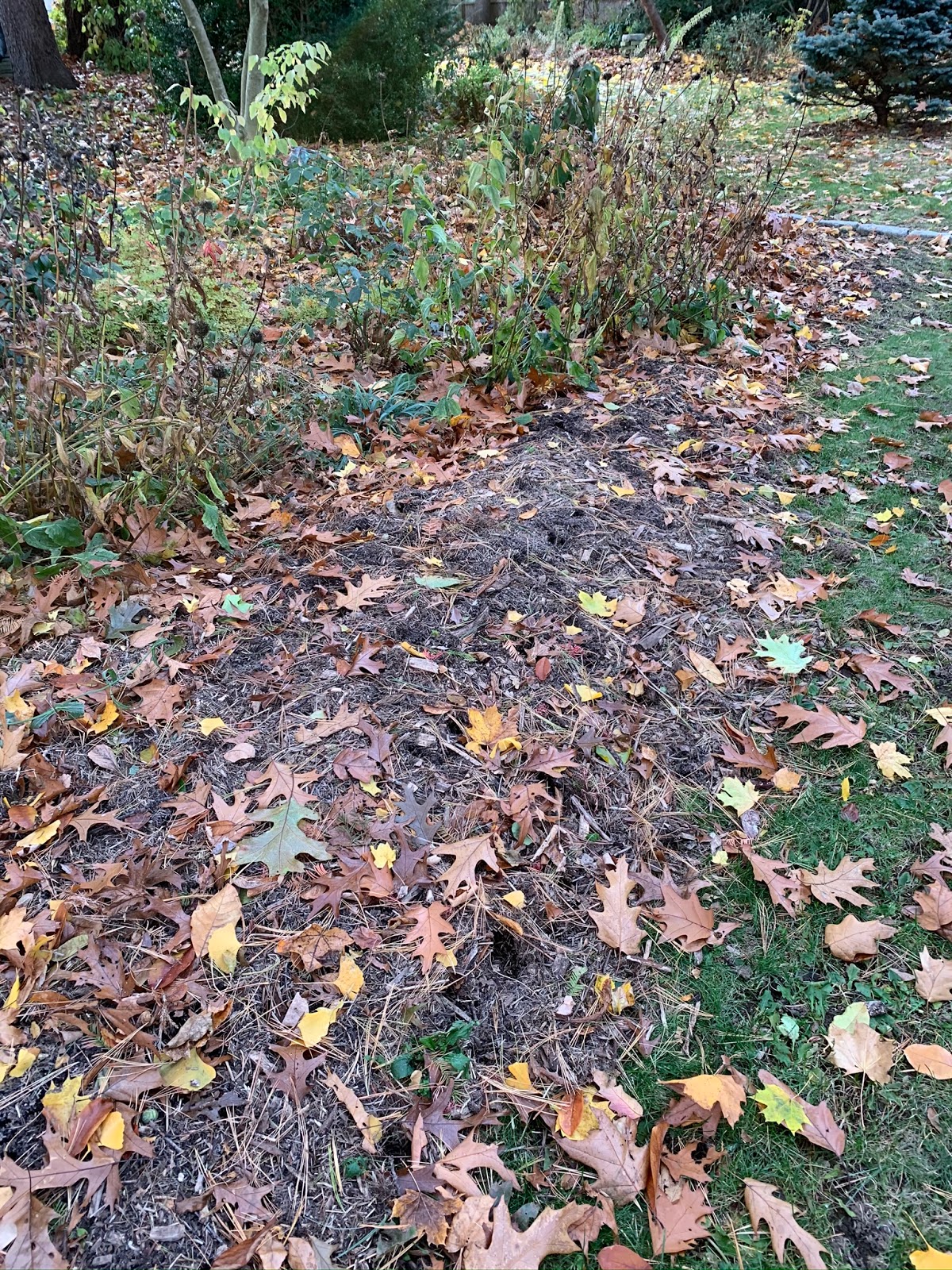
What used to be a far-out, novel idea is now joining the mainstream: “Leave the leaves.” To support biodiversity and especially to provide protection for native insects, gardeners are changing our fall routine. For the past three years, I’ve been letting whole leaves lie on my garden beds.  


Whole leaves work as mulch

    This change allows me to do a lot less work. I used to spend many hours in late October and early November raking leaves to a spot at the back of the house where I could plug in my leaf shredder. I’d feed as many leaves as possible into the machine--basically a string trimmer in a drum—to make shredded leaf mulch for my perennials. 


Leaf shredder: effective but labor intensive

Now I just gather leaves from the driveway, the sidewalk, and the roadway along our block, rake them onto a tarp, and drag the tarp into the backyard. There I dump the leaves on whatever bed seems to need a blanket of mulch. 


    The concept behind this time-saving approach is that lots of native insects overwinter in fallen leaves, whether as eggs, larvae, nymphs, or adult insects. When I chop up leaves in the shredder, I’m chopping up those insects, reducing next year’s population of native insects in my yard. That’s working against myself, because I need a balanced population of leaf eaters, pollinators, and beneficial insects—the predators that keep leaf eaters in check—to keep my garden ecosystem healthy.


I want to host beneficials like this lacewing
 
    While environmentalists and proponents of sustainable gardening advocate for leaving the leaves, I’m disappointed to notice that some of my favorite garden writers are pushing back. I’ve read warnings that a cold-season mat of whole leaves will damage turf grass. Yes, we all knew that! Another worry is that perennials won’t thrive under a blanket of leaves. The thought is that plants from Mediterranean climates may need breathing room and a drier environment.


    All I can say is that these commentators must be gardening very differently than I do. Most of what used to be turf grass in our yard is now covered with wood chips that have no trouble accommodating a layer of fall leaves. And my perennials are ones that have proven tough enough to survive the conditions in the yard—sandy soil, rabbits, varying degrees of shade, humid summers with periods of drought and, increasingly, cold snaps in winter without snow cover for protection. If perennials needed pampering, they’ve long since died out in my garden.


Lavender toughs it out in the garden without special treatment
 
    Given my limited perennial-growing ambitions, I’ve had no trouble with leaving the leaves. Increasing numbers of birds visiting the yard suggest we’ve got more native insects than we used to.


    In spring I do like to peel back the matted leaves from the newest perennial bed off the back deck. It’s quick work to dump them in the wheelbarrow and move them to the compost piles. If I’ve got some dry fall leaves in bags in the garage, I’ll shred them at that time to replace the mulch I’m taking away. Moderation in all things.

Dwarf crested iris, another survivor


Sunday, November 10, 2019

Compost shortage

Once my composting operation settled into a routine, I could count on having two of my four bins produce a good supply of fully made compost every year. Every fall I spread a thick layer on the vegetable bed, where organic matter is used up fast by food-producing annual plants. 

Food compost from the closed bin will enrich the soil of the vegetable bed

When I planted new areas, I spread compost on the soil surface before starting to dig. When I learned that harvesting (really mining) peat contributes to global warming by releasing carbon, I started mixing finished compost from the bins with coir (coconut fiber) to make homemade peat-free potting mix.

     This year I haven't produced as much compost as I used to, and I'm going through it faster. Last year I gave away so many potting mix samples that I ran short of finished compost. 

Cute, right?

The reason for the samples was to interest garden club members I met in making their own peat-free mix. I thought if they tried mine, they'd see how easy it is to make a mix that looks, feels and functions a lot like commercial products based on peat. 

     Last year too I piled fewer fall leaves into the bins. I used to heap up leaves on the bins at the end of the gardening season, knowing the fluffy mounds would flatten during the winter, gradually decompose, and become part of the compost. But last year I went big on piling the whole leaves on beds to provide winter shelter for native insects.

Collecting leaves from the sidewalk to pile on garden beds

     Another call on my compost supply last year was the sheet composting project I started last March. The majority of the material for this composting-in-place soil improvement mound came from thick layers of wood chips and fall leaves. Thinner layers of compost were needed, though, to introduce soil organisms that would do the decomposing. I can see that they're doing their work. Already this fall the mound has sunk to about half its original height.


The sheet composting mound is sinking and starting to look like soil


     These extra demands on my compost economy have left the bins nearly exhausted this fall. Cutting down vegetable plants and emptying summer containers, I've started the process again in two of the four bins. According to the old system, though, the other two bins should be full of year-old developing compost. They're not.

The cupboard is bare


     In the past, I've just waited two years for the compost to be finished. Usually I make a point of adding garden waste to the compost as it comes, with no recipe. But I don't want to go through next summer with no finished compost. I may have to adjust my lazy-woman's composting method this year. 

     To get back on track, I can mix shredded leaves with the dead plants in the bins. 

Shredded leaves will decompose faster

Combining "brown" high carbon and "green" high nitrogen components will speed up the process. Desperate times call for desperate measures.

Sunday, September 22, 2019

Lots to love about leaf mulch

The word is out: leaf mulch is great. 

Shredded leaves make high-quality, free mulch

   I’ve been chopping up fall leaves for mulch since sometime in the 1990s. These days I mulch most beds with whole leaves, because they provide shelter for over-wintering insects. I still use chopped leaves for areas near the lawn, because they don't blow around. 

     Many people chop leaves with the lawnmower. I prefer to use a standing leaf shredder, essentially a string trimmer in a drum. Plastic filaments whirl around and chop the leaves into small shreds. The resulting mulch is pretty, it doesn’t blow around like whole leaves left on the ground would, and it’s great for building soil fertility. And the electric-powered shredder doesn’t generate exhaust.

Electric leaf-shredder doesn't pollute the air

    The Rose Kennedy Greenway, the linear Boston park created in 2008 when the Big Dig moved the highway underground, uses organic methods and has recently experimented with switching from bark mulch to shredded leaves. The product they apply, which you can now buy from landscapers, has a step added to my process. After the leaves are chopped, they’re composted for a year. Horticulturists for the Greenway find the composted leaf mulch is full of beneficial soil organisms.


Rose Kennedy Greenway-photo Tim Grafft/MOTT

    As their test area, the Greenway chose a section of the garden devoted to New England native plants. After three years, they’ve found substantial benefits. In the leaf mulch beds they’ve measure increases in soil organic matter. They’ve also found increased cation exchange capacity, which allows soil to hold on to nutrients and buffers it against excess acidity. In fact, the soil in these beds has improved so much that Greenway staff have to consider whether the soil may become too rich for their native plants.


    One of the few drawbacks of leaf mulch at the Greenway has been small fires in the mulch from discarded cigarettes, which apparently isn’t a problem with bark mulch. Let’s hope visiting smokers can learn not to throw cigarette butts into the garden!


It counts as littering

    The City of Newton passed on a recommendation from Michigan State University for mulching lawns with chopped leaves. Lawn lovers hate the idea of letting leaves lie on lawns through the winter, where snow piled on matted leaves can kill the grass. That’s is one of the reasons for our suburban cultural taboo against letting fall leaves lie.

No fall leaves allowed on the lawn

    Instead of doing all that work raking and bagging the leaves, though, MSU turfgrass scientists found they could save time and improve lawns by chopping the leaves on the lawn with a few passes of a lawn mower. The little leaf fractions sift down out of sight among the turf plants, providing a mulching function that suppresses dandelions and crabgrass by up to 100 percent after three years. The decomposing leaf shreds also fertilize the lawn.

 
Chopping leaves with a lawnmower-photo Rebecca Finneran, MSUE


    My focus when I chop up fall leaves has been on improving the soil for shrubs, vegetables and perennials. The lawn is on its own. But after hearing the MSU results, I think I’ll set up my leaf shredder on the lawn this fall to spread some of those leaf bits around while I make mulch for the beds.


Perennials could share some leaf mulch with the lawn

    I’ll be demonstrating the leaf shredder in action at a hands-on sustainable gardening course in my yard Saturdays October 26 and November 2. You can sign up here through Newton Community Education.

Monday, November 19, 2018

Before the freeze


Come visit my table at Celebrate Newton, a holiday craft fair, on Sunday December 2 from 10 to 4.


Despite interruption by early snow, I’ve spent the past week hurrying to prepare the garden for winter. A list of chores always looms as the light for working outdoors shortens and the ground gets ready to freeze.


Snow already! Time to rush through the last garden tasks

    Number one on the list is gathering in as many fallen leaves as possible and spreading them around the garden. This fall I’ve reverted to shredding leaves to mulch the new perennial beds at the back of the house. I’ve been shredding less since learning that whole leaves shelter insects and other animals through the winter. 


Letting whole leaves lie for shelter

Last spring I found I had to peel back layers of whole leaves I’d piled on these new beds to uncover the emerging young perennials below. That would have been OK, but once those leaves were gone, there was no mulch left on the bare soil between plants. The thin layer of bark mulch I'd applied when I planted the new perennials had long since decomposed. Until the plants grow to full size, I think they'll need some shredded leaf mulch.

     Everywhere else in the yard, I’m piling up whole leaves. My neighbor Pat kindly donated her bags of raked leaves. I go out periodically and collect leaves from nearby sidewalks and gutters, piling them on a tarp to drag into the backyard. 

Precious cargo

At this point, the drifts of fluffy leaves look way too deep, but I know they’ll settle to a reasonable layer of a few inches as the winter comes on.

    I’d hoped to use potting mix from the large pots that hold my container plantings to layer on top of the grass where I’m planning to enlarge a bed. Cold weather came too soon, though. Starting that new planting area with layers of cardboard, wood chips and compost will have to wait until late winter, when some tree pruning should provide me with a big pile of wood chips. 

  
    Frost reminded me to move hoses and watering cans into the garage or basement. 


Time to put away the hoses

The last job of all will be to wash the large ceramic and plastic pots and move them indoors. Freezing and thawing outdoors through the winter shortens the lives of pots and hoses. I eventually store all the pots in the basement but never get around to washing them until the garden is completely dormant.

I'll wash ceramic pots and store them in the basement--eventually

    A few end-of-fall tasks prepare for indoor gardening. I sifted finished compost from one of my piles, transferred it to a bucket, and ferried it into a large plastic garbage bin in the basement. There it’s available to mix with coir—coconut fiber--for making homemade potting mix. I’ll use that to proselytize for moving beyond peat-based potting mix, giving out little sample bags when I visit garden clubs.


    Saturday I picked out amaryllis bulbs at the garden center. With compost and coir in the basement, I’m ready to pot those bulbs in peat-free potting mix. We’ll enjoy their giant flowers in the warm kitchen while winter rages outside.


Amaryllis flowers light up the dark months-photo pizzodisevo

Sunday, October 28, 2018

Helping more by doing less

The Xerces Society, which works to protect invertebrates and their habitats, has created nine handsome posters to advocate letting fall leaves lie. They’re offering them in printable form on their website to spread the word that leaves on the ground are necessary for moths, butterflies, bumblebees, and many other garden contributors.


    The reason to let leaves lie on the ground through the winter is that so many species use that leaf layer for shelter. Most butterfly and moth species don’t migrate. They need to make it through the cold months in some stage of their life cycle, whether it be as an egg, a chrysalis, or an adult. Bumblebees don’t gather in hives, and they too welcome an insulating cover of leaves over the shallow holes in the soil where their queens spend the winter.


Fertilized bumblebee queens survive the winter in holes in the ground

    I’m working to welcome these insects and many others to my garden: leaf-eaters, pollinators, and the beneficial insects that, as predators, keep bug populations in balance. 


Dragonflies are top predators, useful for keeping leaf-eating insects in check

I’m counting on these native insects at the base of the food web to keep my plants healthy and my garden a welcoming place for birds and other animals. The three pillars of this approach are avoiding pesticides, choosing the right plants, and letting those fall leaves lie on the ground.


It might look messy, but letting leaves lie is more sustainable

    To help out native insects, I’ve completely discontinued pesticide spraying, even for nonnative pests without local predators. That’s to avoid killing off native insects with friendly fire. No insecticide is so targeted that it doesn’t cause unintended casualties.


In the woods, leaf litter is free of pesticides and stays undisturbed on the ground.

    I’m also choosing plants with the insects in mind. Last week students at a hands-on Newton Community Education course in the yard helped plant my latest insect-attracting shrub, a New Jersey tea (Ceanothus americanus), adding more native flowers to offer pollen and nectar in spring. 


New Jersey tea flowers offer premium pollen and nectar

This little shrub will grow into a 3-foot mound and attract butterflies and hummingbirds to its white or pale lavender flowers. 

     I’m looking forward to experiencing New Jersey tea’s spring fragrance. It’s drought tolerant once established, which fits with my efforts to water less. Right now it’s leafless, showing a few of the yellow twigs that will stand out in the winter landscape when it settles in. When next year’s leaves fall to the ground, they'll help insects through the winter.

    I could undo some of the benefits of planting insect-friendly perennials and shrubs by bagging up my tree leaves and setting them out at the curb for yard waste pick-up. 


Insects lose winter habitat when organic material goes out as yard waste-photo Bill Barber

The Xerces Society warns that sending away those fall leaves--or chopping them up with a lawnmower or leaf shredder for mulch—would be discarding or destroying insects and their eggs and larvae already sheltering among the leaves.

    Not shredding leaves for mulch will save a lot of time and energy. I can spend some of that time piling leaves around trees and shrubs that could use some extra insulation. And there’ll be time to cook up lots of schemes for moving plants around next spring. That’s the beauty of a garden. It’s never finished.


Sunday, April 2, 2017

Holding off on spring clean-up

If snow, sleet, and freezing rain would stop falling, we’d all like to get outside and start our spring garden clean-up, right? Well, hold off a little longer. An update from my beneficial insect guru Jessica Walliser advises that we need to let last fall’s leaves lie and stems stand until temperatures warm up.

    Last year I learned I needed to adjust my approach in two ways to avoid interrupting the life cycles of insects I want to foster in my garden. There are several reasons to put out the welcome mat for insects. Beneficial insects prey on leaf-eating insects and help keep them in balance. 


Ladybugs eat leaf-eating insects

Pollinators are another desirable group of insect visitors, needed to help plants reproduce and make fruits, whether they’re cucumbers, squash, melons, apples, blueberries, or a host of other crops we take for granted. Even more importantly, we need a wide variety of insects for other animals to feed on. They form the base of the food web; without insects, larger animals will go hungry.

    Last year I heard that chopping up my fall leaves in the leaf shredder could mean I was chopping up insect eggs too. It would be better to let the leaves lie undisturbed through the winter so the eggs have a chance to hatch. So in the fall I cut back on shredding leaves and let more lie on the beds whole. 


Insects eggs laid on fall leaves will hatch in spring

My past practice has been to move these to the compost pile as early as April. Jess advises not to rake up those leaves until the daytime temperature is consistently reaching 50. 

    Second, I learned from Jess’ piece on fall clean-up that it’s best to leave plant stalks standing because many insects hide inside them through the winter. This went against my grain. It looked messy to have perennial stalks poking out of the snow, but I refrained from cutting them down. 


Insects could be hiding in this dead foxglove stem

     At this point I can cut the stems and pile them gently on the compost pile or under the evergreens at the back of the garden, or I can wait a few more weeks for the insects to emerge from their form of hibernation, called diapause. For more of Jess’s tips, see her spring clean-up post at Savvy Gardening.

    Last fall I also restrained myself from cutting down seed heads. Here the idea was that I could offer food for birds if I’d let the seeds stay. Birds are already singing their spring calls, so we know they’re out foraging for food, and I hope the flower seeds I left for them are helping them through the lean days of early spring. 

I left seeds on this spirea for birds to eat

     I’ve seen a few bees visiting the first crocuses, heralding the start of this year’s insect activity. I’ll be interested to see whether the changes I made in my fall and spring clean-up will bring a noticeable increase in the yard’s insect population this spring.


A bumblebee has already found these crocuses