My book and web site

Check out my book, The Sustainable-Enough Garden, available on Amazon, and the book's web site at www.thesustainable-enoughgarden.com. See more plant photos on Instagram.
Showing posts with label fall leaves. Show all posts

Sunday, November 1, 2020

Oh dear

Wildfires in the West, powerful hurricanes and flooding in the South, and derecho in the Midwest. Meanwhile, the Northeast has been feeling relatively safe. We’ve had a severe drought, but so far climate change hasn’t turned us into refugees. 


    Well, we might not be immune to strange weather events. This Friday saw an unusually early snowstorm that weighed down tree branches still in full leaf. 

Ornamental plum bent low by heavy snow

This happened once before in my memory, in 2011, when a Halloween nor’easter shut down much of the New England. But it’s still far what we expect for the end of October. We’re supposed to be raking leaves and decorating our front steps with pumpkins, not shoveling snow.


    My garden got caught way off guard. All the tender perennials were still in their beds and containers. Now they’re a soggy mess, as is the basil I’d hoped to harvest. 

A pot of herbs. Rosemary made it, basil didn't
 

I wanted to provide blooms for pollinators through November. I don’t know whether the aster flowers will survive after two days coated with heavy snow. 


Will these aster blooms last after they thaw?
 
    All I can do is start the process of closing down the garden for winter, though these tasks are coming a lot earlier than I’d expected. When the potting mix thaws, I’ll bag up the elephant ears and cannas and store them in the basement to repot next year. 


The canna season has definitely ended

I’d hoped to pick a few more dahlias, but their tubers too will need to be packed away if I hope to replant them in spring. Today the water barrel holds a block of ice. If the weather warms up later in the week as predicted, I’ll empty the barrel and store it in the garage.

    I’m still hoping for some mild days to move compost into newly built raised beds in the vegetable garden. This will be the place for the compost in those aluminum trash barrels I used for food waste, after noticing that fruit and vegetable scraps on the open piles were attracting rodents. 

Composted food waste for the raised beds

If I can’t lift the barrels into the wheelbarrow, at least I can roll them across the yard. That’s the good thing about their cylindrical shape. I’m hoping these contained beds will boost my vegetable harvest. With 3-foot wide beds and 2-foot paths, I won’t walk on the soil around the growing plants, something I couldn’t avoid with my old free-form design. 

Raised beds for vegetables
 
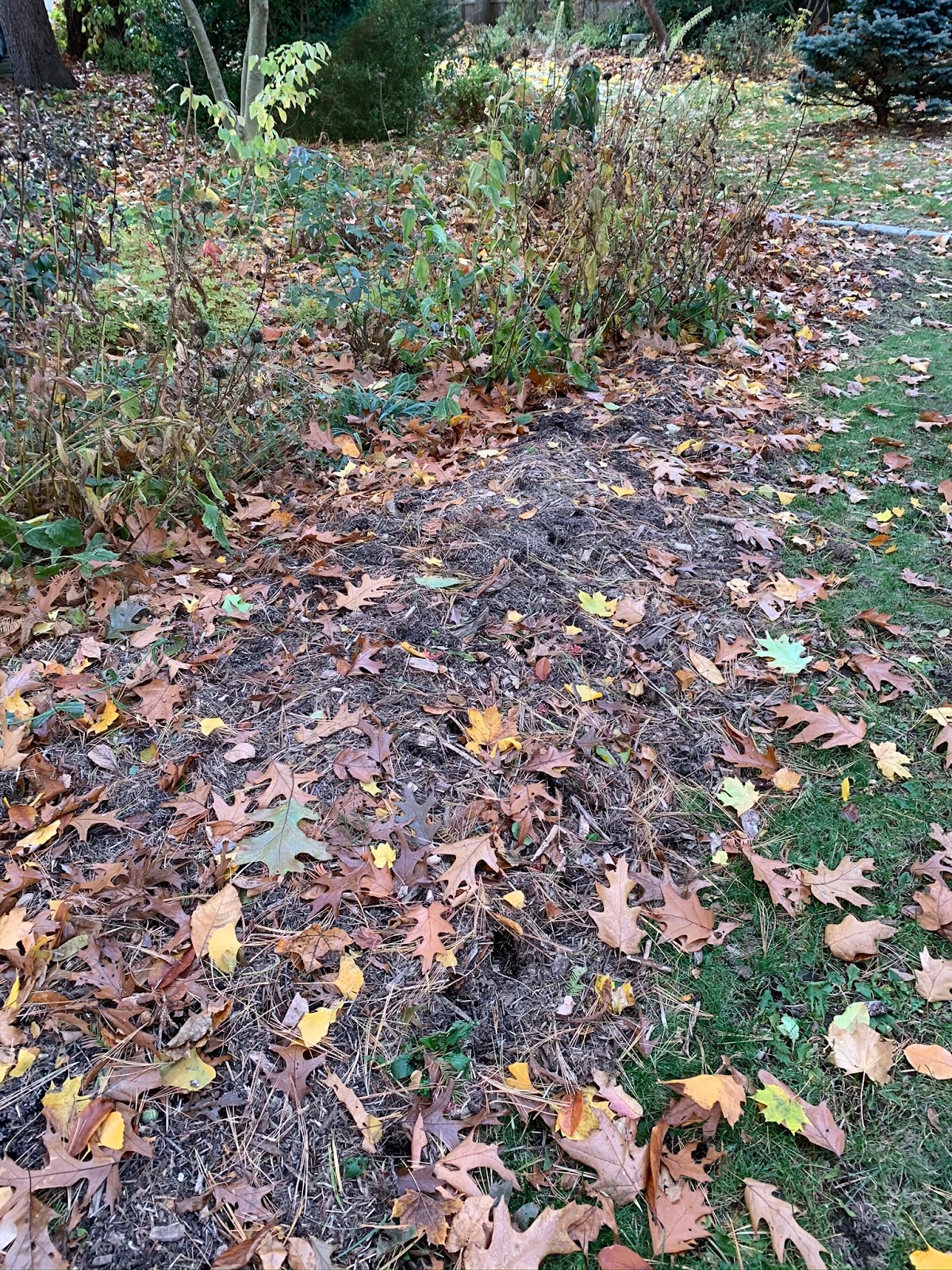
    The other activity for the next month will be relocating fallen leaves from the front of the house to the backyard. Before the snow, I’d fortunately shredded a few for the perennial bed off the deck. There I find finer mulch preferable as new young perennials emerge and gradually expand. 


     For the rest of the yard, I’ll be keeping the leaves whole. Lots is written these days about the advantages of this system. By letting the whole leaves lie undisturbed through the winter, we provide shelter for important native insects that hide there as adults, eggs, or pupae. Plus, it’s a lot less work than bagging or shredding those leaves.


Sunday, May 3, 2020

Thanks, decomposers

With the May Day spotlight on under-valued workers, I’m grateful for the work of decomposers in the garden. Last fall I lamented my depleted compost supply. Now I’m rejoicing to see lots of fresh compost in my bins. This strengthens my impression that compost is like sourdough starter, full of what’s needed to reproduce itself. Once you’ve got the process going, it gets easier and quicker over time.

Under a layer of fall leaves in the bin, I found new compost

    That’s despite my lazy woman’s composting approach. I just pile on the garden waste as it comes. I don’t turn the piles or bother balancing the amount of “brown” high carbon and “green” high nitrogen materials. Compost still happens.


Adding fall leaves to a bin I emptied last fall

    Composting is central to my garden. With a renewed supply of compost, I’m ready to add some oomph to the perennial beds by improving soil from above—no need to dig in that extra organic material, because soil organisms will incorporate it.


Things go better with compost

    I’ll also save some compost for making homemade potting mix. By mixing it with coir, or coconut fiber, I make peat-free potting mix that works just as well as the bagged stuff I used to use for container plants.


Peat-free potting mix: because harvesting peat contributes to climate change

    In 2011, I had my compost tested for biological activity by Soil Food Web, a lab in New York. I highly recommend this experience. The lab reported the populations of the types of organisms in my compost sample: bacteria, fungi, protozoa, and nematodes. They calculated the ratio of fungal to bacterial biomass and observed that the compost was mature, bacterial-dominated, and becoming more fungal. 


     I even got a note, “One of the better compost samples I’ve seen in a while. Keep up the good work.” The only caveat: “Need to work on nematode diversity a bit more.” To that end, they recommended inoculating the pile with forest duff, the mix of half-decomposed material that lies on the forest floor. You can bet I did that right away.

Beneficial nematodes thrive on the forest floor

    Looking out at the thick layer of fall leaves I left on the beds last fall, I recognize that the whole garden depends on the same work these small organisms do in the compost pile. It’s often said that without the work of detritivores--animals such as earthworms that take in, break up, and digest dead stuff—and decomposers--bacteria and fungi that absorb nutrients from dead materials--we’d be living on top of huge piles of dead animals and plants.


    I don’t just count on these small organisms in the compost bins. They’re also hard at work building soil and turning fallen leaves into leaf mold. The wood chips that I spread on paths and around trees and shrubs last a long time, but they too are broken down, predominantly by fungi that can digest lignin, the polymer that makes wood rigid and resists rot. Without those fungi, I’d have everlasting mulch, but it would do a lot less for the underlying soil.


Wood chips would be around forever without decomposing fungi

    Composting is just a half-domesticated way of speeding up what’s happening all around us, thanks to those unseen workers.


As soil organisms break down fall leaves, they make good soil for spring flowers

Sunday, November 10, 2019

Compost shortage

Once my composting operation settled into a routine, I could count on having two of my four bins produce a good supply of fully made compost every year. Every fall I spread a thick layer on the vegetable bed, where organic matter is used up fast by food-producing annual plants. 

Food compost from the closed bin will enrich the soil of the vegetable bed

When I planted new areas, I spread compost on the soil surface before starting to dig. When I learned that harvesting (really mining) peat contributes to global warming by releasing carbon, I started mixing finished compost from the bins with coir (coconut fiber) to make homemade peat-free potting mix.

     This year I haven't produced as much compost as I used to, and I'm going through it faster. Last year I gave away so many potting mix samples that I ran short of finished compost. 

Cute, right?

The reason for the samples was to interest garden club members I met in making their own peat-free mix. I thought if they tried mine, they'd see how easy it is to make a mix that looks, feels and functions a lot like commercial products based on peat. 

     Last year too I piled fewer fall leaves into the bins. I used to heap up leaves on the bins at the end of the gardening season, knowing the fluffy mounds would flatten during the winter, gradually decompose, and become part of the compost. But last year I went big on piling the whole leaves on beds to provide winter shelter for native insects.

Collecting leaves from the sidewalk to pile on garden beds

     Another call on my compost supply last year was the sheet composting project I started last March. The majority of the material for this composting-in-place soil improvement mound came from thick layers of wood chips and fall leaves. Thinner layers of compost were needed, though, to introduce soil organisms that would do the decomposing. I can see that they're doing their work. Already this fall the mound has sunk to about half its original height.


The sheet composting mound is sinking and starting to look like soil


     These extra demands on my compost economy have left the bins nearly exhausted this fall. Cutting down vegetable plants and emptying summer containers, I've started the process again in two of the four bins. According to the old system, though, the other two bins should be full of year-old developing compost. They're not.

The cupboard is bare


     In the past, I've just waited two years for the compost to be finished. Usually I make a point of adding garden waste to the compost as it comes, with no recipe. But I don't want to go through next summer with no finished compost. I may have to adjust my lazy-woman's composting method this year. 

     To get back on track, I can mix shredded leaves with the dead plants in the bins. 

Shredded leaves will decompose faster

Combining "brown" high carbon and "green" high nitrogen components will speed up the process. Desperate times call for desperate measures.

Sunday, November 3, 2019

New aesthetic needed

With October gone, the leaf blower season in my area is officially under way. Rain and heavy winds have brought down a lot of leaves, and many homeowners feel those leaves need to be disposed of post-haste. That means blowing or raking every last leaf into a pile and stuffing it into a leaf bag or vacuuming it into a truck to be transported to “away,” wherever that is.


Move 'em up and move 'em out

    Two years ago some local citizens rose up to protest the noise and health risks caused by leaf blowers. Some towns around the country have imposed meaningful limits, and some have even succeeded in passing outright leaf blower bans. But here, the team I was backing lost the fight, or at least the first round. We ended up with a complicated new noise ordinance that still allows leaf blowers seven days per week, with gas models permitted before Memorial Day and after Labor Day. 


After Labor Day, gas-powered leafblowers are free to roar in my neighborhood

I think this means the anti-leaf blower faction underestimated the determination of local landscape contractors to defend their business model. Leaf blower noise continues at a cost to the rest of us: loss of quiet enjoyment of our property. I hope we’ll eventually achieve an ordinance with more teeth.

    If I ran the zoo, we wouldn’t need leaf blowers because we wouldn’t clear fallen leaves from our yards. My town, like many, is stuck with a standard of landscape maintenance that dates to the aftermath of World War II. According to this aesthetic, fallen leaves are whisked out of sight as quickly as possible, and an ideal front yard consists of a swath of neatly mown lawn, as big as possible, backed by a few shrubs planted against the house’s foundation.


Neatness reigns

    As I’ve traveled farther along the path to a sustainable garden, I’ve gotten increasingly comfortable with seeing leaves on the ground. Fallen leaves on garden beds used to look like a mess to me. Now they’re a pleasing part of the view, just the way they’d be on a walk in the woods.


Fallen leaves enhance the beauty of the woods

    I’ve learned there are lots of good reasons to let those leaves lie on the ground. They add organic material to the soil as they slowly decompose, providing nutrients for plants and improving soil structure. They offer shelter for native insects, helping them survive the winter. They act as mulch, minimizing the number of weeds I’ll be coping with the next spring, insulating the soil so a sudden thaw or cold snap doesn’t kill my plants, and helping to hold moisture in the soil for roots to access.


Fallen leaves and pine needles benefit this shady bed

    Now I wonder why my neighbors bother to send away all that valuable organic material and then pay to replace it with mulch or soil amendments. If we send those leaves away, we’re actually depleting our own soil, because what our trees drew from the soil isn’t replenished by decomposing leaves.


Why send away organic material that should become part of your soil?

    But the truth is, I wouldn’t be letting those leaves lie if I hadn’t come to find them pretty. In garden design, neater isn’t always better.


Sunday, January 6, 2019

Green thoughts in a gray landscape

During a Christmas week visit to New York, I noticed some ways city dwellers bring greenery into their surroundings. People crave vegetation. There were shrubs toughing it out in pots in the front areaways of brownstones, big planters in front of skyscrapers, window boxes, even fake vegetation, such as this plastic sheet printed to make a Brooklyn chain link fence look like a wall of ivy, 

Nice try

and this blanket of artificial turf masking a utility area on Roosevelt Island.

Something must be really unsightly

    I sure miss greenery during the shortest days. House plants help. In addition to cleaning the air and converting the carbon dioxide we exhale into extra oxygen in the house, indoor plants have many demonstrated psychological benefits. They reportedly promote calm, attentiveness and creativity and increase productivity. I’d just say they make winter less depressing and bring life to sterile man-made environments. We weren’t made to live without plants.


Houseplants remind us of greenery to come

    There’s an often-mentioned theory that the reason we surround our houses with lawns is that early humans felt safer in grasslands where they could spot approaching predators before they pounced. This strikes me as possible but completely unproveable, as are many products of the school of thought that attributes the behavior and psychology of modern-day human beings to hunter-gatherer culture earlier in our evolution.


If only he'd had a lawn!-Reconstruction by Mauricio Anton

    Now that the sabre-toothed tigers are gone, we can skip a lot of that lawn and replace it with a more diverse landscape. Even video game designers have gotten past the ubiquitous veldt, endowing their imagined landscapes with lush, region-specific vegetation. That’s what I’m hoping for in my yard. In winter, I’m glad that I planted lots of evergreen shrubs and trees that offer splashes of color in the otherwise drab view from the back of the house. They also provide shelter for wildlife, confirmed as birds pop in and out of the branches.


At least there's something in the yard that's not brown or gray

    As I survey the scene from the back windows, I’m hoping that in addition to the conifers, the thick layer of fall leaves I piled on the beds this fall is also doing good for creatures in the yard. I picture insects burrowed into the leaf litter and sleeping in the flower stalks I left standing. The theory is that lots of beneficial insects will emerge in spring ready to start their work as predators keeping leaf-eating insect populations in balance.


Beneficial lacewing prepares for winter

    Last year in late winter we went south to New Orleans, Memphis and Nashville seeking an earlier spring. We did see some green leaves, 


New Orleans has ferns that don't grow in New England

but I learned what I was really yearning for was the day-by-day unfolding of spring at home. 

     One of the pleasures of tending the same garden space over the years is adding to your store of observations about how it changes through the seasons. I know that winter doesn’t mean an end to all natural processes, they’re just happening where I can’t see them. Roots are still storing nutrients, ready to send them up into new growth in spring. Until then, I’ll crave green things.

Come back soon!