My book and web site

Check out my book, The Sustainable-Enough Garden, available on Amazon, and the book's web site at www.thesustainable-enoughgarden.com. See more plant photos on Instagram.
Showing posts with label wood chip mulch. Show all posts

Sunday, May 9, 2021

Mulch reconsidered

 “Don’t mulch.” That was the surprising advice from native insect expert Heather Holm. What? That was a recommendation I’d never heard before. Heather’s webinar, “Attracting Bees and Beneficial Insects with Native Plants,” described the life cycles and needs of important native pollinators. Many build nests in the ground, she explained, and they need access to bare soil.

Tawny mining bee nest-photo Andrena Fulva 2d
 
    For years I’ve mulched my garden liberally. It started with an unsuccessful plan to use whole leaves to improve soil in the front yard. When they wouldn’t stay put, I invested in a leaf shredder that chopped the leaves into small pieces that didn’t blow around. Soon I was shredding all our fall leaves to spread on planting beds.

Shredded leaves make useful mulch
 
    I never had enough shredded leaves for everything I wanted to mulch, though, so I also brought in bark mulch from the garden center. In the last five years I’ve stopped using bark mulch and switched to arborist wood chips. 

     This idea came from Linda Chalker Scott, an author and urban horticulturist at the University of Washington who subjects conventional garden practices to objective scientific review. She compared different kinds of mulch head to head and found that the wood chips make superior mulch. They’re tops for holding water in the soil, modulating soil temperature, and suppressing weeds. They promote a health diverse population of soil organisms because they’re made up of a mix of different kinds of tree tissue.


Wood chip mulch is nice on paths and around trees and shrubs

    Wood chips fit in with my goal of reducing my garden’s carbon footprint by using locally sourced material. I get them from an arborist who works in the neighborhood.


    Now I’m re-examining my mulch approach because I want to help out native insects. What Heather advised against was bark mulch. She recommended shredded leaves, so I’m OK there. Apparently the insects don’t have a problem pushing their way through leaves to reach the soil, whereas a waxy crust of bark mulch foils them.


    Even better, Heather said, is a landscape where low-growing plants knit together on the garden floor. These plants perform the functions of mulch, and they can also provide food and shelter for native pollinators and beneficial insects (the carnivores that keep leaf-eaters in check).


Sweet woodruff has spread more than I'd like, but it does cover the garden floor


    Much of my garden is already provided with a groundcover layer. Two of the major players are sweet woodruff (Galium odoratum) and Canadian wild ginger (Asarum canadense). Between them they cover a lot of shady areas. There’s still not much growing under the shade of evergreens around the perimeter of the yard. This year I’m trying out native wild strawberry (Fragaria virginiana), which spreads by runners. I’m hoping it can survive and spread where other groundcovers haven’t. 


Wild strawberry, a native groundcover option

    Meanwhile, there are a lot more wood chips in the yard than ever before. They’ve taken the place of the lawn. Since we joined three adjoining yards to let our dogs play together, happy dogs racing around have worn away almost all the lawn grass. Instead of mud, we’re going with wood chips. I’m hoping the nesting insects will cope.


Lawn replaced with wood chips


Sunday, May 3, 2020

Thanks, decomposers

With the May Day spotlight on under-valued workers, I’m grateful for the work of decomposers in the garden. Last fall I lamented my depleted compost supply. Now I’m rejoicing to see lots of fresh compost in my bins. This strengthens my impression that compost is like sourdough starter, full of what’s needed to reproduce itself. Once you’ve got the process going, it gets easier and quicker over time.

Under a layer of fall leaves in the bin, I found new compost

    That’s despite my lazy woman’s composting approach. I just pile on the garden waste as it comes. I don’t turn the piles or bother balancing the amount of “brown” high carbon and “green” high nitrogen materials. Compost still happens.


Adding fall leaves to a bin I emptied last fall

    Composting is central to my garden. With a renewed supply of compost, I’m ready to add some oomph to the perennial beds by improving soil from above—no need to dig in that extra organic material, because soil organisms will incorporate it.


Things go better with compost

    I’ll also save some compost for making homemade potting mix. By mixing it with coir, or coconut fiber, I make peat-free potting mix that works just as well as the bagged stuff I used to use for container plants.


Peat-free potting mix: because harvesting peat contributes to climate change

    In 2011, I had my compost tested for biological activity by Soil Food Web, a lab in New York. I highly recommend this experience. The lab reported the populations of the types of organisms in my compost sample: bacteria, fungi, protozoa, and nematodes. They calculated the ratio of fungal to bacterial biomass and observed that the compost was mature, bacterial-dominated, and becoming more fungal. 


     I even got a note, “One of the better compost samples I’ve seen in a while. Keep up the good work.” The only caveat: “Need to work on nematode diversity a bit more.” To that end, they recommended inoculating the pile with forest duff, the mix of half-decomposed material that lies on the forest floor. You can bet I did that right away.

Beneficial nematodes thrive on the forest floor

    Looking out at the thick layer of fall leaves I left on the beds last fall, I recognize that the whole garden depends on the same work these small organisms do in the compost pile. It’s often said that without the work of detritivores--animals such as earthworms that take in, break up, and digest dead stuff—and decomposers--bacteria and fungi that absorb nutrients from dead materials--we’d be living on top of huge piles of dead animals and plants.


    I don’t just count on these small organisms in the compost bins. They’re also hard at work building soil and turning fallen leaves into leaf mold. The wood chips that I spread on paths and around trees and shrubs last a long time, but they too are broken down, predominantly by fungi that can digest lignin, the polymer that makes wood rigid and resists rot. Without those fungi, I’d have everlasting mulch, but it would do a lot less for the underlying soil.


Wood chips would be around forever without decomposing fungi

    Composting is just a half-domesticated way of speeding up what’s happening all around us, thanks to those unseen workers.


As soil organisms break down fall leaves, they make good soil for spring flowers

Sunday, March 1, 2020

Locally sourced and great

There’s a new pile of wood chips in the driveway. After a heavy wind brought down some big pine branches in the yard, arborist Kevin Newman recommended thinning the crown of our tallest pine. His team left me the resulting chips. 

I'm gradually transferring wood chips from the driveway to the garden

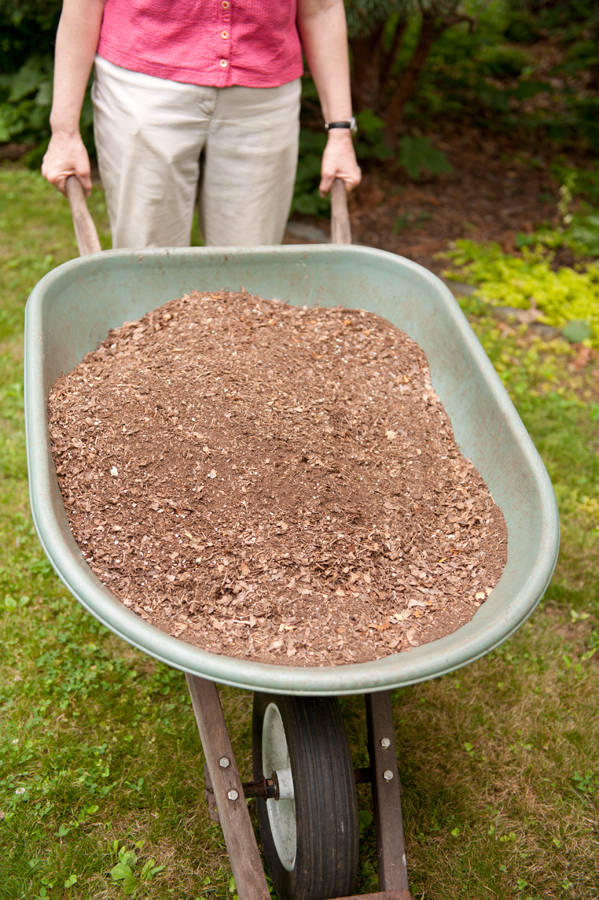
    Now is a great time for spreading wood chip mulch. On warmer days, I’d like to be outside doing something in the garden, but nothing’s growing. That’s when I load up the wheelbarrow with wood chips and trundle around the yard to dump them where they’re needed.


    After working with this mulch for eight years, I’m a huge fan. It’s a sustainable choice, because the chips originate in my own yard or nearby where Kevin’s men are pruning or taking down trees. The chips are easy to work with, much less dense than bark mulch. 


A wheelbarrow full of wood chips isn't too heavy to maneuver

Unlike bark, they don’t contain wax, so they don’t block water from soaking into the soil. The first time I dug into the soil under the wood chip mulch, I was amazed. It’s dark, moist and rich—just what a gardener hopes for.

    This year I’m spreading wood chips around trees and shrubs, and I plan to add some to the garden paths, where they break down fastest because of heavy foot traffic. If I do more sheet composting, they’ll be a key ingredient.


Sheet composting March 2019: wood chips on top of composted cow manure

    My source of mulch information is Linda Chalker Scott, a horticulturist and mulch scholar at Washington State University. She corrects conventional wisdom with scientific fact. For example, people worry that wood chips will acidify soil. Research shows they don’t. I’m increasingly aware that soil is not an inert substance. It’s full of biological and chemical activity, including an effective buffering system. You can’t change the pH of soil without adding chemicals such as lime to make it more alkaline or sulfur to make it more acid.


    There’s a gardening legend that high carbon mulch such as wood chips depletes nitrogen in the soil. Linda studied this and found no evidence for it. She hypothesizes that there’s a narrow band of relative nitrogen deficiency at the interface between the soil and the wood chip mulch. This is actually a plus, because it suppresses weeds. You can use this mulch anywhere in the garden except where you’re going to plant seeds or young annuals that don’t have an established root system. Like young weeds, they’d suffer in this nitrogen-poor zone.


Wood chip mulch will suppress weeds around this tree

    Can chips from diseased trees infect your yard? This is a concern I often hear from garden club members. It turns out not, because the disease organisms in mulch can’t reach plant roots. I often see impressive networks of white fungal hyphae among the chips, either in the pile or after they’ve been on the ground for a while. Linda Chalker Scott explains that these fungi are decomposers, not pathogens. With their help, wood chips decompose slowly, gradually releasing nutrients our plants’ roots can use. I’m grateful to have this free material for pampering my plants and soil.


Sunday, March 25, 2018

So melt, already!


Thank goodness the latest nor’easter missed Massachusetts. There’s still snow on the ground, though. I’m itching to get outside and start spring gardening, but this snow is holding me up.

Snow still hanging around earlier this week

    Kevin Newman and his arborist team came by Wednesday to prune broken branches out of a white pine near the house. They’re working flat out after three storms this month that have brought down trees and countless limbs. Luckily they managed to squeeze in my small job at the end of the day. They ran the pine branches through the chipper and left a big pile of wood chips in the driveway, as I’d requested. 


Wood chips!

This should be just the right time for spreading those chips on paths and around trees and shrubs as mulch. But I can’t do it until the snow melts and the ground dries out a bit. I don’t want to compact the wet soil by tramping over it with a wheelbarrow.

    It’s also the right time to prune shrubs before the leaves show. 


Without leaves you can see what you're pruning

I did some pruning during a warm spell in February and filled up the garage with yard waste bags. I have new tools I’m dying to try, ratchet pruners and loppers. My wrist fracture has healed, but my grip strength hasn’t returned yet. These tools should allow me to make pruning cuts with less effort, if only I can get out there and try them. 

Adaptive pruning tools require less strength

    It’s traditional to plant peas around St. Patrick’s Day. I’d like to get the seeds into the ground by early April. They enjoy cool weather, as do lettuce and arugula. I want to sow a first row of greens soon. Let’s hope the snow on the vegetable bed melts within a couple of weeks.


    Last fall I optimistically planted a lot of spring-blooming bulbs in one large pot. I’d read you could set several levels of bulbs in the same container. There’s a layer of tulip bulbs at the bottom, with daffodils in the next layer and grape hyacinths above them. The pot has been in the cool basement, covered with wire screening to keep out hungry mice with a taste for tulip bulbs. Now hopeful sprouts are pushing at the screen. 


Potted bulbs need to get outside

I should be moving the pot outdoors, but I’m afraid the weather is too cold. I may have to move it inside and out as the temperature fluctuates. To bloom well, the plants should be outdoors.

    And what about all the seedlings that are sprouting under lights? Eventually I’ll need to move them too outside to get them used to sunlight. Will spring have arrived by then?


Borage and basil will need to move outside

    Outdoors the stalwart snowdrops and witch hazel flowers keep blooming. They have proteins in their cells that act as antifreeze. When the snow melts, the still-fresh flowers emerge unharmed. I wish snow had as little effect on me. 

Snowdrops unfazed by a foot of snow last week
 

Sunday, June 4, 2017

Closing the loop

One of the principles of sustainable gardening is cycling of materials. This avoids the energy costs and environmental impacts that come with industrial production. Fully realized, this principle means aiming for a closed loop. In this vision of an ideal garden, no outside inputs would be needed. All energy, nutrients and materials would be generated and grown on-site.

Peonies thrive with leaf mulch and compost for topdressing


    This year I’m noticing that my garden has moved a short way along the spectrum toward that ideal. We’re far from sustaining ourselves through a permaculture system that imitates a natural ecosystem. But more and more I’m improving soil, mulching, and even filling seasonal planters with materials from my own yard.


Allium 'Purple Sensation' sends up more flowers each spring in good soil


    I’m relying more on compost to improve soil. Before I wrote my book, I thought organic gardeners were being unnecessarily pure by avoiding chemical fertilizer. After all, the nitrogen, phosphorus, and potassium are the same however they’re packaged, I thought. But I learned that manufacturing chemical fertilizer has a high environmental cost. I was also surprised to learn that it’s almost impossible to apply little enough of the synthetic stuff. By using it I was undoubtedly harming soil organisms with an over-abundance of nitrogen and adding to the phosphorus leaching into the local water table.


    Compost is free and good for the soil, it happens in two years whether I do any work on the piles of garden waste or not, and it does yield happy, healthy plants. My problem now is to generate enough compost for all the places I’d like to use it.


You can't have too much compost

    For mulch, over the past few years I’ve added arborist wood chips to my previous use of shredded or whole leaves. By using wood chips, I don’t have to buy bark mulch, which carries an energy cost for transportation. The leaves come from my lot or my neighbors’, so they can’t get any more local. The wood chips are the byproduct of tree work on local trees. Both make beautiful mulch. I like to use the leaves on perennial and vegetable beds. The wood chips are great for paths and for mulching around trees and shrubs.


Wood chips are great for paths and around shrubs

    This year many of my container plants are local too. I’ve just finished filling large pots for accents in the landscape. I combined tender perennials that winter in the basement with dispensable perennials I dug up around the garden. I like some large leaves, unusual leaf colors, and variegations to liven up the mostly medium-sized, medium green foliage. Time will tell whether these pots are interesting enough without the annual flowers I included in previous years. I left those out this year to avoid neonics.


Elephant ears with hellebores and a Japanese painted fern dug from the garden

     I’m not a purist. I don’t subscribe to “eating squirrel and crafting our own doorknobs,” in the words of Senator Elizabeth Warren. Just as she’s open to the right kind of international trade, I’m open to store-bought groceries and pesticide-free plants from the garden center. But as much as possible, in the garden I aspire to close the loop.
Onward and upward!

Sunday, November 27, 2016

Fungus among us

Thank goodness some rain fell this fall, although we’re still in a drought. Apparently mushrooms were biding their time, waiting for a bit of moisture before making their move. Once it rained, they popped up around the yard.


    These mushrooms are the fruiting structures of a group of fungi called basidiomycetes. The mushrooms are small parts of these organisms, which include extensive underground networks of hyphae, slender filaments that take up water and carbohydrates. A single individual fungus can send up fruiting bodies over an area as big as a baseball diamond.


    Invisible to me, even after welcome rain, are two huge groups, the saprophytic and mycorrhizal fungi. Saprophytic fungi are decomposers, breaking down dead organic material, including wood, into nutrients plants can use. 


Mycorrhizal fungi join in a symbiotic relationship with plant roots. Thinner and more extensive than root hairs, their hyphae seek out water and nutrients from far and wide. They share these with plants in return for simple sugars.

Fungal hyphae

    Some mycorrhizal fungi excrete a sticky polysaccharide called glomalin that glues soil particles together in small clumps called macroaggregates. These clumps improve growing conditions for roots by creating pore spaces in the soil for water and air. As if that weren’t enough, fungi in the soil also sequester carbon, attack plant pathogens, and cultivate helpful bacteria.


    Luckily the best way to foster these useful partners is to stay out of their way. If I tilled my soil with a rototiller, I’d be breaking up their networks. If I sprinkled chemical fertilizer, I’d turn off their nutrient-collecting efforts. Fortunately there’s no call to do either in my garden. If I need to plant something, I get along fine by digging an appropriately-sized hole. Compost and mulch are providing enough nutrition for my plants.


Offering a home for soil fungi

    It turns out that by mulching with fall leaves and wood chips, I was unknowingly creating a happy environment for soil fungi. I learned about this when I researched the reasons for balancing types of ingredients in the compost pile. Before this I’d thought compost recipes were unnecessarily fussy.


    Compost professionals can titrate ingredients and conditions in their compost piles to determine the proportion of bacteria and fungi in the finished product. By managing the balance of “brown” high-carbon and “green” high-nitrogen compost ingredients, they can cause bacteria or fungi to predominate. Bacteria thrive on simple sugars from green plant material, and fungi prefer high-carbon woody material. 


    Compost high in fungi is best for use around trees, shrubs and perennials, whereas annuals and vegetables prefer more bacteria in the mix. This is because of what soil organisms do with nitrogen from the air. Fungi convert atmospheric nitrogen to ammonium that long-lived plants prefer, whereas bacteria make nitrate that fast-growing short-lived plants particularly need.


    Making compost by recipe probably isn’t in my future, but it’s nice to know that my high-carbon mulches are friendly to soil fungi.