My book and web site

Check out my book, The Sustainable-Enough Garden, available on Amazon, and the book's web site at www.thesustainable-enoughgarden.com. See more plant photos on Instagram.
Showing posts with label permaculture. Show all posts

Monday, May 28, 2018

A shared garden


Permaculture is a philosophy that inspires me, although I don’t anticipate fully realizing its ideals in my garden. It envisions a lightly managed landscape that provides for all living things, including humans.

Permaculture gardens combine many kinds of plants in a productive whole
 
     Reading Toby Hemenway’s book Gaia’s Garden, my introduction to this approach, I wondered about his suggestion that a home gardener grow multiple fruit trees as members in “guilds,” communities of plants that work together. What if I really had productive apple, pear, peach and cherry trees in my yard? I imagined I’d have far more fruit than my family could possibly eat. Composting fruit we couldn’t eat or letting it rot on the ground didn’t sound desirable or sustainable. 

Why grow more apples than you and passing raccoons can use?

    In a chapter on urban permaculture, Hemenway proposed viewing a whole neighborhood as a permaculture garden. I could grow an apple tree, another neighbor a pear, and we could share the fruit. That sounded more neighborly and much more practical. 


    When I’m walking around town coveting the flowering trees and shrubs growing in other yards, I’m reminded of Hemenway’s idea. We share the spring landscape. We all get to enjoy trees covered with sublime blooms. They’re a community asset, even if each tree grows in someone’s front yard.


Someone else's azaleas

    I don’t own a flowering dogwood (Cornus florida), which is one of my favorite native trees. I didn’t plant one when I started my garden because I thought they were all going to succumb to anthracnose, a fungal disease on the rise at the time. As we know, that didn’t happen. I can’t see where I’d shoehorn this understory tree into my landscape at this point. That’s OK, though, because so many beautiful white- and pink-blooming dogwoods grow in my neighborhood. 


Dogwoods are blooming in my neighborhood now


    I also don’t need to own pink lady’s slippers (Cypripedium acaule). These shy native orchids bloom at this time of year on woodsy hillsides with high shade from conifers. 


I came upon these lady's slippers during a walk in the woods

You can buy ethically grown specimens propagated in nurseries from seed (not plants collected from the wild, which is illegal on federal lands and undesirable anywhere else). But why take the risk? I don’t want to bring home a precious plant and kill it with the wrong growing conditions. Better to enjoy it where it grows naturally in local conservation areas.

    Oriental poppies (Papaver orientale) are among the beautiful perennials that are never going to grow in my yard. 


Oriental poppies don't work in my garden

I tried a few, but I just couldn’t offer them the right site. There was nowhere sunny enough in my yard. The one or two flowers they produced leaned hard toward the western light coming over the back fence, hiding their faces from our view. But I know of a front yard a few blocks away where a talented gardener displays a luscious swath of these flowers every June. All I have to do is stroll by this neighborhood asset.

    I remind myself that I don’t have to own one of every plant I admire. I can enjoy them in the larger garden that we share.


More irises than will ever bloom for me, in a neighbor's yard
 

Sunday, June 4, 2017

Closing the loop

One of the principles of sustainable gardening is cycling of materials. This avoids the energy costs and environmental impacts that come with industrial production. Fully realized, this principle means aiming for a closed loop. In this vision of an ideal garden, no outside inputs would be needed. All energy, nutrients and materials would be generated and grown on-site.

Peonies thrive with leaf mulch and compost for topdressing


    This year I’m noticing that my garden has moved a short way along the spectrum toward that ideal. We’re far from sustaining ourselves through a permaculture system that imitates a natural ecosystem. But more and more I’m improving soil, mulching, and even filling seasonal planters with materials from my own yard.


Allium 'Purple Sensation' sends up more flowers each spring in good soil


    I’m relying more on compost to improve soil. Before I wrote my book, I thought organic gardeners were being unnecessarily pure by avoiding chemical fertilizer. After all, the nitrogen, phosphorus, and potassium are the same however they’re packaged, I thought. But I learned that manufacturing chemical fertilizer has a high environmental cost. I was also surprised to learn that it’s almost impossible to apply little enough of the synthetic stuff. By using it I was undoubtedly harming soil organisms with an over-abundance of nitrogen and adding to the phosphorus leaching into the local water table.


    Compost is free and good for the soil, it happens in two years whether I do any work on the piles of garden waste or not, and it does yield happy, healthy plants. My problem now is to generate enough compost for all the places I’d like to use it.


You can't have too much compost

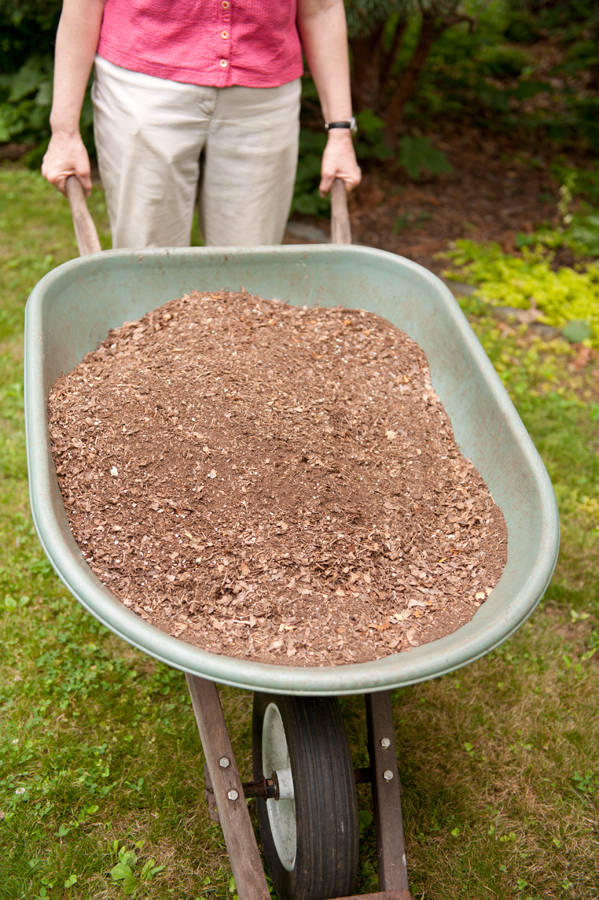
    For mulch, over the past few years I’ve added arborist wood chips to my previous use of shredded or whole leaves. By using wood chips, I don’t have to buy bark mulch, which carries an energy cost for transportation. The leaves come from my lot or my neighbors’, so they can’t get any more local. The wood chips are the byproduct of tree work on local trees. Both make beautiful mulch. I like to use the leaves on perennial and vegetable beds. The wood chips are great for paths and for mulching around trees and shrubs.


Wood chips are great for paths and around shrubs

    This year many of my container plants are local too. I’ve just finished filling large pots for accents in the landscape. I combined tender perennials that winter in the basement with dispensable perennials I dug up around the garden. I like some large leaves, unusual leaf colors, and variegations to liven up the mostly medium-sized, medium green foliage. Time will tell whether these pots are interesting enough without the annual flowers I included in previous years. I left those out this year to avoid neonics.


Elephant ears with hellebores and a Japanese painted fern dug from the garden

     I’m not a purist. I don’t subscribe to “eating squirrel and crafting our own doorknobs,” in the words of Senator Elizabeth Warren. Just as she’s open to the right kind of international trade, I’m open to store-bought groceries and pesticide-free plants from the garden center. But as much as possible, in the garden I aspire to close the loop.
Onward and upward!