My book and web site

Check out my book, The Sustainable-Enough Garden, available on Amazon, and the book's web site at www.thesustainable-enoughgarden.com. See more plant photos on Instagram.
Showing posts with label mulch. Show all posts

Sunday, March 1, 2020

Locally sourced and great

There’s a new pile of wood chips in the driveway. After a heavy wind brought down some big pine branches in the yard, arborist Kevin Newman recommended thinning the crown of our tallest pine. His team left me the resulting chips. 

I'm gradually transferring wood chips from the driveway to the garden

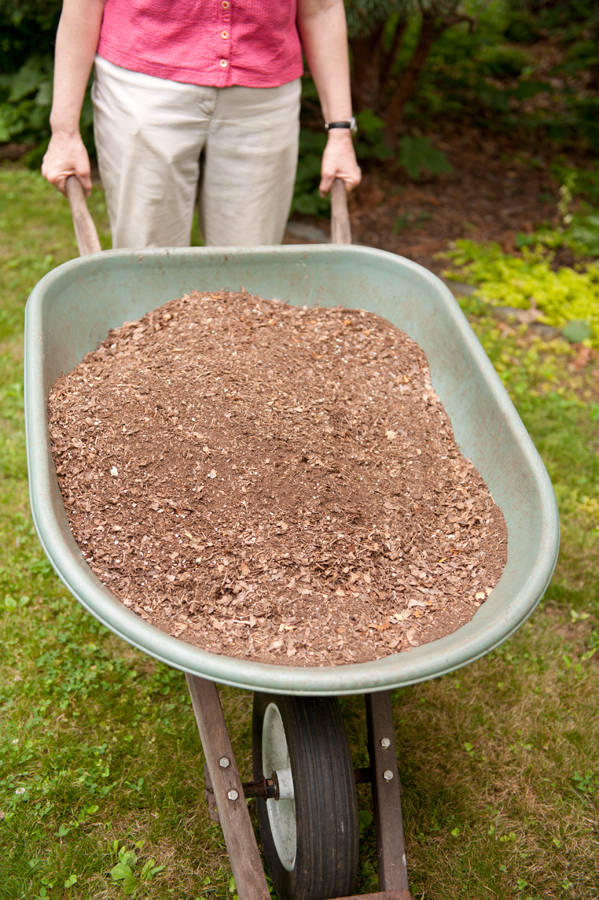
    Now is a great time for spreading wood chip mulch. On warmer days, I’d like to be outside doing something in the garden, but nothing’s growing. That’s when I load up the wheelbarrow with wood chips and trundle around the yard to dump them where they’re needed.


    After working with this mulch for eight years, I’m a huge fan. It’s a sustainable choice, because the chips originate in my own yard or nearby where Kevin’s men are pruning or taking down trees. The chips are easy to work with, much less dense than bark mulch. 


A wheelbarrow full of wood chips isn't too heavy to maneuver

Unlike bark, they don’t contain wax, so they don’t block water from soaking into the soil. The first time I dug into the soil under the wood chip mulch, I was amazed. It’s dark, moist and rich—just what a gardener hopes for.

    This year I’m spreading wood chips around trees and shrubs, and I plan to add some to the garden paths, where they break down fastest because of heavy foot traffic. If I do more sheet composting, they’ll be a key ingredient.


Sheet composting March 2019: wood chips on top of composted cow manure

    My source of mulch information is Linda Chalker Scott, a horticulturist and mulch scholar at Washington State University. She corrects conventional wisdom with scientific fact. For example, people worry that wood chips will acidify soil. Research shows they don’t. I’m increasingly aware that soil is not an inert substance. It’s full of biological and chemical activity, including an effective buffering system. You can’t change the pH of soil without adding chemicals such as lime to make it more alkaline or sulfur to make it more acid.


    There’s a gardening legend that high carbon mulch such as wood chips depletes nitrogen in the soil. Linda studied this and found no evidence for it. She hypothesizes that there’s a narrow band of relative nitrogen deficiency at the interface between the soil and the wood chip mulch. This is actually a plus, because it suppresses weeds. You can use this mulch anywhere in the garden except where you’re going to plant seeds or young annuals that don’t have an established root system. Like young weeds, they’d suffer in this nitrogen-poor zone.


Wood chip mulch will suppress weeds around this tree

    Can chips from diseased trees infect your yard? This is a concern I often hear from garden club members. It turns out not, because the disease organisms in mulch can’t reach plant roots. I often see impressive networks of white fungal hyphae among the chips, either in the pile or after they’ve been on the ground for a while. Linda Chalker Scott explains that these fungi are decomposers, not pathogens. With their help, wood chips decompose slowly, gradually releasing nutrients our plants’ roots can use. I’m grateful to have this free material for pampering my plants and soil.


Sunday, June 2, 2019

Peace in our time

I'll be presenting a free Green Newton lecture on Beautiful Sustainable Gardens at the Newton Free Library next Monday June 10 at 7:00 p.m. See you there!

A delightful group of gardeners came to my house this past weekend for the second of two classes on sustainable gardening sponsored by Newton Community Education. One thing on our minds was the difficulty of protecting plants from wildlife, particularly squirrels.

Spring is a lean time for squirrels

    I’m certainly coping with that challenge this spring. The wet weather has been great for the garden. Every plant seems to be expanding, and cool days keep flowers looking fresh. 

Meadow rue with a background of slender deutzia

Squirrels are busy finding food in the yard. I enjoy watching them—and I’ve got a couple of new strategies for protecting my young seedlings from their depredations.

    I need effective barriers. I was puzzled by an Amazon customer review claiming that 2-foot tall modular fence panels keep squirrels out of her vegetable bed. Either squirrels in Chicago are much less agile than they are here, or hers are very easily spooked.


    Squirrels have a habit of digging where I’ve sown seeds or planted starts from the garden center. In the past, I’ve covered planting areas with wire fencing.


Wire fencing might keep squirrels from digging

Row cover fabric pinned on top lets light and water through and should keep squirrels out. The problem with this method is that I can’t see what’s happening underneath the row cover. 

Row cover: I can't see what's underneath
Sometimes I’ve lifted the fabric a few weeks later and found that insects or larger animals have gotten underneath without my knowing it. I’ve been watering absent or dead seedlings.

    A new tip comes from Ellen Sampson, a reader of Fine Gardening who reuses black plastic carryout flats from nurseries, inverting them over her seed rows or tiny seedlings and pinning them down. I’m trying this for lettuce seedlings I started in the house and transplanted to the garden. Another flat over two young basil seedlings should allow them to root themselves securely enough to survive squirrel excavations in nearby soil. The seedling are partially shaded by the grid that makes up the bottom of each flat. That could actually be a benefit in the first week or so while they’re adjusting to the shock of transplantation.


Basil seedlings under a flat

    For my containers, I gamble on mulch, which seems to be less interesting to curious squirrels than soft, uncovered potting mix or soil. 

Will mulch deter digging?

A native meadowsweet (Spiraea alba) I bought came with a disc of fiber matting covering the soil surface. I repurposed that to protect a tomato seedling I have high hopes for in a pot on the deck. The fiber barrier supplements window screening cut to size to guard the soil surface. 

Trying everything to coddle a young tomato vine

If the matting keeps squirrels out, I could open up fiber pots that contained herbs and vegetable seedlings to keep squirrels from excavating some other young plants in containers. 

Fiber pots could make a useful barrier


    Last week I watched a squirrel climb over the pots on the deck, investigating each one before jumping down. He didn’t do any digging. It’s small compromises like this that make our relationship work. Squirrels can have the acorns and spruce cones. I hope they’ll leave the tomatoes for us. 


No need to dig for food, plenty of cones available

Sunday, November 26, 2017

Holiday choices

With Thanksgiving passed, we’ve entered the period for buying Christmas trees. Already an outdoor stand near us has stacks of trees ready to sell, and I’m seeing station wagons cruising by with trees strapped to their roofs.


Ready to go

    In my present state of constant background worry about climate change, my reflex is to think that cutting down trees is a bad thing. But what’s the total environmental impact of Christmas trees? Predictably, tree farmers say that real trees are more environmentally friendly, while makers of artificial trees argue that man-made trees can be just as sustainable.


    Proponents of natural trees point out that used Christmas trees can be recycled to make mulch. Like many cities, ours picks up trees at curbside after the holiday for this purpose. Tree farms provide wildlife habitat, if pesticide spraying doesn’t poison animals trying to move in. Whole trees can be laid down to prevent erosion, and if all else fails, used trees can be fed to goats!

 
Christmas trees stabilize a Connecticut beach

    The trees themselves are carbon neutral over their lifetime. When harvested, they give up the same amount of carbon that they took in. There’s carbon cost for powering machines used in farming—did you know that Christmas trees have to be sheared annually to create dense, uniform foliage? 


Christmas tree farm

Shipping harvested trees to the point of sale also uses fossil fuel, so it’s good to buy local. In all, production of a live tree that makes its way to your home generates an estimated 6.8 pounds of greenhouse gases per year of the tree’s life.

    By comparison, cars and trucks account for an average of 24 pounds of greenhouse gases per gallon of gasoline.


Christmas trees are paltry polluters compared to cars

    A 2008 study from a group of sustainable development consultants in Quebec found that artificial trees have lower environmental impact only if they’re used for at least 20 years. 


Buying an artificial tree could be the start of a long-term relationship

An alarming wrinkle: many of the artificial trees currently in use are made of recycled plastic, usually polyvinyl chloride, that has been stabilized with metal. What metal did Chinese makers add? You guessed it: lead. The plastic degrades as it ages, and at nine years, it starts to give off lead. Use of lead in plastic Christmas trees has recently been outlawed in China.

    I’m not in the market for a Christmas tree, but if I were, I’d be tempted to buy a living tree in a pot and grow it in my yard once it had played its part in the holiday celebration. 


A petite balsam fir (Abies balsamea)

Clemson Cooperative Extension in South Carolina describes the pitfalls of this approach. Trees that spend more than 10 days in the hot, dry indoor environment aren’t likely to survive being planted outdoors. Planting sooner is better, but that’s assuming that the ground isn’t frozen after Christmas. As an alternative, Clemson suggests planting a tree in your yard and decorating it there.

    As always with personal environmental decisions, assigning weights to these factors is complicated. My conclusion: enjoy your Christmas tree, park the car, and try to walk more.

Sunday, November 19, 2017

Mulch falling from the trees

My new perennial bed near the back of the house is covered with needles from a big white pine (Pinus strobus) nearby. 

Pine needles on the new bed in October

When the area was lawn, I didn’t notice how many needles fell from the tree, perhaps because our focus was on raking them off the grass.

    Now I realize that those pine needles are providing natural mulch without my intervention. Is that a good thing? A couple of persistent urban legends warn against pine needle mulch.


    In the South, you can buy compressed bales of pine needles, commonly called pine straw, in various shapes and sizes at the garden center. 


Bales of pine straw at Space Coast Landscape Supply in Florida

Proponents point out that this mulch is pretty, it’s slow to decompose because of the needles’ waxy coating, it doesn’t blow around or pack down to create a water barrier, and it’s less dense than bark mulch. A 40-pound bale of pine straw covers as much ground as 30 cubic feet of other much heavier mulches. By contrast, big bags of bark mulch that I purchased recently contain 3 cubic feet each. I can barely lift them, and a bag covers a dishearteningly small area.

Bark mulch, heavy as all get out

    Tossing pine needles around has got to be easier than schlepping those bags of bark mulch. Having the tree and the wind spread pine needles is even less work. (My recent mulch favorite, arborist wood chips, also has the advantage of being less dense than bark).


Arborist wood chips make great mulch too

    It’s often suggested that pine needle mulch will acidify soil. The argument is that since the needles have a lower pH than average soil, adding them to soil must make it more acidic. Many gardeners hesitate to mulch with oak leaves for the same reason. But science doesn’t substantiate this.


    Soil has tremendous buffering capacity. As Robert Pavlis points out in this blog post, rain becomes acidic as it falls, picking up carbon dioxide from the air and converting it to carbonic acid. This is true even without the pollution that causes acid rain. If rain hasn’t changed soil pH over millennia, you’re not going to do it with a few pine needles or oak leaves.


Pine needles can't overpower soil's buffering capacity

    Second, pine needles contain a group of organic compounds called terpenes that people worry may suppress growth in the garden. Terpenes act as insecticides, preventing insects from eating the needles. They may also help suppress growth of other plants under the tree. But once the needles fall from the tree and hit the ground, the volatile terpenes quickly float into air or water—that’s why the needles stop giving off that pleasing pine scent. Plants can and do grow under our white pine.


Shade lovers growing at the base of the white pine


    Recent research suggests terpenes help trigger rainfall by combining with free radicals and oxygen in the atmosphere, forming aerosols of polarized molecules that collect water and grow into clouds. Trees aren’t as passive as we used to think!


Conifers don't just wait for rain

    I’ll soon be able to assess whether pine needles are improving soil, suppressing weeds, and helping to retain moisture in my new bed. I’m optimistic.

Sunday, June 4, 2017

Closing the loop

One of the principles of sustainable gardening is cycling of materials. This avoids the energy costs and environmental impacts that come with industrial production. Fully realized, this principle means aiming for a closed loop. In this vision of an ideal garden, no outside inputs would be needed. All energy, nutrients and materials would be generated and grown on-site.

Peonies thrive with leaf mulch and compost for topdressing


    This year I’m noticing that my garden has moved a short way along the spectrum toward that ideal. We’re far from sustaining ourselves through a permaculture system that imitates a natural ecosystem. But more and more I’m improving soil, mulching, and even filling seasonal planters with materials from my own yard.


Allium 'Purple Sensation' sends up more flowers each spring in good soil


    I’m relying more on compost to improve soil. Before I wrote my book, I thought organic gardeners were being unnecessarily pure by avoiding chemical fertilizer. After all, the nitrogen, phosphorus, and potassium are the same however they’re packaged, I thought. But I learned that manufacturing chemical fertilizer has a high environmental cost. I was also surprised to learn that it’s almost impossible to apply little enough of the synthetic stuff. By using it I was undoubtedly harming soil organisms with an over-abundance of nitrogen and adding to the phosphorus leaching into the local water table.


    Compost is free and good for the soil, it happens in two years whether I do any work on the piles of garden waste or not, and it does yield happy, healthy plants. My problem now is to generate enough compost for all the places I’d like to use it.


You can't have too much compost

    For mulch, over the past few years I’ve added arborist wood chips to my previous use of shredded or whole leaves. By using wood chips, I don’t have to buy bark mulch, which carries an energy cost for transportation. The leaves come from my lot or my neighbors’, so they can’t get any more local. The wood chips are the byproduct of tree work on local trees. Both make beautiful mulch. I like to use the leaves on perennial and vegetable beds. The wood chips are great for paths and for mulching around trees and shrubs.


Wood chips are great for paths and around shrubs

    This year many of my container plants are local too. I’ve just finished filling large pots for accents in the landscape. I combined tender perennials that winter in the basement with dispensable perennials I dug up around the garden. I like some large leaves, unusual leaf colors, and variegations to liven up the mostly medium-sized, medium green foliage. Time will tell whether these pots are interesting enough without the annual flowers I included in previous years. I left those out this year to avoid neonics.


Elephant ears with hellebores and a Japanese painted fern dug from the garden

     I’m not a purist. I don’t subscribe to “eating squirrel and crafting our own doorknobs,” in the words of Senator Elizabeth Warren. Just as she’s open to the right kind of international trade, I’m open to store-bought groceries and pesticide-free plants from the garden center. But as much as possible, in the garden I aspire to close the loop.
Onward and upward!

Sunday, February 5, 2017

Doing something about the weather

I thought snowdrops blooming this week were the earliest I’d recorded, but looking back I see I spotted some on January 31 in 2012, another winter with very little snow.

Snowdrops are blooming early

In recent years, I’ve noticed spring growth starting earlier. Scientific data confirms this trend is affecting wild plant populations. Our climate is changing, and gardeners are on the front lines.
 
Witch hazel buds are already opening

     I’m finding the lack of snow cover ominous this year. Is this the new normal? Last year demonstrated the kind of damage that our plants suffer when they experience blasts of cold weather without the insulating protection of snow.


    The New York Times recently reported that farmers in Kansas are talking about changes in the weather, although many still don’t blame human actions for causing global warming. One farmer they spotlighted also spoke about sequestering carbon in the soil. On a much smaller scale, that’s something we can do too in our backyards. 


     Brooklyn Botanic Garden offers The Climate Conscious Gardener, a handbook of useful approaches for minimizing the carbon footprint of your garden and sequestering carbon in your soil and plants. 

    With Congress and the Trump administration rolling back restrictions on methane leaking from oil and natural gas rigs and wells, it’s even more important for us to seize the opportunity to be good climate stewards. 


     Methane is a greenhouse gas 21 times more potent than carbon dioxide. Federal regulations restricting its release were intended to fight climate change. Now with climate change deniers having their way, oil drillers and frackers hope to be spared the trouble and expense of preventing methane release. The planet and everyone on it will pay the price.
 
Gas flare from North Sea oil drilling--photo by Varodrig

    Some of the steps the BBG handbook recommends:


Planting trees. We’ve all heard about this as a way to keep carbon out of the atmosphere. Long-lived trees are best.

 
The dense wood of this tall white pine sequesters lots of carbon

Siting trees and shrubs to provide windbreaks and shade. This will reduce your house’s energy needs for heating and cooling—and save you money. 


Minimizing digging or, even better, switching to no-till gardening. When we dig, we introduce oxygen that speeds up decomposition of organic material, releasing carbon into the air.


Recycling fallen leaves and garden waste as compost. When you keep organic material at home as compost, you’re holding onto carbon. 


Applying organic mulches. Mulches made from materials you can get close to home are especially carbon-thrifty. I like to mulch with shredded or whole leaves and arborist wood chips.

 
Wood chip mulch holds carbon

Shrinking your lawn
. Every other landscape feature requires less energy, petrochemicals, and water for maintenance.


Skipping peat-based potting mix
. Peat bogs are a major carbon sink, sequestering more carbon worldwide than trees. When peat is extracted, carbon is released, and the carbon sink it provided is lost. It’s easy to make homemade potting mix from compost and coir (coconut fiber).


By following some of these recommendations, we can be part of the solution locally, even when the federal government is going in the wrong direction globally.


Neck deep in the Big Muddy

Sunday, November 6, 2016

Conventional wisdom that's wrong

With fall garden work in my future—spreading compost, chopping leaves for mulch, and generally preparing for the cold months ahead—I’m glad to learn that some conventional gardening wisdom turns out to be false. 

Time to prepare the garden for winter

My heroine Linda Chalker-Scott, professor of urban horticulture at Washington State University, has the research to prove it. Here are three myths we can forget about:

Nitrogen-sucking mulch
It used to be an article of faith that high-carbon mulches such as the ones I use—shredded leaves and wood chips—would use up nitrogen in the soil in their decomposition process, thereby leaving plants short of this important nutrient. 


Does wood chip mulch cause nitrogen deficiency?

Chalker-Scott found that it doesn’t happen. So we can go on spreading organic mulch without adding high-nitrogen chemical fertilizer to make up for the imagined loss. 

     There may be a narrow zone of nutrient deficiency just at the mulch-soil interface. That’s actually a good thing, because it’s where young weeds would try to get started. The lack of nitrogen will help keep them from succeeding. It doesn’t hamper the growth of plants with established root systems, though, because they feed further down under the soil surface.

Acidifying soil
Another shibboleth is the proposition that adding oak leaves or pine needles to compost or using them as mulch will acidify soil. Soil is not as simple as we used to think. Adding acidic components to soil is not like putting vinegar on your salad. The soil has a buffering system that prevents swings in its pH. People who mulch with oak leaves year after year see no change in their soil’s pH, and pine needles, widely used in the Southeast, make some of the best mulch there is. 


Pine needles make great mulch

If you really want acid soil, you have to add chemicals such as ammonium sulfate, which only works temporarily. Here in Massachusetts our soil is naturally acid, so we don’t need to add chemicals to grow acid-loving plants like blueberries and rhododendrons.

Winter wraps
Some people in my town wrap their broadleaf evergreen shrubs in burlap during the winter. This is intended to prevent drying caused by sun and cold winter winds. There’s some justification for this; leaves can indeed be killed when they lose moisture to evaporation and the frozen ground offers no replacement. 


     You may also see ads for anti-dessicants sprays that purport to prevent evaporation from leaves. Chalker-Scott found that using these materials is more likely to prevent your plant from taking in carbon dioxide, photosynthesizing, and avoiding overheating. 

    To my mind, wrapping rhododendrons and boxwood shrubs in burlap cancels the benefits of growing them in the first place. One of my main reasons for planting evergreen shrubs is the chance to enjoy their green leaves in the winter landscape.


Greenery is welcome in winter

     It turns out you can protect your shrubs best by making sure they’ve had enough water before winter starts and by mulching generously to hold that moisture in the soil. That way they can lose some water without ill effects.

Sunday, October 23, 2016

Soil needs plants

As I become more aware of the “underground herd” of soil organisms, I’m changing my perspective on soil, looking at it as a living system that interacts with plant communities. Two recent paradigm-shifting books shed light on this approach. They are The Living Landscape, by Rick Darke and Doug Tallamy, and Planting in a Post-Wild World, by Thomas Rainer and Claudia West.

    To my surprise, I learned from Rainer and West, “When soil is exposed to sunlight, rain and extreme temperature changes, it is damaged,” and its stored carbon is oxidized and released as carbon dioxide. “The longer a soil is exposed, the harder it is to vegetate later.” 


    Like many suburbanites, I’ve had the fond belief that unplanted areas would be fine for indefinite periods if they’re covered with mulch. 


I thought mulch was enough to protect soil.

Apparently this is better than leaving soil bare to the elements, but it’s not the best approach. 

    It seems that roots and plants’ “underground storage organs” (more on this somewhat risqué phrase in a future post) are crucial for building functioning soil. The channels dug by roots open up space for air and water. When roots decompose in fall and winter, their organic material stays behind as humus, storing carbon and nutrients in the soil. That’s good for plants and good for the climate, too.


Dense groundcover is healthier for soil

    Both author duos describe natural landscapes in terms of plant layers. Among the broad landscape types, my yard is closest to a woodland edge. In this kind of landscape there’s a canopy layer formed by trees, a woody understory of lower trees and shrubs, and an herbaceous layer of perennials and grasses, ranging down to the lowest plants that cover the ground. 

  
    This week I moved some bearded iris that were blocking our view of the fish pond and replaced some tired moss phlox (Phlox subulata) with five pots of bearberry (Arctostaphylos uva-ursi). Their spot is one of the most visible in the yard, within clear view of the kitchen windows. 


The fish pond in August

The bearberry plants join the groundcover layer, and I hope they’ll stay low and neat-looking. I had pulled out some moss phlox a few weeks ago and left the soil bare before covering it with bark mulch last week.

Bearberry and bare soil. I hope it will fill in next spring.

    Both sets of authors emphasize the benefits of a rich and diverse groundcover layer for providing habitat for insects and other small organisms. Native bearberry should help in this regard. I’ve certainly got lots growing at ground level. Over the years I’ve planted something in just about every inch of garden soil. 


    When I squeezed in those little plants I couldn’t resist bringing home, of course, it was to help the environment. As one of this year’s presidential candidates would say, “Believe me!”  And I’m willing to do even more shopping for the sake of the earth.

Sunday, March 6, 2016

Time for wood chips

With spring almost in the air, I asked my neighbor Kevin Newman to drop off some wood chips from his arborist business. Kevin and his men came over and carefully dumped a moderate pile of chips in the driveway. 


Three years ago they brought a whole dump truck’s load, and it made a pile almost too huge for me to deal with.

    I got the idea of using wood chips as mulch from reading Linda Chalker-Scott, known to her admirers as “the Mulch Queen.” She is a professor of urban horticulture at the University of Washington at Puyallup and a myth-buster who applies scientific principles to conventional wisdom in gardening. She and colleagues blog at The Garden Professors, which is a great source of unembroidered horticultural truths.


    Chalker-Scott has reviewed the scientific literature on mulch and conducted her own experiments. She recommends arborist wood chips as the best mulch of all. 


     Before trying the wood chips, I was happy with the mulch I made from fall leaves. I never have enough for the whole yard, though, and the leaf mulch decomposes fast, mostly melting into the soil within a year. 


I was still supplementing this homemade product with bark mulch I bought at garden centers or Home Depot.

    The wood chips are superior in several ways. First, they’re free. Kevin is willing to give them to me; otherwise he’d pay to dispose of them. Second, they do impressive work building soil. I was amazed when I first dug through a layer of wood chips to plant some native Allegheny spurge (Pachysandra procumbens) in a shady area under a line of trees. The soil under the mulch was rich, black, moist, and easy to work. When I’ve dug under bark mulch, I’ve sometimes found the soil dry and hard, possibly because the wax in the bark can prevent water from penetrating the mulch layer. 


     Another good feature of the wood chips is that they’re easy to handle. A wheelbarrow full of chips is much lighter than an equivalent volume of bark mulch, which is so dense that I can barely heft a bag from my car to the wheelbarrow.


    The look of the chips is an acquired taste. I found their blonde color jarring when I first laid them down. Now I’ve gotten used to it, and I know that over a few months they’ll fade to a less conspicuous gray and later to brown.


A path of aged wood chips

    So I’m spending this weekend shuttling back and forth with my wheelbarrow, adding a new layer of wood chips to my garden paths. The next priority will be the berm at the back of the yard, where they’ve been enabling water to soak down to the roots of mature evergreens that screen us from our neighbors (The only place not to use the chips is around vegetables and annual flowers). 


     It almost feels like the gardening season has started!