My book and web site

Check out my book, The Sustainable-Enough Garden, available on Amazon, and the book's web site at www.thesustainable-enoughgarden.com. See more plant photos on Instagram.
Showing posts with label squirrels. Show all posts

Sunday, June 2, 2019

Peace in our time

I'll be presenting a free Green Newton lecture on Beautiful Sustainable Gardens at the Newton Free Library next Monday June 10 at 7:00 p.m. See you there!

A delightful group of gardeners came to my house this past weekend for the second of two classes on sustainable gardening sponsored by Newton Community Education. One thing on our minds was the difficulty of protecting plants from wildlife, particularly squirrels.

Spring is a lean time for squirrels

    I’m certainly coping with that challenge this spring. The wet weather has been great for the garden. Every plant seems to be expanding, and cool days keep flowers looking fresh. 

Meadow rue with a background of slender deutzia

Squirrels are busy finding food in the yard. I enjoy watching them—and I’ve got a couple of new strategies for protecting my young seedlings from their depredations.

    I need effective barriers. I was puzzled by an Amazon customer review claiming that 2-foot tall modular fence panels keep squirrels out of her vegetable bed. Either squirrels in Chicago are much less agile than they are here, or hers are very easily spooked.


    Squirrels have a habit of digging where I’ve sown seeds or planted starts from the garden center. In the past, I’ve covered planting areas with wire fencing.


Wire fencing might keep squirrels from digging

Row cover fabric pinned on top lets light and water through and should keep squirrels out. The problem with this method is that I can’t see what’s happening underneath the row cover. 

Row cover: I can't see what's underneath
Sometimes I’ve lifted the fabric a few weeks later and found that insects or larger animals have gotten underneath without my knowing it. I’ve been watering absent or dead seedlings.

    A new tip comes from Ellen Sampson, a reader of Fine Gardening who reuses black plastic carryout flats from nurseries, inverting them over her seed rows or tiny seedlings and pinning them down. I’m trying this for lettuce seedlings I started in the house and transplanted to the garden. Another flat over two young basil seedlings should allow them to root themselves securely enough to survive squirrel excavations in nearby soil. The seedling are partially shaded by the grid that makes up the bottom of each flat. That could actually be a benefit in the first week or so while they’re adjusting to the shock of transplantation.


Basil seedlings under a flat

    For my containers, I gamble on mulch, which seems to be less interesting to curious squirrels than soft, uncovered potting mix or soil. 

Will mulch deter digging?

A native meadowsweet (Spiraea alba) I bought came with a disc of fiber matting covering the soil surface. I repurposed that to protect a tomato seedling I have high hopes for in a pot on the deck. The fiber barrier supplements window screening cut to size to guard the soil surface. 

Trying everything to coddle a young tomato vine

If the matting keeps squirrels out, I could open up fiber pots that contained herbs and vegetable seedlings to keep squirrels from excavating some other young plants in containers. 

Fiber pots could make a useful barrier


    Last week I watched a squirrel climb over the pots on the deck, investigating each one before jumping down. He didn’t do any digging. It’s small compromises like this that make our relationship work. Squirrels can have the acorns and spruce cones. I hope they’ll leave the tomatoes for us. 


No need to dig for food, plenty of cones available

Monday, March 18, 2019

A safe place

While I’m trying to prioritize native plants, I still enjoy lots of the nonnatives I chose over the years. My climbing hydrangea (Hydrangea anomala subsp. petiolaris) is one of those imports. Garden designer Betsy Brown recommended this Asian plant back in the 1990s, and it hasn’t disappointed.


Climbing hydrangea flowering in June

After a slow start, it now covers itself every June with romantic clouds of white “lacecap” flowers, which I prefer to the “mophead” puffball blooms of some hydrangea shrubs. It clings to the bark of a towering oak next to the corner of the garage with sticktight adhesive pads, no supports needed. 

 
The vine attaches to the oak's bark

 
Every time I sit at the kitchen table or stand at the sink, I can check out what’s going on with this vine. And there’s a lot happening.

    This winter I particularly notice what great shelter this vine provides for birds. Chickadees in particular seem to find it a great perch, and flocks of dark-eyed juncos frequent it too. 


Black-capped chickadees perch in the shelter of lateral twigs

They benefit from the vine’s growth habit. It sends out horizontal shoots from the main stems that hold leaves and flowers during the growing season. There are so many of these side shoots that they create a protected area along the trunk where birds seem to feel safe. Squirrels find the combination of the tree and the vine a very reassuring place. 

Squirrels take advantage of the vine's shelter

A British blogger observes pollinators including bees and hoverflies on a climbing hydrangea he grows in an aluminum trash bin on his balcony, so insects benefit too.

    With the leaves down, the vine’s main protection for creatures that are active in winter comes from the nimbus of twigs. In summer, as you can imagine, it’s a much better hiding place. The hydrangea's shiny bright green heart-shaped leaves afford privacy for squirrels as they dash up and down the trunk on their way to a Norway spruce that hangs over the garage. 


Lattice and vine together provide safety

A major section of the vine has attached to the lattice on the garage wall that I put up to support clematis vines. At the top of the lattice panels, birds have enough space to perch and socialize. A cardinal couple built their nest nearby in the heart of an evergreen shrub.

    A few weeks ago during a warm spell, I found the grisly remains of a squirrel, just the head and tail. Hawks have joined the backyard ecosystem. That must be why the climbing hydrangea is such as welcome sheltering perch for smaller birds.


Cooper's hawks prey on backyard birds and squirrels

    This spring I plan to create another bird shelter in the yard, a brush pile. In an open garden, this could look too messy, but fortunately I have space among evergreen trees where I can pile up fallen branches loosely without creating an eyesore. This will be an extra place where birds can hide out when it’s cold or predators are around. I can place it near a bird feeder and a water source to make it attractive. It won’t provide the great show I get from that hydrangea vine, though.


Native honeysuckle offers wildlife benefits too


Sunday, October 14, 2018

A scurry of squirrels

We’re experiencing a squirrel population surge in northern New England. Wildlife experts say it’s because of a bounteous supply of acorns last year. With lots of food to fatten them up before the winter, more squirrels survived until spring, and they had more babies this spring and summer. Now lots of squirrels are crossing New England highways, and some are ending up as roadkill that highway departments have to contend with.


Squirrels are on the move searching for food - photo Michael Palmer

    This explains trouble I’m having with squirrels in my yard. Gray squirrels are digging frantically in the potting soil around my container plants. It’s worst if they’re newly planted and there’s lots of soil unbound by roots. But the squirrels try out all the pots, even ones filled with established plants. I’m not sure whether they’re searching for food they previously hid or checking out new potential cache sites. The result is damage to plants that I want to keep through the winter, such as a new blueberry bush and some promising young strawberry plants just starting to bear fruit.


Netting to keep squirrels out of pot of strawberries

    Investigating this moment in squirrel history, I learned that the expected density of squirrels in wooded areas is approximately two per acre. It feels as if I’ve got about ten living on my third-of-an-acre lot, although I admit I can’t tell one squirrel from another. Researchers deal with this problem by capturing squirrels and marking them or implanting chips in order to track individuals.


Squirrel research - photo USFWS

    Our yard must be a favorable place for squirrels because we have so many trees. It’s fun to watch squirrels circumnavigating the clearing at the back of the house, running along thin branches and stretching or leaping from treetop to treetop without ever having to leave the top of the canopy. The neighborhood is full of mature red and white oaks, including a venerable red oak in our yard, so we’ve got lots of acorns.


Will there be enough acorns for the squirrels?

    I also learned that booms and busts in squirrel populations are expected and common. In the 17th and 18th centuries, when North America was covered with forest and squirrels inhabited more territory, explorers and naturalists observed estimated millions of squirrels migrating when food ran out due to population explosions. The herds of squirrels reportedly ran for up to 100 miles and swam major rivers, including the Mississippi. Squirrel numbers declined in the 19th and 20th centuries, but periodic migrations continued. The most recent major migrations occurred in 1968 and 1985. What a sight that would be!


Add swimming to squirrels' talents - photo Lindsay Trostle

    Of course, the predictable end of a squirrel population explosion is a squirrel population crash. Without enough acorns to feed all the squirrels, some will die this winter, and the survivors will produce fewer young. Then the population will presumably level off again.


Winter is a hard time for squirrels

    I’m not sure how I feel about this squirrel die-off. While squirrels in general may be a problem for the garden, it’s hard not to think of a single squirrel as a conscious individual with her own reasons to survive. So take some strawberries, squirrels. I can spare them.


"If you prick us, do we not bleed?"


Sunday, June 10, 2018

The little squirrels that could

I'll be selling gardeners' gift baskets at the farmer's market in West Newton, MA 10-2 on June 23, June 30, and every other Saturday thereafter until October 6. Stop by and say hello if you're in the neighborhood! The market is on Elm Street between Washington Street and Webster Street. 
 
Baby needs acorns—that seems to be the imperative for squirrels in my yard at this time of year. Local squirrels are in high gear, digging everywhere. 

Squirrels are persistent in their search for food. They've got all day.

I wake in the morning to find holes dug every six inches in the wood chip paths. There are few edible seeds or nuts around at this season. Squirrels are digging for food wherever soil is loose.

Wood chip paths make for easy digging

    Whatever I plant in the ground is in danger of being thrown back out by foraging squirrels. This year’s plan to grow vegetables and berries in containers on the deck is in serious jeopardy unless I can keep squirrels out of the pots until the plants are firmly rooted.


      Checking Google, I learn that other people are having the same problem. 

Can you see where squirrels dug a hole in the bottom right corner of this pot?

Writers promoting “natural” gardening recommend non-toxic repellents: human hair or dog hair, cayenne pepper, or bone meal spread on the soil surface. Folk remedies like these get passed on from gardener to gardener, but I’ve never found they had much effect on wildlife.

    Instead, I’m opting for mechanical barriers. One recommendation that recurred in my Internet search was to lay down chicken wire or wire mesh fencing and plant through it. Cutting a hole with wire clippers every time you plant a seedling sounds to me like a recipe for frustration and laceration. 


    I prefer to cover rows of seeds with row cover, a spun-bonded synthetic textile. I keep the fabric off the ground with rectangles of wire fencing with 2-inch openings. These are held down with small stakes. 


Peas under row cover
 I take the row cover off when the seeds sprout. I can remove the fencing when the seedlings have several leaves or let it remain to deter digging all summer. 

    I have to admit that this approach adds extra time and work to the job of starting the vegetable garden in spring. It does increase the chance that squirrels will leave the seedlings in peace.


    Protecting young plants in pots is even more complicated. This spring I’ve potted strawberry plants, a blueberry bush, a patio tomato, a bush cucumber, and two eggplant seedlings. I’ve planted radish and lettuce seeds in shallow containers. The question is how to keep these plants safe, short of standing guard all day. Past experience warns that they have little chance of surviving or producing without a barrier to keep squirrels out.


    I covered the little blueberry bush with a chicken wire cloche I bought from Gardeners Supply. 


Chicken wire cloche: adorable but pricey

Glass cloches were originally invented as mini-greenhouses, providing a warm, moist environment to encourage individual plants to grow. This one is just a barrier to keep marauders out. It’s not cheap at $25 plus shipping, otherwise I’d purchase a fleet of them. 
   
    After squirrels started digging in the other containers, I covered the pots with window screen or wire mesh or laid cut pieces of these around the plants on the soil surface, holding them down with small stakes or tomato cages. Still the squirrels find ways around my barriers. They never give up!


A squirrel found a way past the protective screening and threw mulch out of this tomato's pot

Sunday, August 27, 2017

Squirreling away acorns for winter

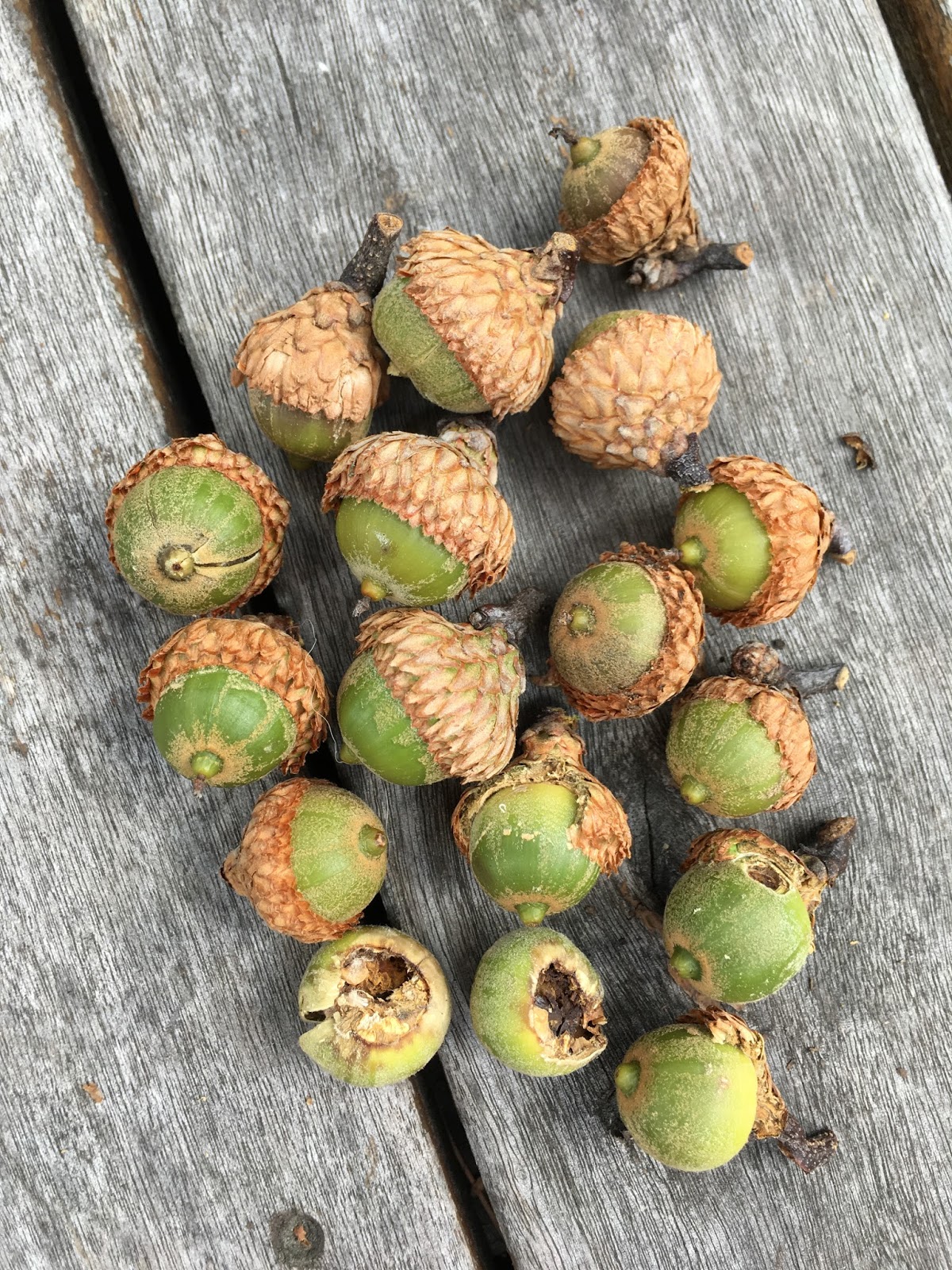
Acorns are falling. I swept the deck yesterday afternoon, and by this morning a few dozen more acorns dotted the surface. They’re a sign that autumn isn’t far off, and for squirrels, they’re the start of the fall harvest.

Red oak acorns


    Gray squirrels are so much part of our suburban surroundings that we tend to overlook their activities. To remedy this, I opened North American Tree Squirrels, by biologists Michael Steele and John Koprowski. Steele and his colleagues and students designed clever experiments to elucidate the feeding behavior of squirrels they found on their campus at Wilkes University in Pennsylvania.


Eastern gray squirrel (Sciurus carolinensis)

    For gardeners who like oaks, it was good news that acorns can be half eaten and still germinate and produce seedlings. Steele noticed that in early fall, when acorns were plentiful and the weather was still warm, squirrels usually ate acorns of white oaks but cached red oak acorns for later. White oak acorns are programmed to germinate in the fall.


Squirrels may pretend to bury acorns in decoy locations


    The red oaks play a longer game. Their acorns contain higher levels of tannin, a nasty-tasting chemical that protects seeds from predators. They’ve evolved to germinate in spring after a necessary cold period. The researchers observed that later in the fall, squirrels started removing the acorn caps to eat just the tops of the red oak acorns, which contained more high-calorie lipids and less tannin. As winter set in, they were willing to eat the whole red oak acorn, tannin and all. Apparently like us, squirrels balance tastiness versus health factors when they choose food.


Health food or tasty treats? It depends on the time of year

    Do gray squirrels remember where they hide their acorns? It was long thought that they didn’t and had to sniff out buried acorns. Lucia Jacobs, then at Princeton University, showed through an ingenious experiment that squirrels found their own cached acorns more readily than those hidden by other squirrels, although others’ caches might be quite nearby. 


Squirrels remember where they hid their nuts--photo by Juraj Patekar

    As a directionally challenged navigator, I’m awed by squirrels’ ability to recover their hidden nuts. Scientists asked whether squirrels were just good at retracing their steps—I can usually do that—and were finding their caches that way. Or were they constructing a three-dimensional mental map that allowed them to locate their hidden acorns? 


    Another of Jacobs’ lab experiments confirmed the latter. If she trained squirrels to find a nut in a maze and then kept the nut in the same location but changed the way to get there, the squirrels still found the nut. They’d retained its location, not just the directions for getting there.


    Although squirrels recover most of the acorns they store, they do serve red oaks by dispersing their seeds. A study of white versus red oak seedlings found that most of the white oaks sprouted close to the parent trees, whereas red oak seedlings appeared three to six times farther from the mature trees, their acorns having been moved by squirrels and other animals. In this way, squirrels contribute to the development of our forests.


Sunday, May 28, 2017

Woman versus squirrel

Wildlife—can’t live with ‘em, can’t live without ‘em. This month it’s squirrels. I’ve been driven to elaborate measures to keep them from digging up my young seedlings.

Squirrel at work--photo by pelican

     A fair percentage of the seeds I planted indoors this spring succeeded in growing into little plants around four inches tall. I hardened them off, moving them outdoors for lengthening periods over a couple of weeks to make sure they were ready for this season’s wildly oscillating temperatures. 


Toughening up to live outdoors

Then there were delays during days of heavy rain that kept me out of the garden for fear of trampling the soil into concrete.

    In the last three weeks I used whatever dry days there were for planting the seedlings out. Most were headed for the fenced, rabbit-proof vegetable plot.


The vegetable garden fence reaches 12 inches underground to keep rabbits out

Basil and dill seedlings landed in a corner dedicated to herbs. Nearby I also planted seeds of peas, cucumbers, and beans directly in the ground.

     Opposite the herbs is a section that stays dry and partially shaded because of a neighbor’s tall red oak. The tree’s branches extend above the vegetable plot, and its roots efficiently draw up whatever irrigation I provide. This area can’t sustain vegetables, so it has become an insectary garden offering food and shelter for native insects.


      This month I added some seedlings of common milkweed (Asclepias syriaca) and cockscomb (Celosia species) to it and edged the path that bisects the vegetable bed with sweet alyssum (Lobularia maritima).

Sweet alyssum attracts pollinators and has a honey scent

     Near the insectary bed, I’m hoping to produce flowers for cutting. In that section I planted the zinnias, bachelor’s buttons, and cosmos I started indoors with hopes of enjoying summer bouquets. Some spider flower (Cleome hassleriana) that had popped up in the homemade potting mix came along too. The flowers of these easy annuals are popular with pollinators.


Exuberant zinnias at Locust Grove in Poughkeepsie, NY

     So far the sustainable-enough approach was working. I’d managed to procure most of the annuals I wanted without resorting to seeds or plants treated with neonicotinoid insecticides. I’d gotten the young plants safely into the garden. That’s when squirrels became a menace. 


     When I dig, squirrels follow after me, digging in the same spot and throwing the young seedlings I’ve planted out of the ground. If I don’t notice and replant them, the exposed roots dry up and the little plants die. Squirrels don’t seem to want to eat the seedlings (except sunflowers, which must have delicious sprouts). Maybe they suspect I’ve buried nuts. Whatever the reason for this behavior, it’s very frustrating.


     To foil this sabotage, wherever I dug in the vegetable garden, I had to cover the loosened soil with wire fencing and then anchor row cover fabric on top of it. 


Row cover fabric lets water and light through and keeps squirrels out

That gave the vegetable seeds and the young seedlings a chance to take root. Yesterday, after the row cover had been in place for two weeks, I lifted it off. I left the fencing in place.

Lettuce and greens growing through the wire fencing

 I covered the bare soil with leaf mulch. Here’s hoping I’ve outsmarted the squirrels, and they’ll dig somewhere else.

 Are these pea plants old enough to be squirrel-proof?