My book and web site

Check out my book, The Sustainable-Enough Garden, available on Amazon, and the book's web site at www.thesustainable-enoughgarden.com. See more plant photos on Instagram.
Showing posts with label native plants. Show all posts

Sunday, March 27, 2022

It's not too late

Could you use some good news? Here’s some: last Thanksgiving the population of Western monarch butterflies counted in California increased by over 100-fold, from fewer than 2,000 butterflies counted in 2020 to 247,237 in 2021. 


Monarchs roosting for the winter

That’s not full recovery. Some experts estimate we’ve lost 80 percent of monarchs in 20 years. But it’s nice to know how resilient these butterflies can be.


    Western monarchs are genetically indistinguishable from the Eastern kind. It’s just that monarchs that live west of the Rockies overwinter in California and migrate to the Northwest for the summer. The ones that live east of the Rockies overwinter in central Mexico in the Monarch Butterfly Biosphere Reserve. Around this time of year, as the weather warms, they start their flight to Texas.


During the spring three or more successive generations of monarchs journey through the Southeast to the northern states and southern Canada where they spend the summer. Then in August and September another new generation starts to flutter all the way back to Mexico, a journey that takes up to two months (this Google Earth video illustrates it all). 


    Migration is necessary because monarchs can’t survive northern winters. In the mild, humid winter climate of Mexico’s Sierra Madre mountains, they roost in oyamel fir trees (here’s another fascinating video), packing together to stay warm. 


     With this successful life cycle evolved over the millennia, why did the monarchs suddenly start to disappear? The first obvious culprit was glyphosate (Roundup) sprayed on agricultural fields. Glyphosate use surged in the 1990s with the introduction of genetically modified Roundup Ready crops that resist the herbicide spray while it kills the weeds around them. 

Monarch caterpillars need to eat milkweed to survive. Milkweed toxins ingested by monarchs make them poisonous to predators but don't hurt the monarchs.


     Some of those weeds/wildflowers are native milkweeds. Monarchs need to lay their eggs on milkweeds to reproduce. Instead of finding milkweeds offering nectar and forage for their caterpillars alongside every field, the migrating butterflies now had to cross vast milkweed deserts in agricultural regions of the U.S.

Eastern native swamp milkweed is easy to grow and provides a lifeline for monarchs


     A recent meta-analysis by a team at Michigan State University, using data from thousands of volunteer monarch counts, found that glyphosate, habitat loss, and climate change have all contributed to the monarchs’ decline. In recent years, hotter weather in their northern range seems to have been a major factor.


     When we hear that climate change is the reason that species are dying out, it can sound hopeless. We’re not moving fast enough to save ourselves; how are we going to save the monarchs? But as the scientists point out, when migrating monarchs are stressed by high temperatures, that’s when they especially need lots of milkweeds and other native flowers for nectar along their path so they can stop off and refuel or lay eggs.


Migrating monarchs need other flowers too for energy from nectar
 
     The surge in Western monarchs shows that the monarch population has the capacity to rebound suddenly and dramatically. And the fact that thousands of human well-wishers are already helping encourages me too. This year let’s redouble our efforts to plant for native insects, and let’s be sure to include milkweeds in the mix.


Common milkweed is another good choice. It's a spreader.


Sunday, August 29, 2021

Ugly ducklings?

 Steve Aitken’s intriguing article about naturalistic gardens in the October issue of Fine Gardening reminded me that a garden inspired by native plant communities doesn’t have to look like a hodgepodge of plants. It often contains blocks or “drifts” of a single species or cultivar. Grouping them together heightens our enjoyment of the colors, textures and shapes of the chosen plants.


A drift of blue sage makes a bold statement-photo filipvandamme.be

    Now in late summer, I’m noticing some of those big aggregations in undesigned areas. At the edge of a mowed playing field in my neighborhood, large clumps have developed where one native species predominates, and they’re looking good. 

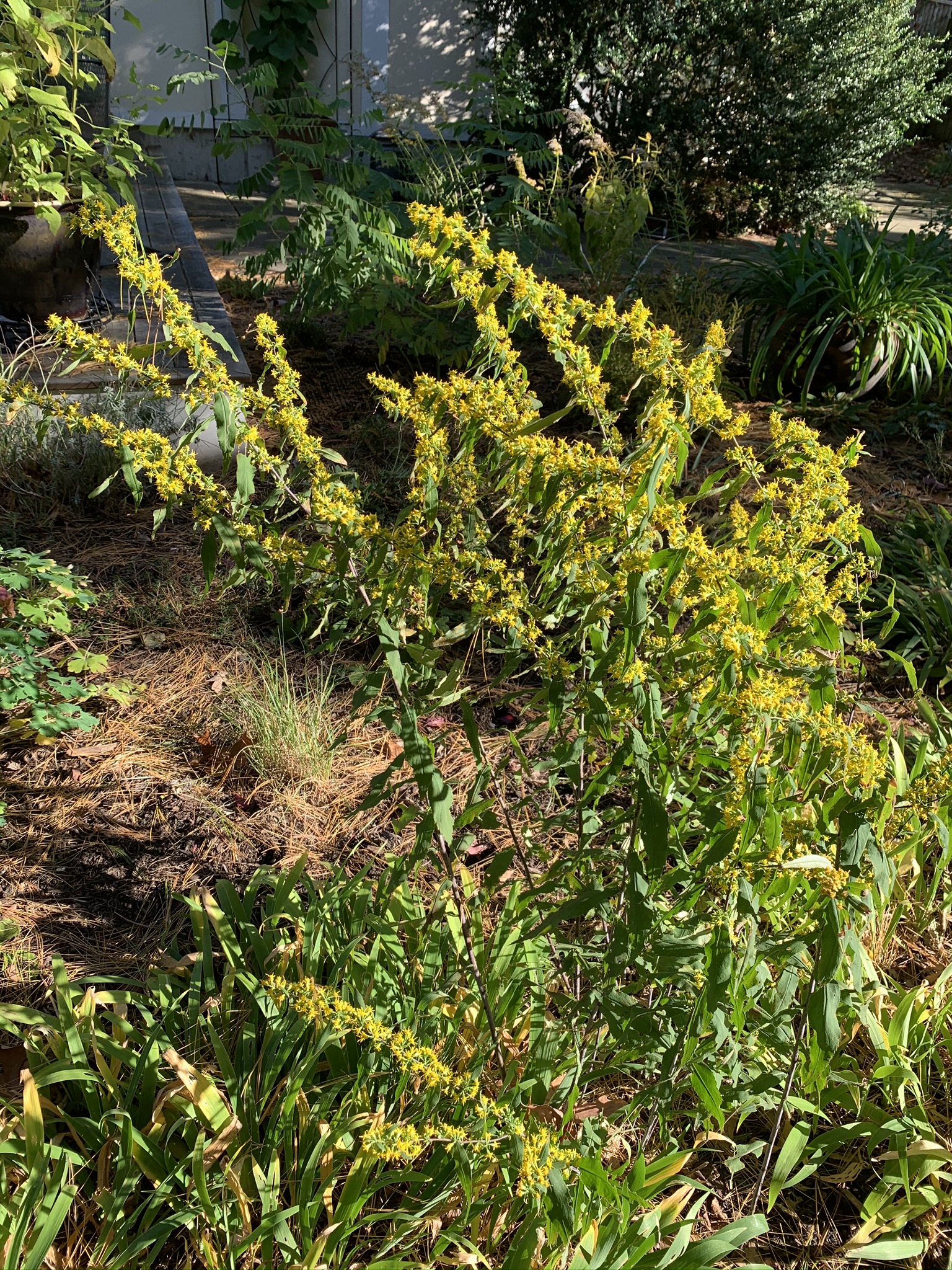
A big clump of Canadian goldenrod stands out
 

But these colonies were not intentionally planted. They’re weeds. This made me wonder: could some of the plants we think of as weeds be developed as reliable, easy-to-grow natives for garden use?


    Many weeds are nonnatives. But some that catch my eye do originate from eastern North America. There’s pale smartweed (Polygonum lapathifolium), with drooping chains of pink flowers at this time of year. 

Pendulous flowers of pale smartweed

The blooms offer nectar for visiting insects, and native caterpillars forage on the leaves. If pale smartweed’s flowers were twice as big and covered the plant densely, could you see growing a clump of this plant as a garden annual? The blooms aren’t too different from those of an amaranth I’m growing for cutting flowers.

Amaranth 'Red Garnet'
 
    I reflexively yank out yellow wood sorrel (Oxalis stricta), a native of both Europe and North America. It pops up all over the garden, and it’s easy to pull. But the yellow flowers are actually rather sweet-looking above fresh, tender clover-like foliage, and it blooms through the summer. 

Yellow wood sorrel is a familiar garden weed-photo Dcrjsr

Yellow wood sorrel is a pollinator plant, and birds eat its seeds. I could see intentionally growing a block of it and calling it an ornamental, especially if someone developed a variety with larger flowers.


    A lot of my lawn used to be taken over by common blue violets (Viola sororia), also native to eastern North America (now the lawn is taken over by wood chips). 


Violets took over where lawn used to grow

Violets like shade, and they do better in acid soil with low calcium content than lawn grasses do--but then, lawn grasses are such prima donnas! Violet seeds are surrounded by fatty elaiosomes that make them popular food for ants, birds and small mammals, and fritillary caterpillars eat violets’ leaves. 

With no work on my part, violets bloom in spring

I’m thinking of tearing out the last tufts of grass in one remaining lawn area and leaving the violets as a native groundcover. They can certainly deal with being walked on, and the flowers are pretty in spring.


    These are plants we see around us every day in New England. We know they’re strong growers that adapt to tough growing conditions. A lot of garden center darlings came into being because breeders recognized the potential of a modest wild flowering plant and made it more eye-catching through selective breeding. Breeders, have a look at our native weeds!


Sunday, June 27, 2021

Rolling with the punches

With rainfall in Massachusetts staying about three inches below average for the year, gardeners are bracing for another summer drought. It’s worrying, but I’m impressed with how some of my established perennials are holding up.

A clematis is blooming well despite dry weather


    We often read that new plants need regular watering while they settle in. After the first season or two, they’ve established networks of roots and recruited fungal helpers (mycorrhizae) to collect water from the soil. When I started my garden, I wasn’t thinking about choosing drought tolerant plants. Now I try to avoid native perennials whose native habitat is described as a moist streamside. But some are more adaptable than you might expect. 


    Two areas of established plants look surprisingly lush despite the dry weather. Off the back deck, yarrow (Achillea ‘Coronation Gold’) is covered with flat yellow flowers. Nearby a bushy St. John’s wort (Hypericum ‘Universe’) is opening yellow blooms. A sneezeweed (Helenium ‘Short ‘n Sassy’) is coming into its own this year, putting out lots of foliage and numerous buds that promise an excellent display.


Bright yarrow blooms suit hot, dry weather
 

     In the insectary bed swamp milkweed (Asclepias incarnata) and ox-eye sunflower (Heliopsis helianthoides) are going great guns. This is an area of the fenced vegetable plot that I’ve devoted to planting for native insects. I call it an insectary bed instead of a pollinator garden, because it’s intended to benefit not just pollinators but also leaf-eaters and beneficial insects (the predators that keep the herbivores in check). 


    Swamp milkweed sounds like one of those moisture-lovers. Indeed, it grows naturally in wet meadows. But it’s doing fine for me in a rather dry situation. I like to think it’s providing larval food for migrating monarch butterflies. Another milkweed, butterfly weed (Asclepias tuberosa) is having a very good year in the same bed. That one took years to establish itself, but now it’s unfazed by the sparse rainfall. Common milkweed (Asclepias syriaca) is taking hold there too.


Swamp milkweed

    I’ve tried for years to grow common sunflowers (Helianthus annuus), but something always eats the seedlings before their stems get woody enough to support big flower heads. Ox-eye sunflower, which comes from a different genus, seems to have no problem coping with dry conditions. Instead of plate-sized sunflowers, I’ve got multiple yellow flowers attracting lots of insects.


Ox-eye sunflower attracts native insects


    I’ve been trying to establish some Joe Pye weed (Eutrochium spp.). These are billed as moisture lovers. One I planted last year had completely died back by the end of the summer after lackadaisical watering, and I wrote it off as a failure. This spring, though, it sent up new growth and seems to be thriving. I planted a group of Joe Pye weeds in a low-lying area where I hope they’ll benefit from water pooling when it rains. That’s a transitory event in our yard because our sandy soil drains rapidly. So far they’re bulking up surprisingly, considering that they’re regularly trampled by romping dogs.


Lavender and alyssum thrive in dry summer weather

    With dogs charging around the yard and rainfall infrequent, it’s nice to see some perennials rising to the challenge.

Sunday, March 14, 2021

Goodbye to bird feeders?

 It may be time to take down my bird feeders for good. I’ve been feeding birds in the garden for at least 30 years. I love watching our local downy woodpecker feeding upside down on the suet feeder. When a goldfinch happens by in spring and perches on the nyjer seed feeder, it makes my day.  


Goldfinches like small seeds of coneflowers and (thistle-like) nyjer-photo Rob Amend

    So why change this longstanding habit? First I learned that I could be poisoning hummingbirds by offering them infected or moldy sugar solution unless I emptied, cleaned and refilled the feeder every couple of days. That was more than I could promise, so I took that feeder down. 

Hummingbirds are safer on native cardinal flower than at my feeder

Then I stopped filling the seed feeders in the warm months. I read that I could feed birds more sustainably by choosing plants that produce seeds they can eat. That gave me a reason to add more native plants to the yard, always a welcome opportunity. And more diverse native plantings did seem to attract more birds.


Native coralberry will attract lots of birds-photo Servernjc

    This winter, though, I told myself that birds could use some extra seed to sustain them through the cold months. I filled my favorite feeders: a big oblong hopper with a weighted bar to close off the seed supply when a squirrel lands on it and a house-shaped suet feeder with a mesh-covered floor for clingers who feed upside down, like nuthatches and woodpeckers.


This battered bird feeder does keep squirrels out

Once the food was on offer, birds soon arrived, alighting on tree branches and inside twiggy shrubs, checking for predators and competitors before darting over to the feeders to grab a quick meal. 


    Unfortunately, my bird feeders could be superspreader locations, where birds come in contact with deadly infectious agents. Wildlife observers are reporting increased deaths of migratory finches caused by salmonella infection, possibly an unintended consequence of homebound bird lovers filling more feeders during the pandemic. Disease-causing microbes shared at bird feeders include bacteria, protozoa, fungi and viruses.


Pine siskin, one of the affected species-photo Cephas
 
    To avoid spreading infection, experts advise cleaning your feeder every one to two weeks, scrubbing it with soap and water and then soaking it in diluted bleach. Seed and seed hulls that fall to the ground, they declare, should be swept up in case they carry disease. Ideally, I shouldn’t put out more than two days’ worth of seed at a time, so that it’ll stay clean until it’s eaten. Even that stone birdbath I’ve been keeping filled is supposed to be scrubbed out and sterilized regularly.


The bird bath in May

    When I found a dead junco on the ground, I got the message: this is serious. I like feeding the birds, but I don’t want them to die for my amusement. 


Dark-eyed juncos visit frequently in winter

 I know myself well enough to realize I’m not going to bring those feeders indoors to clean them every two weeks through the winter. And I’m uncomfortable about the environmental impact of manufacturing chlorine bleach. It’s time to let our birds forage for themselves. In future, I’ll leave the bird feeders to those more committed to cleanliness. Instead, I’ll be planting more shrubs and perennials with berries and edible seeds.


American black elderberry offers lots of fruit for birds


Sunday, November 22, 2020

Food for thought

 This week my garden club got together on Zoom to watch a video of a talk by Doug Tallamy. I’ve been a Tallamy follower since 2011, when his book Bringing Nature Home changed my gardening philosophy. Since then I’ve been working on growing more native plants.


Insectary bed: flowers and foliage for pollinators and other insects

    In 2019 Tallamy published a new, more prescriptive book, Nature’s Best Hope. He’s marshaling us to rescue biodiversity by creating Homegrown National Park, a combined nationwide habitat for native insects in our backyards. 


    Tallamy demonstrates how we can get the most environmental bang from our native plantings by prioritizing caterpillar host plants. Caterpillars provide the lion’s share of the biomass birds need to feed their young. 

Hummingbirds feeding insects to their chick

Tallamy has identified more than 800 caterpillar species on his 10-acre property in Pennsylvania as he and his wife have replaced nonnative invasive plants with natives (check out his stunning photos of some of them in the new book).


    A light bulb went on for me when Tallamy mentioned that people occasionally write him to point out that an imported species—the Asian ginkgo tree (Ginkgo biloba), for example--used to be native to North America in a previous geological era and claim it’s therefore entitled to native plant status. That doesn’t matter, he said. What’s important is whether a plant supports any native insects. Ginkgoes don’t.


Ginkgo is a beautiful tree from Asia-photo Sunroofguy
 
    We’ve come a long way since concern about supporting insects first surfaced. I remember reading in the 1980s about designing a butterfly garden. That was when we planted butterfly bush (Buddleia spp.), which is now out of favor because it’s nonnative and potentially invasive. Butterfly bush and many other flowering imports do serve a purpose, though, providing nectar for bees, butterflies and moths in their adult forms.

Eastern Tiger swallowtail nectaring on a butterfly bush


    As I became more aware of my garden as an ecosystem, I started planting native flowers that provide the right pollen for native pollinators, especially bees. Now we can take the next step and choose to plant for native caterpillars. These aren’t looking for flowers. While adult pollinators can afford to sip nectar unselectively, caterpillars need to eat the right leaves to be able to grow and pupate.

      Because of decades of research in this area, we now know that about 90 percent of insects specialize: they’ve evolved to live off a limited group of plants. Most caterpillars aren’t equipped to deal with the chemical defenses mounted by plant species outside their small group of native host plants.


Monarch caterpillars need to eat milkweed
 
    So with data accumulating about which plants host which native insects, we can stop fighting about whether gardeners should plant only native plants. Instead, we can ask which plants host the most insects. Tallamy proposes that we prioritize keystone plants, such as native oaks, willows, cherries, and goldenrods, that provide food for hundreds of species of native caterpillars. How to find these? You can go to the websites of the National Wildlife Federation and the Audubon Society and get lists for your zip code. Somehow this prescription seems much more doable.


Native red oak supports more insects than any other local tree-photo Jason Hollinger


Sunday, October 11, 2020

Getting by without rain

In late July I blithely congratulated myself on watering less, assuming that rain would come and my plants would be refreshed without supplemental irrigation. My expectations were way off. In the month of September, we got less than an inch of rain. So far October is just as dry.

The garden is drooping

    During the drought, I’ve had to make difficult decisions about watering. I’m finding out the hard way which plants can tolerate sustained dryness. For container plants, it was easier to know what to expect. In hot weather, they wouldn’t last more than a day or two without watering, because the small volume of growing medium in the pot dries out so fast. Those I kept watering with the hose wand or watering can.


    Then there were newly planted perennials and shrubs. Before the drought, I optimistically planted in new areas. When we replaced a rotting stockade fence with chain link last fall, I planted a row of evergreens. In spring I added a buttonbush (Cephalanthus occidentalis) 


The buttonbush has survived so far

and moved a chokeberry (Aronia arbutifolia) to a sunny spot nearby. Around the garden pond, I planted native perennials for pollinators: false aster (Boltonia asteroides), northern blazing star (Liatris novae-angliae), wild bergamot (Monarda fistulosa), and mountain mint (Pycnanthemum muticum). All these will need supplemental watering for their first two years. I’ve kept at it with the watering can.


Northern blazing star at the end of its first season
 
    For the rest, it was survival of the fittest. The lawn completely surrendered. With our dog and her friends racing around on its parched surface, the grass wore away completely. Luckily, turf grass is my least favorite garden plant. It should grow in cool, damp environments like the British Isles, where it belongs.


So much for the grass

    In the drought, it’s easy to see the advantage of protective adaptations like waxy leaves. The boxwood (Buxus sempervirens) hasn’t batted an eye. The vinca (Vinca minor) groundcover in the front yard is starting to droop after two full months with no water at all, but it’s still green—another reason I’m glad it replaced the former front lawn.

Vinca has proven very tough

But some waxy leaves of a few evergreen shrubs are turning yellow or brown, as on the Catawba rhododendrons (Rhododendron catawbiense) and mountain laurels (Kalmia latifolia).


Rhododendron leaves yellowing
 
    Softer deciduous leaves are drooping. Even the Canadian wild ginger (Asarum canadense), which is usually impervious, has flopped to the ground. 


Wild ginger has collapsed
 

In contrast, the goldenrods (Solidago spp.) and asters (Symphiotrichum spp.) are unfazed.


Goldenrod dealing with drought

     I notice that some perennials with fleshy roots have an advantage. Smooth Solomon’s seal (Polygonatum biflorum) is still holding up its leaves. In the cutting garden, the cosmos (Cosmos bipinnatus) has turned completely brown, but dahlias are going strong. Presumably rhizomes and other fat root forms store water for hard times.


Smooth Solomon's seal has fleshy roots
 
     I find myself wishing that some of the rain flooding the Gulf Coast would come our way. We’re supposed to get some remnants from Hurricane Delta next week. May it be so! At this point I’ll only believe it when I see it, because so much forecasted rain hasn’t materialized.


New England aster holding up well


Sunday, September 13, 2020

A fair exchange

An excellent summary by Anne Bikle in Fine Gardening reminded me that there’s no free lunch in the rhizosphere, the top few inches of soil where most of the biological activity happens. True, lots of soil organisms are at work breaking down organic matter into forms that our plants’ roots can use. 

Electron micrograph of soil microbes-photo Pacific Northwest National Lab

But that’s not a coincidence. The roots offer something in return. Every plant exudes proteins, carbohydrates and fats from its roots. These attract the organisms that help plants get what they need and protect them from diseases and pests.


Fungal network associated with spruce roots-photo André-Ph. D. Picard
 
    Bikle’s article was a good reminder to support this process by taking good care of soil organisms in the garden. I checked myself against her three recommendations: leaving soil undisturbed when possible, mulching to add organic material to the system, and growing a variety of plants.


    A few years ago I gave up turning the soil in the vegetable bed with my spade before planting in spring. I’d thought this was a necessary step to mix in amendments such as compost and composted manure and turn under any weeds that had sprouted.


     I stopped all this digging when I learned it was counterproductive. I was breaking up soil networks, killing or slowing down soil organisms that were nourishing my plants. I was also churning through organic material by introducing a rush of oxygen into the soil, wasting the compost I added to the bed. 


     I found out it was better to let soil organisms do their work undisturbed. Now I confine the digging to times when I need a planting hole for a seedling such as a young tomato plant. The soil in the vegetable bed has improved. As a side benefit, I’ve got fewer weeds, because when I cut out the digging, I stopped bringing weed seeds to the surface to germinate.

I avoid digging except to plant seedlings

    I’m also making a point of not clearing away leaves that fall on the ground, except on the lawn. I’m still working on striking a balance for fall leaves. I used to chop them up for leaf mulch, until I learned this also chopped up useful insects at various stages of development that were settling into the leaf litter for the winter. For the past couple of years, I’ve mostly let the leaves lie on beds, supplemented by more leaves I drag in from the street that would otherwise go to the city’s composting site. 


Letting fall leaves lie
     

     Now I’m missing my leaf shreds. There are places where they’d be especially useful, such as in the newest perennial beds, where the soil could use some quick help. The leaf shreds stay put, not blowing around like whole leaves, and they decompose faster. This fall I think I’ll do some limited shredding to cover those spots.

 
     From Bikle I learned that I’m offering a diverse buffet of root exudates by increasing variety in the garden as I’ve added native plants. That’s because each plant sends out its own recipe to attract organisms to meet its needs. All the better.


A mix of native plants: wild ginger, leucothoe, heuchera


Sunday, August 30, 2020

Columbines: Johnny-on-the-spot

 Some of the toughest plants in my garden are columbines (Aquilegia spp.). While other plants in a newish bed off the deck have started to turn brown and lose leaves during the current drought, the columbines are holding on.


Columbines bloom here in May and June


    I appreciate the way these easy growers pop up around the garden wherever there’s open soil. This trait of filling in where they’re needed has been especially convenient in areas where I’m waiting for slower growers to get established. 


     In the deck bed, I planted a combination of low growers and medium-height mound-formers, aiming for a tapestry of pollinator-attracting plants that would cover the soil densely. That hasn’t happened yet. The bearberry (Arctostaphylos uva-ursi) I hope will eventually form a mat of small shiny leaves is just starting to spread. New native perennials need time to grow wide. While they’re gathering strength, the columbines are helping out. 


Columbines in the deck bed in June


     I have lots of young columbines to choose from. In the vegetable garden alone, each spring reveals a selection of new seedlings. It’s a happy spot for them. The rich soil is renewed annually with compost, and there’s little competition in early spring before food plants have filled the space. 


Columbine volunteer in the vegetable garden

I can dig up columbines wherever they aren’t needed and move them to where they are. Three have settled in comfortably around those young bearberries.


    I started out with a broad selection of columbines, some blue-flowered or blue and white, some rose pink, some deep plum purple. The combinations of traits showing up now reflect interbreeding between these varieties. Columbines aren’t shy about spreading their genes around.

A later generation


     Since the 1960s, there’s been an effort to categorize plant strategies, the approaches that plant species employ to defend themselves, survive, compete, and reproduce. Columbines have chosen the role of ruderal plants—pioneers in disturbed areas. They sprout where a natural event or human activity creates an opening. They produce lots of seed that drops wherever there’s a favorable place to grow. They grow fast, covering ground quickly. When they’re crowded out by expanding clumps of stronger growers in one area, they move to another. They live short lives, but their offspring take their places so seamlessly that I can’t tell when an older plant dies and a younger takes over.

New columbines bloom each spring


     Claudia West and Thomas Rainer, in their book Planting in a Post-Wild World, recommend leveraging these plant strategies in designing for visually impactful native plant communities. They divide plants into four categories. In the first group are the taller structural or framework plants, from trees to shrubs to large perennials and ornamental grasses. Second are the seasonal theme plants, such as my rhododendrons (Rhodendron catawbiense), black-eyed Susans (Rudbeckia hirta), and asters (Symphyotrichum spp).


Native Catawba rhododendron

 Third are groundcover plants such as wild geranium (Geranium spp.), foam flower (Tiarella cordifolia), and barren strawberry (Waldsteinia fragaroides) that control erosion and provide nectar for visiting insects.


Foam flower
 
Last are the filler plants, and that’s where the columbines fit in. They fill the gaps. That’s what I love about them.