My book and web site

Check out my book, The Sustainable-Enough Garden, available on Amazon, and the book's web site at www.thesustainable-enoughgarden.com. See more plant photos on Instagram.
Showing posts with label rain. Show all posts

Sunday, October 11, 2020

Getting by without rain

In late July I blithely congratulated myself on watering less, assuming that rain would come and my plants would be refreshed without supplemental irrigation. My expectations were way off. In the month of September, we got less than an inch of rain. So far October is just as dry.

The garden is drooping

    During the drought, I’ve had to make difficult decisions about watering. I’m finding out the hard way which plants can tolerate sustained dryness. For container plants, it was easier to know what to expect. In hot weather, they wouldn’t last more than a day or two without watering, because the small volume of growing medium in the pot dries out so fast. Those I kept watering with the hose wand or watering can.


    Then there were newly planted perennials and shrubs. Before the drought, I optimistically planted in new areas. When we replaced a rotting stockade fence with chain link last fall, I planted a row of evergreens. In spring I added a buttonbush (Cephalanthus occidentalis


The buttonbush has survived so far

and moved a chokeberry (Aronia arbutifolia) to a sunny spot nearby. Around the garden pond, I planted native perennials for pollinators: false aster (Boltonia asteroides), northern blazing star (Liatris novae-angliae), wild bergamot (Monarda fistulosa), and mountain mint (Pycnanthemum muticum). All these will need supplemental watering for their first two years. I’ve kept at it with the watering can.


Northern blazing star at the end of its first season
 
    For the rest, it was survival of the fittest. The lawn completely surrendered. With our dog and her friends racing around on its parched surface, the grass wore away completely. Luckily, turf grass is my least favorite garden plant. It should grow in cool, damp environments like the British Isles, where it belongs.


So much for the grass

    In the drought, it’s easy to see the advantage of protective adaptations like waxy leaves. The boxwood (Buxus sempervirens) hasn’t batted an eye. The vinca (Vinca minor) groundcover in the front yard is starting to droop after two full months with no water at all, but it’s still green—another reason I’m glad it replaced the former front lawn.

Vinca has proven very tough

But some waxy leaves of a few evergreen shrubs are turning yellow or brown, as on the Catawba rhododendrons (Rhododendron catawbiense) and mountain laurels (Kalmia latifolia).


Rhododendron leaves yellowing
 
    Softer deciduous leaves are drooping. Even the Canadian wild ginger (Asarum canadense), which is usually impervious, has flopped to the ground. 


Wild ginger has collapsed
 

In contrast, the goldenrods (Solidago spp.) and asters (Symphiotrichum spp.) are unfazed.
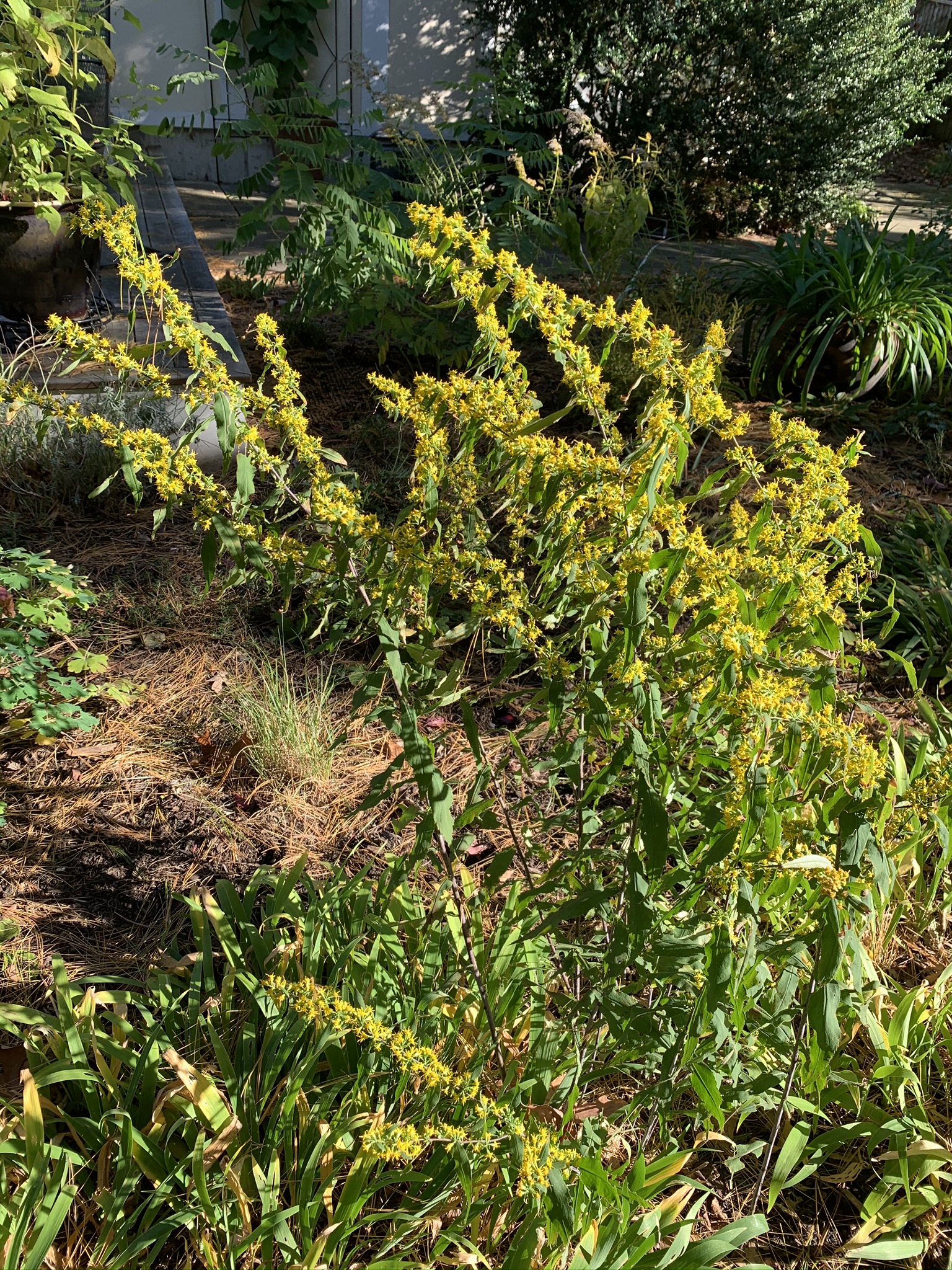

Goldenrod dealing with drought

     I notice that some perennials with fleshy roots have an advantage. Smooth Solomon’s seal (Polygonatum biflorum) is still holding up its leaves. In the cutting garden, the cosmos (Cosmos bipinnatus) has turned completely brown, but dahlias are going strong. Presumably rhizomes and other fat root forms store water for hard times.


Smooth Solomon's seal has fleshy roots
 
     I find myself wishing that some of the rain flooding the Gulf Coast would come our way. We’re supposed to get some remnants from Hurricane Delta next week. May it be so! At this point I’ll only believe it when I see it, because so much forecasted rain hasn’t materialized.


New England aster holding up well


Sunday, August 6, 2017

Let it rain

What a lush garden year we’re having! Last summer’s gardens were parched by drought. This summer the Northeast has been blessed with plentiful rain. 

Foliage is thriving thanks to plentiful rain

As of August 6, we’d had 30.83 inches of precipitation in the Boston area in 2017, well above the average of 25.88 inches by this date. You can probably see the difference in your garden; I certainly can in mine.

    Why should that be? What makes rain better for gardens than irrigation? We run a sprinkler irrigation system, so unless I cut back on scheduled watering, my plants should be getting enough water even when it doesn’t rain.


Water beads on a giant elephant ear leaf

    There are limitations to even the best-designed irrigation system. Ours is set up in 12 watering zones. Twice a week, sprinkler heads pop up in the early morning and start spraying in a programmed sequence, controlled by a computer in the basement. A rain sensor prevents watering when there’s been adequate rain. With this system, I lavish a lot of water on the garden, sometimes more than my conscience tells me I should.

    Theoretically every plant gets plenty of irrigation water, but in practice, I’ve learned, it’s not that simple. As the garden has matured, shrubs have grown wide and tall, hogging the spray of water and creating dry shadows behind their bulk. And the arcs described by the sprinklers’ spray don’t fit exactly to every angle and curve of plantings. Inevitably some patches get less irrigation.


    Beyond falling evenly on the whole garden, rain conveys numerous advantages:


Lots of rain is helping this St. John's wort get established

•    Whereas irrigation water contains dissolved minerals, including calcium, magnesium and sodium, rainwater is “soft” and mineral-free. As a result, it pulls nutrients by diffusion from where they're bound in the soil, making them available to plants’ roots.
•    Rain water is acidic, which promotes release of micronutrients including zinc, manganese, copper and iron that plants need. Most of my garden soil is acidic already, but there may be alkaline areas where concrete paving leaches lime. Acidic rainwater is especially beneficial in those spots.


Soil next to sidewalks may be alkaline

•    Rain falls at 20 miles per hour, penetrating soil better than irrigation water, which falls at 5 mph.
•    Rain is saturated with air, so it oxygenates soil. That’s good for plants
•    Rain contains nitrogen in the form of nitrate and ammonium from the air. This nitrogen becomes available to plant roots and promotes growth.


Big canna leaves can use a boost from extra nitrogen in rain

•    Rain doesn’t contain the chlorine that comes with treated drinking water. Chlorine inhibits plant growth.
•    Rain flushes salts (such as road salt) that inhibit growth through the root zone and washes mineral deposits, dust and pollutants off leaves, making for more effective photosynthesis.


The proof is in the pudding. The garden looks happier this year with more rain. 


New plants I added in June and July are surviving, despite the heat. Just watering them might not have been enough if it hadn’t been for well-timed, frequent rain.

Monday, October 3, 2016

Rain at last!

Whoopee! I’ve returned from a vacation in dry and sunny Italy

Ah, Venice . . .

to find that the Boston area had almost an inch of rain while I was away. It’s amazing how different the garden looks with just that much welcome refreshment.

Wet at last

     The lawn has turned green again, and in containers and beds plants are looking peppy, shedding their tired late-summer appearance. It helps that some fall color is starting to show. Fall-blooming flowers are beginning their display. The whole garden scene is a lot more encouraging.


Japanese maple leaves starting to turn red

    How long will this last? Occasional showers are expected into next week as a storm system gradually moves away. We heard predictions of possible showers all summer, though, and most of them either didn’t occur or dropped only light sprinklings that wet the leaves without seeming to moisten the soil. We haven’t seen sustained rain like Saturday’s in a long time.


    Can’t leaves absorb moisture even if sprinklings of rain don’t make it to the ground? Some water can get in through the stomata, pores that open to allow water out of leaves under non-drought conditions. That’s enough to reverse wilting temporarily. I suppose it’s one reason for creating a humid environment around our house plants with misting or pebble trays.


Ornamental grass flower holding water droplets

     But leaves of most plants can’t take in enough moisture to replace water from soil. Come to think of it, some of those house plants originate in the cloud forest, where absorbing water through leaves is a more common adaptation. New England natives need to get their water from the ground.

Even huge leaves of elephant ears can't absorb all the water the plant needs

    Last week’s inch of rain permeates the top twelve inches of soil. My sandy loam takes in water easily, but it also lets water flow through quickly. Sand holds water by capillary action, the way a sponge or a paper towel does. As water drains through sandy soil, soil moisture drops to the wilting point, the proportion at which plant roots can’t extract water they need. We saw that happen over and over again this summer.


Hydrangea at the wilting point

    Soil water retention is one reason that adding organic material such as compost is so important. The chemical properties of organic material enable soil to hold more water for longer because of adsorptive forces that surround soil particles with a film of water molecules. 


    I hope that compost and leaf litter—leaves decomposing in place when I didn’t rake or blow them away—are giving my plants a chance to take advantage of this long-awaited rain. If these soil builders just lie on top of the soil, at least they’re preventing evaporation, holding moisture in the soil for longer than if it were bare. 


Compost to the rescue!

    Incorporated into soil by organisms ranging from fungi and bacteria to nematodes, insects, and earthworms, the organic matter does even better. The organic particles hold water near the surface where roots can drink it in. Cheers, Salud, and L’chaim!