My book and web site

Check out my book, The Sustainable-Enough Garden, available on Amazon, and the book's web site at www.thesustainable-enoughgarden.com. See more plant photos on Instagram.
Showing posts with label Drought. Show all posts

Sunday, June 27, 2021

Rolling with the punches

With rainfall in Massachusetts staying about three inches below average for the year, gardeners are bracing for another summer drought. It’s worrying, but I’m impressed with how some of my established perennials are holding up.

A clematis is blooming well despite dry weather


    We often read that new plants need regular watering while they settle in. After the first season or two, they’ve established networks of roots and recruited fungal helpers (mycorrhizae) to collect water from the soil. When I started my garden, I wasn’t thinking about choosing drought tolerant plants. Now I try to avoid native perennials whose native habitat is described as a moist streamside. But some are more adaptable than you might expect. 


    Two areas of established plants look surprisingly lush despite the dry weather. Off the back deck, yarrow (Achillea ‘Coronation Gold’) is covered with flat yellow flowers. Nearby a bushy St. John’s wort (Hypericum ‘Universe’) is opening yellow blooms. A sneezeweed (Helenium ‘Short ‘n Sassy’) is coming into its own this year, putting out lots of foliage and numerous buds that promise an excellent display.


Bright yarrow blooms suit hot, dry weather
 

     In the insectary bed swamp milkweed (Asclepias incarnata) and ox-eye sunflower (Heliopsis helianthoides) are going great guns. This is an area of the fenced vegetable plot that I’ve devoted to planting for native insects. I call it an insectary bed instead of a pollinator garden, because it’s intended to benefit not just pollinators but also leaf-eaters and beneficial insects (the predators that keep the herbivores in check). 


    Swamp milkweed sounds like one of those moisture-lovers. Indeed, it grows naturally in wet meadows. But it’s doing fine for me in a rather dry situation. I like to think it’s providing larval food for migrating monarch butterflies. Another milkweed, butterfly weed (Asclepias tuberosa) is having a very good year in the same bed. That one took years to establish itself, but now it’s unfazed by the sparse rainfall. Common milkweed (Asclepias syriaca) is taking hold there too.


Swamp milkweed

    I’ve tried for years to grow common sunflowers (Helianthus annuus), but something always eats the seedlings before their stems get woody enough to support big flower heads. Ox-eye sunflower, which comes from a different genus, seems to have no problem coping with dry conditions. Instead of plate-sized sunflowers, I’ve got multiple yellow flowers attracting lots of insects.


Ox-eye sunflower attracts native insects


    I’ve been trying to establish some Joe Pye weed (Eutrochium spp.). These are billed as moisture lovers. One I planted last year had completely died back by the end of the summer after lackadaisical watering, and I wrote it off as a failure. This spring, though, it sent up new growth and seems to be thriving. I planted a group of Joe Pye weeds in a low-lying area where I hope they’ll benefit from water pooling when it rains. That’s a transitory event in our yard because our sandy soil drains rapidly. So far they’re bulking up surprisingly, considering that they’re regularly trampled by romping dogs.


Lavender and alyssum thrive in dry summer weather

    With dogs charging around the yard and rainfall infrequent, it’s nice to see some perennials rising to the challenge.

Sunday, October 11, 2020

Getting by without rain

In late July I blithely congratulated myself on watering less, assuming that rain would come and my plants would be refreshed without supplemental irrigation. My expectations were way off. In the month of September, we got less than an inch of rain. So far October is just as dry.

The garden is drooping

    During the drought, I’ve had to make difficult decisions about watering. I’m finding out the hard way which plants can tolerate sustained dryness. For container plants, it was easier to know what to expect. In hot weather, they wouldn’t last more than a day or two without watering, because the small volume of growing medium in the pot dries out so fast. Those I kept watering with the hose wand or watering can.


    Then there were newly planted perennials and shrubs. Before the drought, I optimistically planted in new areas. When we replaced a rotting stockade fence with chain link last fall, I planted a row of evergreens. In spring I added a buttonbush (Cephalanthus occidentalis


The buttonbush has survived so far

and moved a chokeberry (Aronia arbutifolia) to a sunny spot nearby. Around the garden pond, I planted native perennials for pollinators: false aster (Boltonia asteroides), northern blazing star (Liatris novae-angliae), wild bergamot (Monarda fistulosa), and mountain mint (Pycnanthemum muticum). All these will need supplemental watering for their first two years. I’ve kept at it with the watering can.


Northern blazing star at the end of its first season
 
    For the rest, it was survival of the fittest. The lawn completely surrendered. With our dog and her friends racing around on its parched surface, the grass wore away completely. Luckily, turf grass is my least favorite garden plant. It should grow in cool, damp environments like the British Isles, where it belongs.


So much for the grass

    In the drought, it’s easy to see the advantage of protective adaptations like waxy leaves. The boxwood (Buxus sempervirens) hasn’t batted an eye. The vinca (Vinca minor) groundcover in the front yard is starting to droop after two full months with no water at all, but it’s still green—another reason I’m glad it replaced the former front lawn.

Vinca has proven very tough

But some waxy leaves of a few evergreen shrubs are turning yellow or brown, as on the Catawba rhododendrons (Rhododendron catawbiense) and mountain laurels (Kalmia latifolia).


Rhododendron leaves yellowing
 
    Softer deciduous leaves are drooping. Even the Canadian wild ginger (Asarum canadense), which is usually impervious, has flopped to the ground. 


Wild ginger has collapsed
 

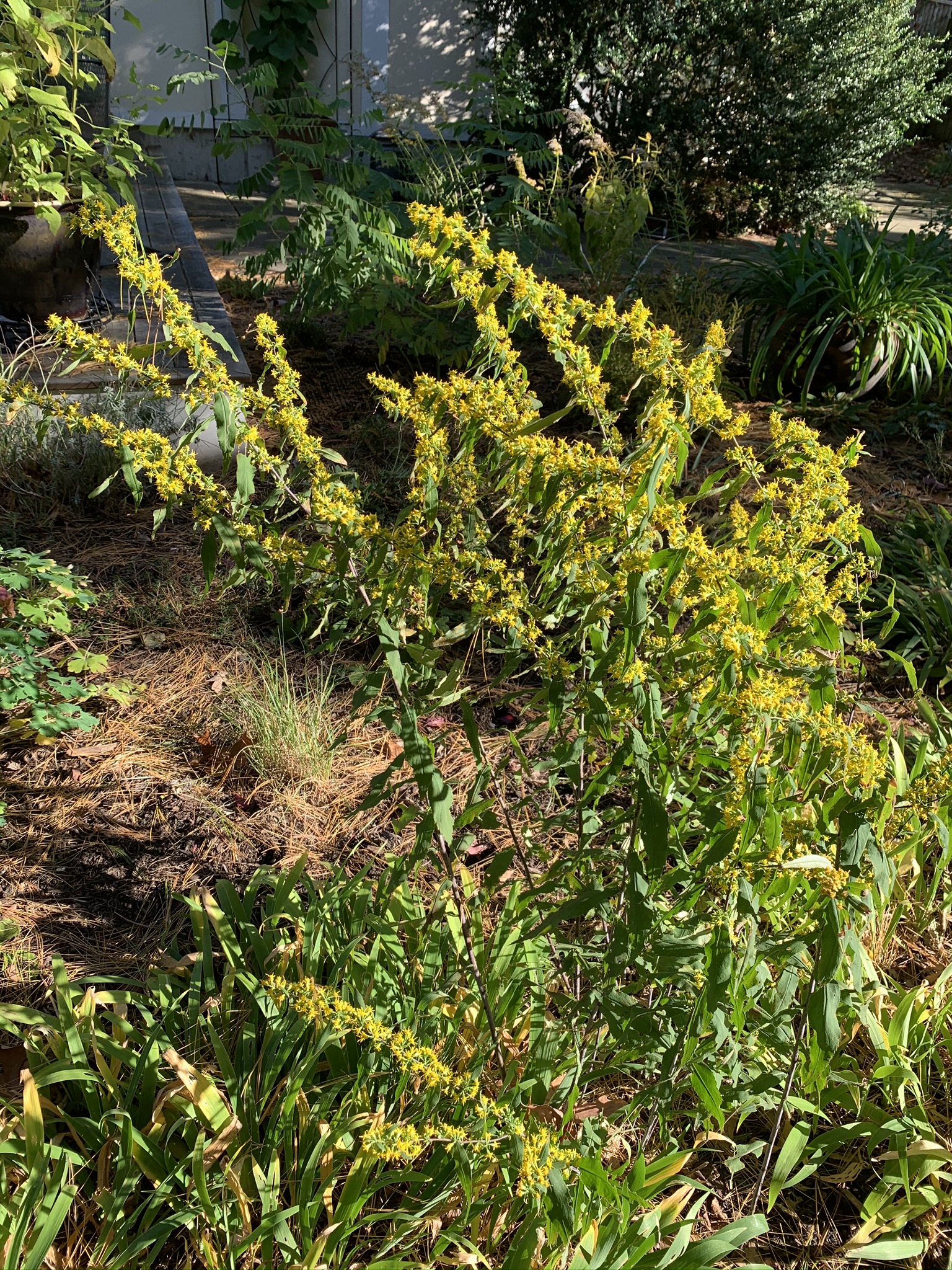
In contrast, the goldenrods (Solidago spp.) and asters (Symphiotrichum spp.) are unfazed.


Goldenrod dealing with drought

     I notice that some perennials with fleshy roots have an advantage. Smooth Solomon’s seal (Polygonatum biflorum) is still holding up its leaves. In the cutting garden, the cosmos (Cosmos bipinnatus) has turned completely brown, but dahlias are going strong. Presumably rhizomes and other fat root forms store water for hard times.


Smooth Solomon's seal has fleshy roots
 
     I find myself wishing that some of the rain flooding the Gulf Coast would come our way. We’re supposed to get some remnants from Hurricane Delta next week. May it be so! At this point I’ll only believe it when I see it, because so much forecasted rain hasn’t materialized.


New England aster holding up well


Sunday, July 26, 2020

Weathering drought

This May I posted about my suspicion that I was over-watering my garden, and why that was environmentally unsound. The post prompted me to cut back drastically on watering via our sprinkler irrigation system. Until this summer, I had the system programmed to deliver water twice weekly to each of twelve irrigation zones.

    I was aware that most of my established trees, shrubs, and perennials were well adapted to dry spells during New England summers. They needed frequent watering in their first two years while they got settled and developed a generous network of roots. After that, they should be able to thrive without supplemental watering, except at the driest times. 


Established plants should be able to cope with dry summer conditions

    So why didn’t I cut out the watering after plants entered their third year in the garden? One excuse is that I was continually adding new plants, so often a bed with older plants also contained newcomers. But I think the real reason was that in my heart, I didn’t really believe that my babies could make it through the summer without a regular soaking two or three times per week.


Would the balloon flowers perish without watering?

    After challenging myself with that blog post, I decided to focus on watering areas where I’m growing vegetables, annuals, and newly planted and perennials. In the rest of the garden, I’d stop irrigating. If individual plants needed water, I’d water them by hand.


I'm still watering a bed of vegetables and pollinator plants

     Overall, I’m surprised and pleased at how well the garden is looking this year with about a third as much irrigation as I gave it during the last few summers. My area is experiencing a mild drought. This weekend we were 5 inches behind our average precipitation for the year, despite heavy rains this week. Yet the garden is chugging along, not noticeably daunted by the dry conditions.


Doing fine without watering

    Over the years I did reduce watering in some of the irrigation zones that contained only mature plants. A red-leaved Japanese maple (Acer palmatum ‘Atropurpureum’) and mostly evergreen shrubs in a bed of vinca (Vinca minor) in the front yard got less and less irrigation. This year this zone is getting none, which highlights an issue with my planting plan.
     

     Two mountain hydrangeas (Hydrangea serrata) that I planted in the front yard don’t tolerate dry spells the way the other denizens do. The hydrangeas wilt dramatically after three days without rain or irrigation. 

Lacecap hydrangea starting to wilt

This year, instead of taking that as a cue to irrigate the whole bed, I’m watering the hydrangeas with a watering can. That seems to suit them fine. 

     I could have avoided this complication if I’d thought to group plants that need lots of water together in one irrigation zone, as a Xeriscape gardener would do. That way I could have lavished water on one section close to the house and let the rest of the yard fend for itself.


     By taking parched conditions in stride, the garden is teaching me a lesson. I’m seeing that it’s OK to let my plants live as they would naturally, including tolerating some dry times. 


Coneflowers unfazed by summer weather

Sunday, September 10, 2017

Gypsy moth: more complicated than you'd think

While waiting last week for my computer to return from urgent care, I contemplated a talk about biological controls by Joseph Elkinton, a professor of environmental conservation at the University of Massachusetts, that I heard last November. 

Gypsy moth caterpillar

    What Elkinton said about the history of gypsy moth in North America turns out to be unexpectedly relevant. We had a gypsy moth surge in 2016, and this year there has been significant defoliation by gypsy moth caterpillars, especially in southeastern Massachusetts.

Voracious gypsy moth caterpillars shred leaves

    A complicated web of factors influences the gypsy moth population. It all goes back to acorns.


    Gypsy moth (Lymantria dispar), native to Europe, was introduced to Medford, Massachusetts by Étienne Léopold Trouvelot, an astronomer dabbling in silk worm breeding. He thought he could cross the gypsy moths with native silk moths to produce silk in the US. The insects escaped from his home in the 1860s, and over 50 years they slowly established themselves in the wild. They’ve spread as far as Minnesota and North Carolina.


Life stages of the gypsy moth

    Elkinton explained that until 1989, gypsy moths experienced population outbreaks about every 10 years. Throughout the twentieth century, predator insects were introduced in hopes of controlling the gypsy moth population, but none did enough.


Predatory wasps kill caterpillars, but not enough

     Meanwhile, research into the ecology of the gypsy moth uncovered a system of natural controls. Robert Campbell of the US Forest Service found that the white-footed mouse was the most significant predator of the caterpillars, with birds less of a factor.

White-footed mouse, Peromyscus leucopus, in captivity

     Mouse populations rose and fell with the supply of their main food, acorns, which fluctuated with weather conditions. The mice couldn’t expand their population enough to control gypsy moth outbreaks, when caterpillar numbers spiked exponentially.

    Outbreaks were brought to an end by Nuclear Polyhedrosis Virus (NPV), which eventually killed up to 99 percent of the horde of larvae.


    This cycle continued until another accidental foreign introduction in 1989: Entomophaga maimaiga, a Japanese fungus. Infected by the fungus, gypsy moth caterpillars suddenly died all over southern New England.


    So with mice, viruses and fungi controlling its population, why is gypsy moth surging again? The levels of fungus are highest in wet years. Last year’s severe New England drought allowed the gypsy moth population to escape from its fungal control. This summer, caterpillars chomped foliage until June, when they started to die off. Caterpillars examined by Elkinton’s team showed a combination of viral and fungal infections. Wet weather had turned the tide.


    This means, thank heavens, that we don’t have to make the difficult decision whether to spray for gypsy moth.


    The future outlook for New England trees is mixed. Gypsy moths won’t die out completely, and our trees face a number of stresses from drought and other nonnative insect attacks. A tree can survive one defoliation, but repeated losses deplete its energy stores. Elkinton worries about major losses of native oaks, which the caterpillars particularly enjoy. Then what will happen to the white-footed mice?


Sunday, June 18, 2017

Water, water all around

With Massachusetts’ drought officially over as of May 10,  I’m feeling more comfortable about watering my garden. 

Nice to see rain on the hostas

I’m happy when it rains, even though some of my annual plants, most noticeably the tomatoes, are slow to take off this spring because of fewer sunny days. 

     With plentiful rain comes other problems, though. During last week’s heavy rain, water streamed down the street in front of our house toward the storm drains.


Rainwater heading for the storm drain

    Rainwater running off roofs and down driveways in our neighborhood could be carrying toxic chemicals from both surfaces into storm drains and through them to rivers and Boston Harbor. The EPA, the Massachusetts Department of Environmental Protection, and local government all advocate keeping rainwater at home, not letting it wash into the street.


     Our section of town backs up against the Charles River, which is one of our area’s most beautiful and prized natural resources. 


A quiet spot along the Charles

Years of effort have gone into restoring it from a toxic waste stream to a place where people and wildlife can enjoy the benefits of clean water. 

     At this point, storm water runoff is most of what pollutes the Charles by carrying oil, grease, gasoline, pet waste, detergents, pesticides, fertilizer, and trash into the river. 

Overgrowth of algae in a river caused by fertilizer runoff

Rain should be soaking into the soil to replenish groundwater, but with more areas paved or covered with lawns that slope toward the street, it flows into storm drains instead. 

     Not wanting to be part of the problem for the river, in 2013 we agreed to install two 14-foot strips of porous paving in our driveway. One runs from a downspout at the corner of the house toward the street. The other crosses the width of the driveway alongside the sidewalk. 


     This material looks like asphalt but allows water to flow through to a layer of crushed stone which holds the water while it gradually percolates into the subsoil. When it rains, we can see that water no longer flows down the driveway into the street. As the water reaches the porous paving, it disappears into the ground.

Water drains through the darker porous paving

     Our sandy soil drains fast. We never see flooding in our yard. Rainwater falling on soil sinks into the ground and doesn’t flow toward the neighbors’ paved parking area behind our lot. So the porous paving in the driveway is enough to prevent storm water from running off our property.


Rainwater doesn't flow off the berm at the back of the yard


     Rainwater streaming from downspouts and driveways into the street now looks to me like a waste. Instead of watering with purified tap water, we could be collecting storm water and using it in our gardens. I calculate that the rain falling annually on our 1,900-square-foot roof could supply just about all the water I use for irrigation. 


     So have I been harvesting water that falls on the roof? No, I’m sorry to say I haven’t. The obstacles are cost and the prospect of digging a huge hole in the garden for an underground cistern. Maybe 

someday. Meanwhile, I’m enjoying the irrigation that’s falling from the sky.

Diverting some rainwater with a rain barrel


Sunday, March 12, 2017

The endangered EPA

It’s been a big week for climate change deniers and polluters. First Scott Pruitt, the new leader of the Environmental Protection Agency, opined that carbon dioxide from human activity isn’t causing global warming. Then Florida Congressman Matt Gaetz sponsored a bill to eliminate the EPA altogether. Meanwhile, the Trump administration proposes to cut EPA funding by 25 percent.

    Where would we be if the EPA hadn’t been at work since 1970? Without it, gardens would be in poor shape for so many reasons.


As spring flowers open, I'm grateful to the EPA for protecting the garden environment

    Remember acid rain? Sulfur dioxide and nitrogen oxides from Midwest power plants used to drift eastward, damaging northeastern forests. The big oak tree that anchors my garden would likely have succumbed to this toxic mix, along with many of its fellows. Instead, thanks to air pollution standards, New England forests rebounded. 


    Back when America was “great,” lead from gasoline routinely accumulated in garden soil. Our lot is small; no part of it is far from roads and car exhaust. If it weren’t for the EPA’s phase-out of leaded gas, we might not be able to eat vegetables from our own yard without risking brain damage from lead poisoning.


With lead in soil from exhaust, we'd have to skip the home-grown tomatoes

    I can thank the EPA for keeping me in shape to garden. Mental health used to be a smoky job, with many of our patients chain-smoking. EPA insisted on the link between secondhand smoke and cancer, lung and heart disease. Clinical encounters are now smoke-free. If I’d breathed secondhand smoke for 40 years, would I still be able to wield a shovel or a rake?


    The EPA has banned or restricted toxic chemicals we formerly used in our landscapes, starting with DDT. In 1972, many bird populations were dangerously low, poisoned by DDT as it concentrated up the food chain. Now bald eagles are back, and healthy native birds visit my yard.


Bald eagles chicks, safe without DDT

    Businesses chafe at EPA regulations that prevent them from exploiting our natural resources and sticking the rest of us with the externalized costs in money, health, and environmental damage. That seems to be the motivation for Pruitt’s long career of suing the EPA and his current mission to destroy it.


     Now more than ever, we need the government scientists who’ve been supplying the data on climate change that the Trump team plans to ignore or shred. I can only imagine how sad and infuriating it would be to see your life’s work heading for the electronic recycle bin.


Berkeley data hack saving NASA and DOE research--photo by Jamie Lyons

Because of that data and much more from climate scientists around the world, the previous administration forged ahead on regulations like the Clean Power Plan, which restricted carbon dioxide emissions from power plants, directing us toward renewable energy sources. 

     If climate change continues to accelerate, gardeners can expect more extreme weather and increases in flooding and drought. For the sake of our gardens and our life on Earth, I hope we’ll benefit from the EPA’s protection for many years to come.

Sunday, November 13, 2016

Weathering disappointments

Back in April there was no reason to think this wouldn’t be a typical gardening season. Various weather phenomena were jockeying for position—spring rain, late snow, cool sunny days, warm spells.

Everything seemed normal in April

     Drought was in the running, but no one thought it could win. It was offensive, and it just didn’t fit with our New England (horti)culture. After all, we were well-informed, progressive gardeners. We knew our history, and we knew the climate wouldn’t deal us such a blow.

Not In Our Back Yard

    June and July were awfully dry. Against all odds, drought seemed to be pulling ahead. Other weather options tried to compete. Heat and humidity made a bid for the top slot. They seemed much more likely to win. Their kind had always won in the past. Clearly drought was going to fade. It couldn’t make a sustained run. We could all see its deficits. It wouldn’t supply the needs of our plants. It was just a matter of time until rain would take the lead, and we’d be back to a normal gardening summer.


    Pundits explained that drought was bound to fizzle out. Statistics showed that summer rain was by far the more likely pattern. Comparing this summer to previous ones, it was obvious that drought couldn’t maintain a lead in New England.  It might hold on in the Western states, but not here.


Clearly drought couldn't last

     
Everyone we knew was in favor of rain. It was more popular than ever. In the past eight years, rain had started us on the right path. Rain had promoted new growth that we all wanted to continue. Anyone could see that a balance of rain and sun was in everyone’s interest.


On a green path in years past

    As the summer dragged on, drought brought out the worst in us. It was tempting to water our own yards and forget about the gardeners who couldn’t. People were angry. 


Green grass wins out over community spirit

    We weren’t surprised when a scandal hit the news: drought was assaulting our most vulnerable plants. That was sure to clinch its defeat. There was a wave of outrage. State officials warned that if drought continued in the lead, crops would be destroyed and endangered animals would die. 


Drought was destructive

Gardeners would need to water less. We’d make some sacrifices for the common good. But that would turn the tide, surely.

    Despite some fall rain, a late October dirty trick put drought back on top. We hoped no one would be fooled.


    You all know the end of this story. Tuesday night we sat down to watch the returns, nervous but still certain that drought would be defeated. That’s what all the experts predicted. Rain was going to come, and we could stop worrying.


    Instead, we woke up Wednesday morning to face the reality: drought was still with us. In fact, we’d be dealing with the painful consequences for a long time to come.


    Fortunately the gardening world is made new every spring. We can still hope that winter snow and spring rain will bring lush gardens next summer. If only other disappointments faded as fast.


Gardens may be green next year, but will we lose our last chance to slow climate change?

Monday, October 3, 2016

Rain at last!

Whoopee! I’ve returned from a vacation in dry and sunny Italy

Ah, Venice . . .

to find that the Boston area had almost an inch of rain while I was away. It’s amazing how different the garden looks with just that much welcome refreshment.

Wet at last

     The lawn has turned green again, and in containers and beds plants are looking peppy, shedding their tired late-summer appearance. It helps that some fall color is starting to show. Fall-blooming flowers are beginning their display. The whole garden scene is a lot more encouraging.


Japanese maple leaves starting to turn red

    How long will this last? Occasional showers are expected into next week as a storm system gradually moves away. We heard predictions of possible showers all summer, though, and most of them either didn’t occur or dropped only light sprinklings that wet the leaves without seeming to moisten the soil. We haven’t seen sustained rain like Saturday’s in a long time.


    Can’t leaves absorb moisture even if sprinklings of rain don’t make it to the ground? Some water can get in through the stomata, pores that open to allow water out of leaves under non-drought conditions. That’s enough to reverse wilting temporarily. I suppose it’s one reason for creating a humid environment around our house plants with misting or pebble trays.


Ornamental grass flower holding water droplets

     But leaves of most plants can’t take in enough moisture to replace water from soil. Come to think of it, some of those house plants originate in the cloud forest, where absorbing water through leaves is a more common adaptation. New England natives need to get their water from the ground.

Even huge leaves of elephant ears can't absorb all the water the plant needs

    Last week’s inch of rain permeates the top twelve inches of soil. My sandy loam takes in water easily, but it also lets water flow through quickly. Sand holds water by capillary action, the way a sponge or a paper towel does. As water drains through sandy soil, soil moisture drops to the wilting point, the proportion at which plant roots can’t extract water they need. We saw that happen over and over again this summer.


Hydrangea at the wilting point

    Soil water retention is one reason that adding organic material such as compost is so important. The chemical properties of organic material enable soil to hold more water for longer because of adsorptive forces that surround soil particles with a film of water molecules. 


    I hope that compost and leaf litter—leaves decomposing in place when I didn’t rake or blow them away—are giving my plants a chance to take advantage of this long-awaited rain. If these soil builders just lie on top of the soil, at least they’re preventing evaporation, holding moisture in the soil for longer than if it were bare. 


Compost to the rescue!

    Incorporated into soil by organisms ranging from fungi and bacteria to nematodes, insects, and earthworms, the organic matter does even better. The organic particles hold water near the surface where roots can drink it in. Cheers, Salud, and L’chaim!