My book and web site

Check out my book, The Sustainable-Enough Garden, available on Amazon, and the book's web site at www.thesustainable-enoughgarden.com. See more plant photos on Instagram.
Showing posts with label irrigation. Show all posts

Sunday, October 11, 2020

Getting by without rain

In late July I blithely congratulated myself on watering less, assuming that rain would come and my plants would be refreshed without supplemental irrigation. My expectations were way off. In the month of September, we got less than an inch of rain. So far October is just as dry.

The garden is drooping

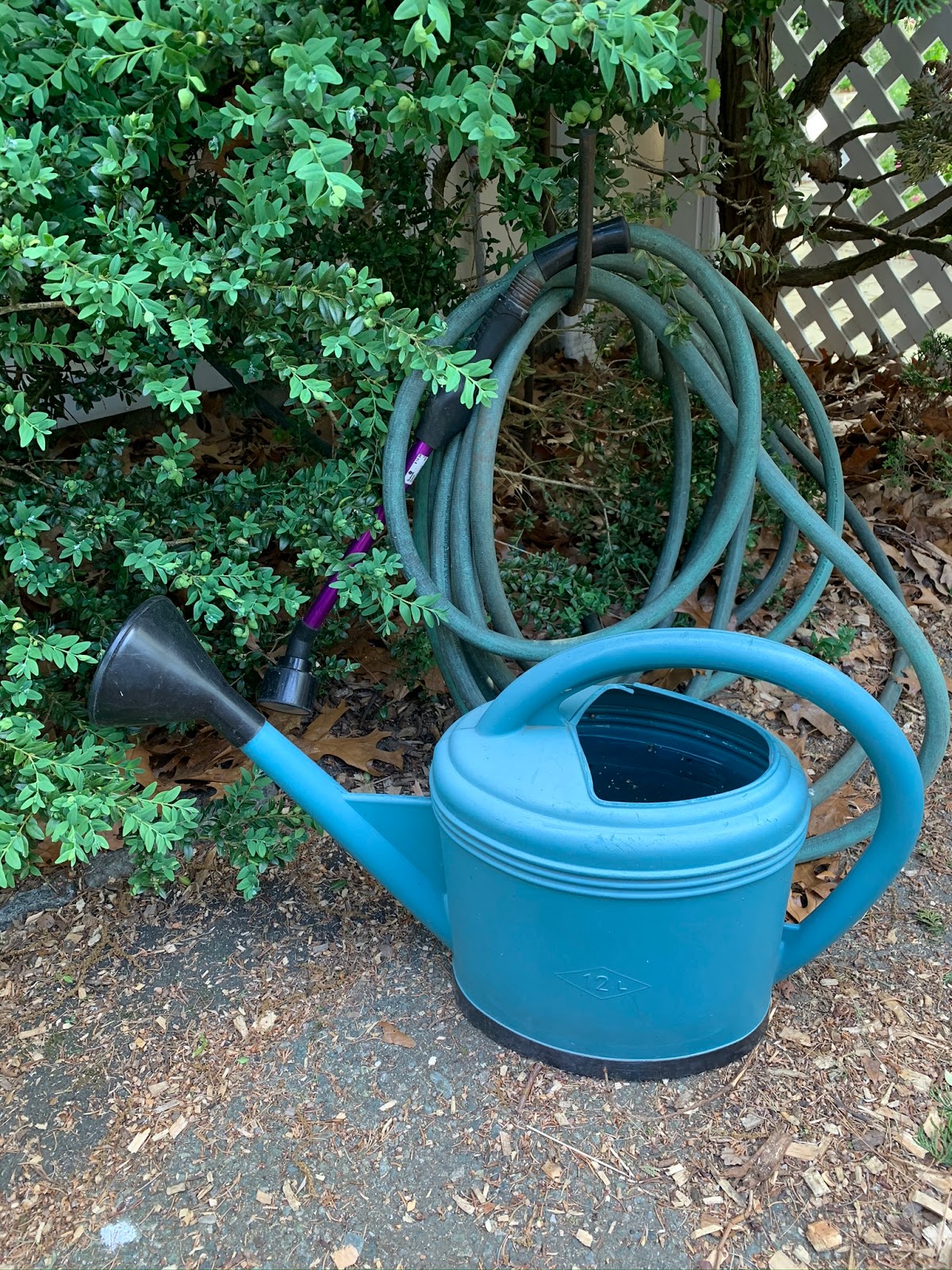
    During the drought, I’ve had to make difficult decisions about watering. I’m finding out the hard way which plants can tolerate sustained dryness. For container plants, it was easier to know what to expect. In hot weather, they wouldn’t last more than a day or two without watering, because the small volume of growing medium in the pot dries out so fast. Those I kept watering with the hose wand or watering can.


    Then there were newly planted perennials and shrubs. Before the drought, I optimistically planted in new areas. When we replaced a rotting stockade fence with chain link last fall, I planted a row of evergreens. In spring I added a buttonbush (Cephalanthus occidentalis


The buttonbush has survived so far

and moved a chokeberry (Aronia arbutifolia) to a sunny spot nearby. Around the garden pond, I planted native perennials for pollinators: false aster (Boltonia asteroides), northern blazing star (Liatris novae-angliae), wild bergamot (Monarda fistulosa), and mountain mint (Pycnanthemum muticum). All these will need supplemental watering for their first two years. I’ve kept at it with the watering can.


Northern blazing star at the end of its first season
 
    For the rest, it was survival of the fittest. The lawn completely surrendered. With our dog and her friends racing around on its parched surface, the grass wore away completely. Luckily, turf grass is my least favorite garden plant. It should grow in cool, damp environments like the British Isles, where it belongs.


So much for the grass

    In the drought, it’s easy to see the advantage of protective adaptations like waxy leaves. The boxwood (Buxus sempervirens) hasn’t batted an eye. The vinca (Vinca minor) groundcover in the front yard is starting to droop after two full months with no water at all, but it’s still green—another reason I’m glad it replaced the former front lawn.

Vinca has proven very tough

But some waxy leaves of a few evergreen shrubs are turning yellow or brown, as on the Catawba rhododendrons (Rhododendron catawbiense) and mountain laurels (Kalmia latifolia).


Rhododendron leaves yellowing
 
    Softer deciduous leaves are drooping. Even the Canadian wild ginger (Asarum canadense), which is usually impervious, has flopped to the ground. 


Wild ginger has collapsed
 

In contrast, the goldenrods (Solidago spp.) and asters (Symphiotrichum spp.) are unfazed.
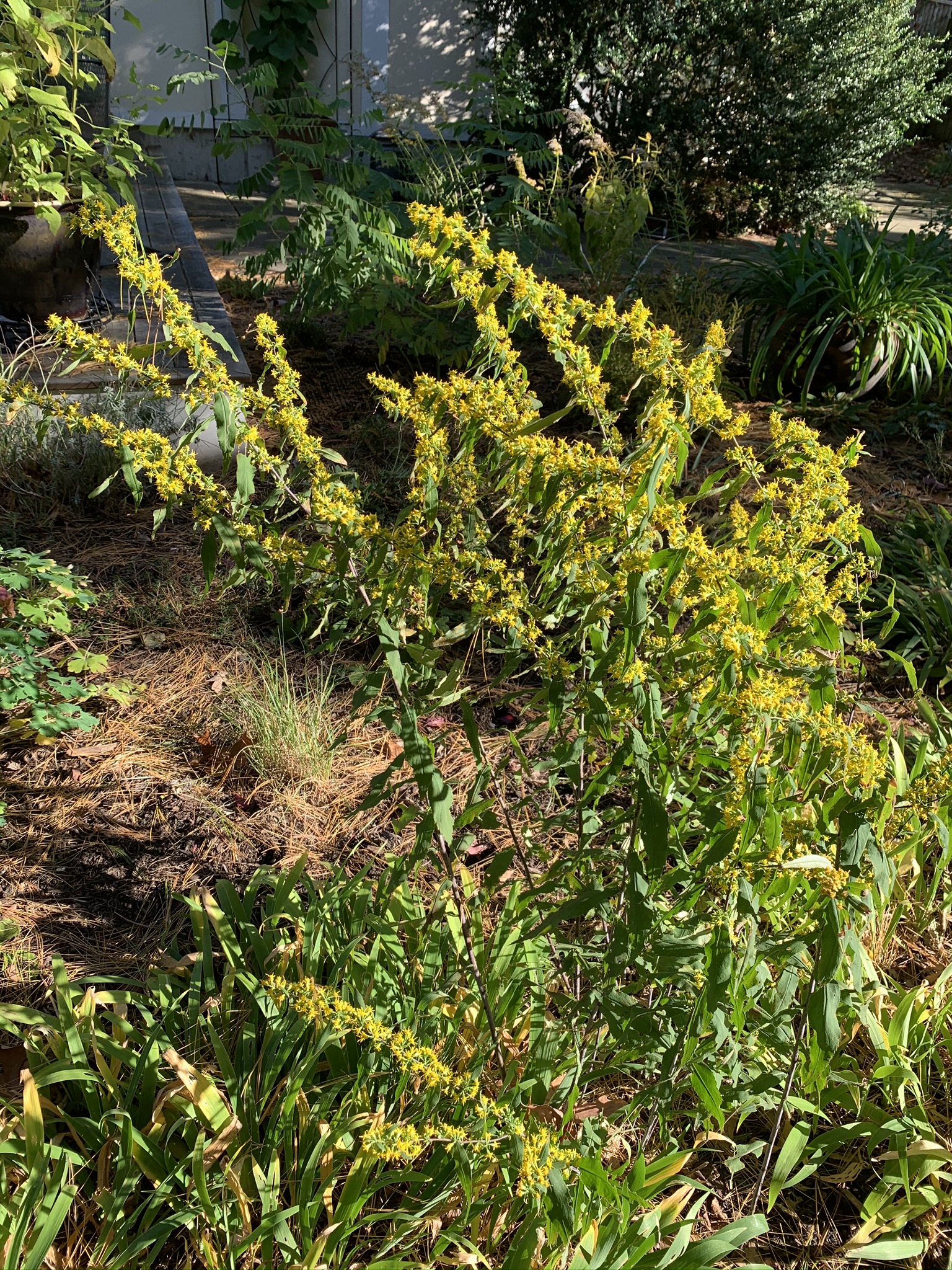

Goldenrod dealing with drought

     I notice that some perennials with fleshy roots have an advantage. Smooth Solomon’s seal (Polygonatum biflorum) is still holding up its leaves. In the cutting garden, the cosmos (Cosmos bipinnatus) has turned completely brown, but dahlias are going strong. Presumably rhizomes and other fat root forms store water for hard times.


Smooth Solomon's seal has fleshy roots
 
     I find myself wishing that some of the rain flooding the Gulf Coast would come our way. We’re supposed to get some remnants from Hurricane Delta next week. May it be so! At this point I’ll only believe it when I see it, because so much forecasted rain hasn’t materialized.


New England aster holding up well


Sunday, July 26, 2020

Weathering drought

This May I posted about my suspicion that I was over-watering my garden, and why that was environmentally unsound. The post prompted me to cut back drastically on watering via our sprinkler irrigation system. Until this summer, I had the system programmed to deliver water twice weekly to each of twelve irrigation zones.

    I was aware that most of my established trees, shrubs, and perennials were well adapted to dry spells during New England summers. They needed frequent watering in their first two years while they got settled and developed a generous network of roots. After that, they should be able to thrive without supplemental watering, except at the driest times. 


Established plants should be able to cope with dry summer conditions

    So why didn’t I cut out the watering after plants entered their third year in the garden? One excuse is that I was continually adding new plants, so often a bed with older plants also contained newcomers. But I think the real reason was that in my heart, I didn’t really believe that my babies could make it through the summer without a regular soaking two or three times per week.


Would the balloon flowers perish without watering?

    After challenging myself with that blog post, I decided to focus on watering areas where I’m growing vegetables, annuals, and newly planted and perennials. In the rest of the garden, I’d stop irrigating. If individual plants needed water, I’d water them by hand.


I'm still watering a bed of vegetables and pollinator plants

     Overall, I’m surprised and pleased at how well the garden is looking this year with about a third as much irrigation as I gave it during the last few summers. My area is experiencing a mild drought. This weekend we were 5 inches behind our average precipitation for the year, despite heavy rains this week. Yet the garden is chugging along, not noticeably daunted by the dry conditions.


Doing fine without watering

    Over the years I did reduce watering in some of the irrigation zones that contained only mature plants. A red-leaved Japanese maple (Acer palmatum ‘Atropurpureum’) and mostly evergreen shrubs in a bed of vinca (Vinca minor) in the front yard got less and less irrigation. This year this zone is getting none, which highlights an issue with my planting plan.
     

     Two mountain hydrangeas (Hydrangea serrata) that I planted in the front yard don’t tolerate dry spells the way the other denizens do. The hydrangeas wilt dramatically after three days without rain or irrigation. 

Lacecap hydrangea starting to wilt

This year, instead of taking that as a cue to irrigate the whole bed, I’m watering the hydrangeas with a watering can. That seems to suit them fine. 

     I could have avoided this complication if I’d thought to group plants that need lots of water together in one irrigation zone, as a Xeriscape gardener would do. That way I could have lavished water on one section close to the house and let the rest of the yard fend for itself.


     By taking parched conditions in stride, the garden is teaching me a lesson. I’m seeing that it’s OK to let my plants live as they would naturally, including tolerating some dry times. 


Coneflowers unfazed by summer weather

Monday, May 25, 2020

Watering smarter

On warm days this week, I’ve resumed one of summer’s tasks: watering. Back when my garden was young and all the plants were new, I was grateful to have a computerized irrigation system to keep them lush. Over the years, though, I’ve become increasingly conscious of using too much water. 


Automatic sprinkler watering the lawn and nearby beds

One of the environmental downsides to using purified drinking water in the garden, as I do, is its energy cost. Water utilities consume 3 percent of the energy generated in the United States. By cutting back on automatic irrigation, I can make a small contribution to the fight against global warming.

Clean drinking water comes with a carbon cost

Our sprinkler irrigation system was typical for our area when it was installed in 1997. It divides the yard into twelve watering zones, and it’s controlled by a computer in the basement. An attached rain gauge prevents watering after a storm. In retrospect, I could have saved a lot of water by choosing drip irrigation instead of sprinklers. 

Drip irrigation in an almond orchard. Emitters deliver water only to the trees' root zones

A drip system for trees and shrubs would direct water to exactly where it’s needed. Sprinklers inevitably lose water to evaporation. I cringe a bit when I see sprinklers in the neighborhood running in the middle of the day. To minimize that evaporative loss, I program the sprinklers to run after midnight, when it's dark and cool. That’s still less efficient than drip emitters would be. 


Another wasteful feature: our system’s watering zones were laid out when the garden was new. Sprinkler heads placed to water sections of lawn now cover a mix of grass and young and old shrubs and perennials. I don’t have the flexibility to target just the new plantings within a zone. 


Some environmentally-minded gardeners water only by hand, even in the relatively wet Northeast. A lovely garden I visited last summer is maintained without an irrigation system. The homeowner and garden designer explained that most of her garden gets no supplemental watering. When she needs to water new plants, she fills a bucket or watering can from one of her rain barrels.


Water from barrels at downspouts is sufficient for Joanne's native plant garden


At this stage, most of my garden is comprised of established trees, shrubs and perennials. They’ve spread their roots far and wide to find water when soil is dry. New England plants have adapted to survive our summer dry spells, even without the kind of Xeriscaping that’s appropriate to arid parts of the country. A lot of the irrigation I’ve been doing is probably unnecessary at this point.

It's pretty in May, but sweet woodruff is taking over, maybe because of steady moisture from irrigation.

The bold move would be to cut off irrigation to those older plants, at least until I see that they’re really suffering from drought. New plants will still need two years of watering to get established. That’s where watering cans and hose wands come in.


Ready for summer

Hand watering has its pleasures, especially in summer’s soft morning and evening light. That’s often when I truly see these new arrivals to the garden. I notice the unique patterns of new leaves and register the weeds emerging alongside. I’m looking forward to observing more closely this summer.


Sunday, August 6, 2017

Let it rain

What a lush garden year we’re having! Last summer’s gardens were parched by drought. This summer the Northeast has been blessed with plentiful rain. 

Foliage is thriving thanks to plentiful rain

As of August 6, we’d had 30.83 inches of precipitation in the Boston area in 2017, well above the average of 25.88 inches by this date. You can probably see the difference in your garden; I certainly can in mine.

    Why should that be? What makes rain better for gardens than irrigation? We run a sprinkler irrigation system, so unless I cut back on scheduled watering, my plants should be getting enough water even when it doesn’t rain.


Water beads on a giant elephant ear leaf

    There are limitations to even the best-designed irrigation system. Ours is set up in 12 watering zones. Twice a week, sprinkler heads pop up in the early morning and start spraying in a programmed sequence, controlled by a computer in the basement. A rain sensor prevents watering when there’s been adequate rain. With this system, I lavish a lot of water on the garden, sometimes more than my conscience tells me I should.

    Theoretically every plant gets plenty of irrigation water, but in practice, I’ve learned, it’s not that simple. As the garden has matured, shrubs have grown wide and tall, hogging the spray of water and creating dry shadows behind their bulk. And the arcs described by the sprinklers’ spray don’t fit exactly to every angle and curve of plantings. Inevitably some patches get less irrigation.


    Beyond falling evenly on the whole garden, rain conveys numerous advantages:


Lots of rain is helping this St. John's wort get established

•    Whereas irrigation water contains dissolved minerals, including calcium, magnesium and sodium, rainwater is “soft” and mineral-free. As a result, it pulls nutrients by diffusion from where they're bound in the soil, making them available to plants’ roots.
•    Rain water is acidic, which promotes release of micronutrients including zinc, manganese, copper and iron that plants need. Most of my garden soil is acidic already, but there may be alkaline areas where concrete paving leaches lime. Acidic rainwater is especially beneficial in those spots.


Soil next to sidewalks may be alkaline

•    Rain falls at 20 miles per hour, penetrating soil better than irrigation water, which falls at 5 mph.
•    Rain is saturated with air, so it oxygenates soil. That’s good for plants
•    Rain contains nitrogen in the form of nitrate and ammonium from the air. This nitrogen becomes available to plant roots and promotes growth.


Big canna leaves can use a boost from extra nitrogen in rain

•    Rain doesn’t contain the chlorine that comes with treated drinking water. Chlorine inhibits plant growth.
•    Rain flushes salts (such as road salt) that inhibit growth through the root zone and washes mineral deposits, dust and pollutants off leaves, making for more effective photosynthesis.


The proof is in the pudding. The garden looks happier this year with more rain. 


New plants I added in June and July are surviving, despite the heat. Just watering them might not have been enough if it hadn’t been for well-timed, frequent rain.

Sunday, July 31, 2016

Dry and thirsty

The recent heat wave following on a months-long drought displays the many mistakes I made regarding water when I designed my garden. In hindsight, it’s easy to see better choices I should have made.

    Most basic was plant choices. Xeriscape, a water-conscious approach to garden design, provides guidelines for selecting plants that don’t need supplemental watering. Some tips: smaller leaves generally need and lose less water, grayish or fuzzy foliage usually means a plant is drought-tolerant, low-growing plants avoid drying winds, and plants with a scent, such as lavender, produce aromatic oils that help plants hold onto water. I did end up with some plants with each of these characteristics, but not out of any conscious plan.


Gray, fuzzy leaves of lambs' ears (Stachys byzantina) conserve water


    Next, I should have grouped plants based on their water needs. Putting thirsty hydrangeas next to water-sipping catmint, with its small gray leaves, might have looked nice, but it meant I under-watered the hydrangeas and probably used more water on catmint than it needed—though it didn’t complain.


Hydrangeas need a lot of water


    Then there was my choice of irrigation method.


Sprinklers lose water to evaporation

The sprinkler system we installed was standard for our city, but I could have saved on evaporation by using soaker hoses, which sweat droplets of water, or drip irrigation, with small emitters that deliver water precisely to the spot its needed at the base of a tree or shrub.

    My rain barrel is a small step toward collecting rain to irrigate the garden. 


The rain barrel is great--when it rains

I wish I’d thought to install an underground cistern to store all the rainwater that falls on the roof before I planted my garden. If I had, in an average year the cistern could have supplied my garden’s irrigation needs. This is certainly not an average year, though. To irrigate with rainwater, you have to have rain, and this year that’s been scarce.
 
    So at this point, my garden is looking sad and parched. 


A forsythia wilting outside the range of the irrigation sprinklers

With a guilty conscience, I supplement scheduled irrigation from the sprinkler system with evening use of a rotating sprinkler to revive wilting plants in areas the automatic system misses (evening watering is recommended to minimize evaporation). 

     We get our water from the Quabbin and Wachusett reservoirs in western Massachusetts, and our water authority hasn’t imposed a watering ban so far. Not so lucky are gardeners whose water comes from town supplies, nearby rivers, or wells on their own property. I can only imagine how painful it would be to watch cherished plantings die from lack of water.

    If I ever build a new house, I’ll put in that underground rainwater cistern before I start planting, and I’ll push for a graywater system too. That would collect water from sinks, dishwasher, clothes washer, and shower to reuse for irrigation. The city of Las Vegas has this all worked out long since. 


     In the meantime, I’ll make sure I dump water from the sink on garden beds when I can instead of letting it flow down the drain, and I’ll think about less lawn and more drought-tolerant native plants for next year.

Cucumbers on the deck benefit from any spare water from the sink