My book and web site

Check out my book, The Sustainable-Enough Garden, available on Amazon, and the book's web site at www.thesustainable-enoughgarden.com. See more plant photos on Instagram.
Showing posts with label watering. Show all posts

Monday, May 25, 2020

Watering smarter

On warm days this week, I’ve resumed one of summer’s tasks: watering. Back when my garden was young and all the plants were new, I was grateful to have a computerized irrigation system to keep them lush. Over the years, though, I’ve become increasingly conscious of using too much water. 


Automatic sprinkler watering the lawn and nearby beds

One of the environmental downsides to using purified drinking water in the garden, as I do, is its energy cost. Water utilities consume 3 percent of the energy generated in the United States. By cutting back on automatic irrigation, I can make a small contribution to the fight against global warming.

Clean drinking water comes with a carbon cost

Our sprinkler irrigation system was typical for our area when it was installed in 1997. It divides the yard into twelve watering zones, and it’s controlled by a computer in the basement. An attached rain gauge prevents watering after a storm. In retrospect, I could have saved a lot of water by choosing drip irrigation instead of sprinklers. 

Drip irrigation in an almond orchard. Emitters deliver water only to the trees' root zones

A drip system for trees and shrubs would direct water to exactly where it’s needed. Sprinklers inevitably lose water to evaporation. I cringe a bit when I see sprinklers in the neighborhood running in the middle of the day. To minimize that evaporative loss, I program the sprinklers to run after midnight, when it's dark and cool. That’s still less efficient than drip emitters would be. 


Another wasteful feature: our system’s watering zones were laid out when the garden was new. Sprinkler heads placed to water sections of lawn now cover a mix of grass and young and old shrubs and perennials. I don’t have the flexibility to target just the new plantings within a zone. 


Some environmentally-minded gardeners water only by hand, even in the relatively wet Northeast. A lovely garden I visited last summer is maintained without an irrigation system. The homeowner and garden designer explained that most of her garden gets no supplemental watering. When she needs to water new plants, she fills a bucket or watering can from one of her rain barrels.


Water from barrels at downspouts is sufficient for Joanne's native plant garden


At this stage, most of my garden is comprised of established trees, shrubs and perennials. They’ve spread their roots far and wide to find water when soil is dry. New England plants have adapted to survive our summer dry spells, even without the kind of Xeriscaping that’s appropriate to arid parts of the country. A lot of the irrigation I’ve been doing is probably unnecessary at this point.

It's pretty in May, but sweet woodruff is taking over, maybe because of steady moisture from irrigation.

The bold move would be to cut off irrigation to those older plants, at least until I see that they’re really suffering from drought. New plants will still need two years of watering to get established. That’s where watering cans and hose wands come in.
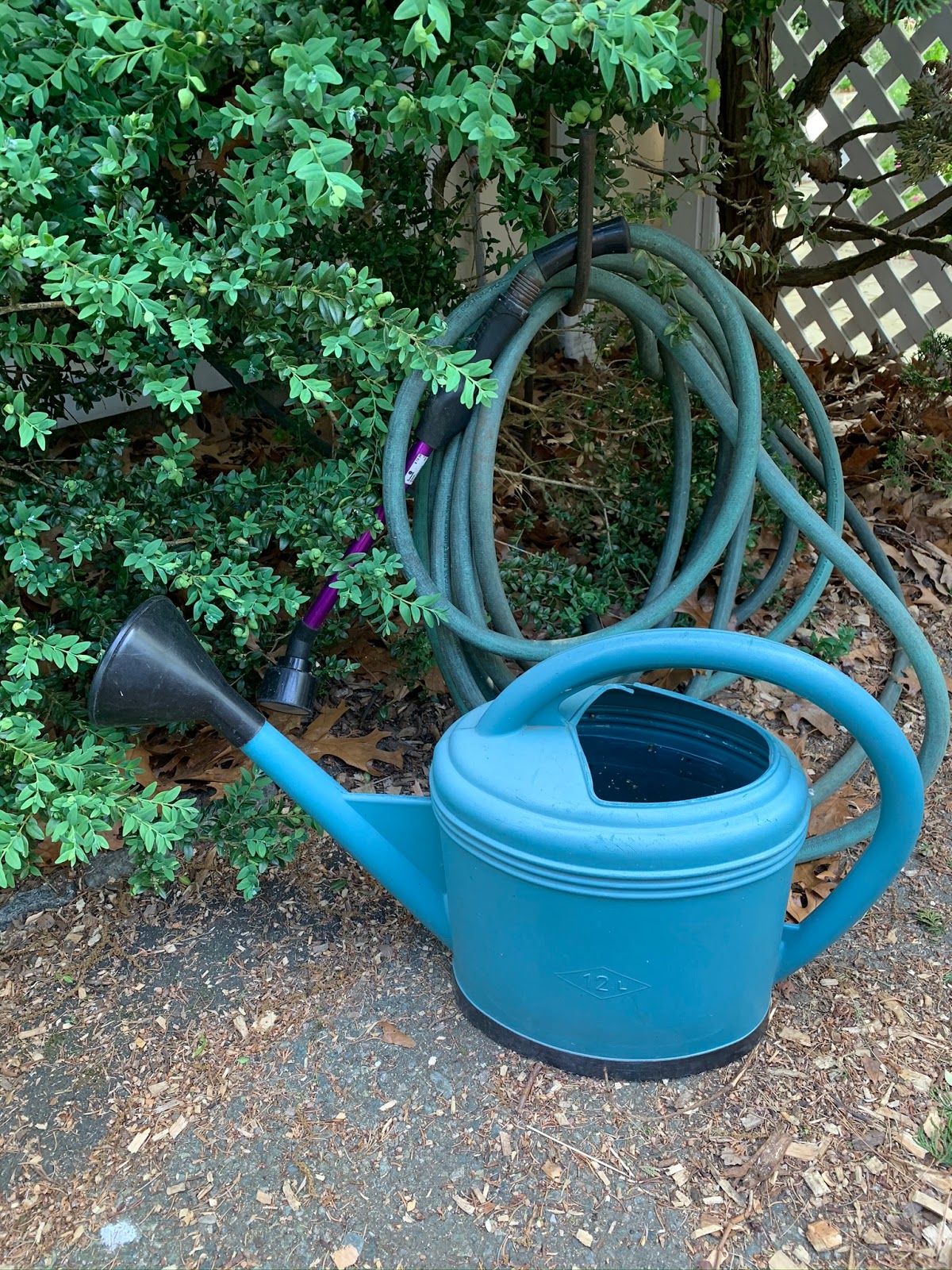

Ready for summer

Hand watering has its pleasures, especially in summer’s soft morning and evening light. That’s often when I truly see these new arrivals to the garden. I notice the unique patterns of new leaves and register the weeds emerging alongside. I’m looking forward to observing more closely this summer.


Sunday, April 22, 2018

Live and learn

This year more than usual is riding on my plant propagation. As part of an ongoing quest to publicize my book, The Sustainable-Enough Garden, I'm planning to participate in our local farmer's market, selling gift baskets for gardeners that contain six-packs of herbs and edible flowers, along with the book and other fun items. I'm starting more seeds indoors than usual, and I'm worrying about them more. If I can't produce the seedlings, then what?

Purple and green basil--will they be ready for market?

    I’m learning first hand that production growing is fraught with many pitfalls. What’s enough water, and what’s too much? Exactly when should I plant each variety to have little plants the right size by June 30, the first market date, and through the summer?


Tarragon cuttings are doing well (left), but only one of 24 seeds I planted germinated (right). Why?

Transitioning the seedlings outdoors to “harden off” will be an anxious experience with many questions regarding correct timing. This growing is like mothering, with all its uncertainty and need for constant vigilance.

    This week I came back from eight days on vacation away from my seedlings fearing heavy attrition. Would they have wilted and died without watering? I’d moved all the seedlings to the basement, figuring they’d need less water in a cool space where evaporation would be slower. 


     I followed the advice of one of my gardening heroines, Thalassa Cruso, for getting houseplants through times when no one’s at home to water. She recommends covering them with plastic sheeting to minimize evaporation. I adapted this for my seedlings by using some rigid clear plastic covers sized to fit over the seed trays. 

A clear plastic cover made for the seed tray is convenient

When I ran out of those, I cut open old dry-cleaning bags to drape over the little plants.

A repurposed clear plastic bag works too

    In the bottom of each tray, under the six-packs that hold the seedlings, I’d already placed a layer of capillary matting, absorbent synthetic fabric that gradually releases water to the pots.  I made sure to water the growing medium and soak the capillary matting before I left town.


Spongy fabric absorbs water and releases it gradually

    As soon as I got home, I pulled off the plastic to check on the little plants. Most of them were fine. I was surprised to find that the growing medium was still moist in many of the six-packs, and much of the matting was still wet. Moss or algae was growing on the surface of the growing mix in some of the pots. That showed how humid it had stayed inside the plastic enclosure, but it didn't seem to be doing any harm.  


    I’d managed to kill some cuttings I’d taken from a rosemary plant I brought indoors last fall. I’d left these uncovered because I thought they’d rot under the plastic, and I hadn’t set their six-pack on wet matting either. Unsurprisingly in retrospect, four of the six dried up, dropped their leaves and died.


News flash! Plants need water to survive

    Lots of questions remain. Clearly farming requires expertise and experience that I don’t have. Even if my farmer’s market project fails, I’m bound to learn a lot this year.


It's spring! Cornelian cherry (Cornus mas) blooming at last