My book and web site

Check out my book, The Sustainable-Enough Garden, available on Amazon, and the book's web site at www.thesustainable-enoughgarden.com. See more plant photos on Instagram.
Showing posts with label energy use. Show all posts

Monday, May 25, 2020

Watering smarter

On warm days this week, I’ve resumed one of summer’s tasks: watering. Back when my garden was young and all the plants were new, I was grateful to have a computerized irrigation system to keep them lush. Over the years, though, I’ve become increasingly conscious of using too much water. 


Automatic sprinkler watering the lawn and nearby beds

One of the environmental downsides to using purified drinking water in the garden, as I do, is its energy cost. Water utilities consume 3 percent of the energy generated in the United States. By cutting back on automatic irrigation, I can make a small contribution to the fight against global warming.

Clean drinking water comes with a carbon cost

Our sprinkler irrigation system was typical for our area when it was installed in 1997. It divides the yard into twelve watering zones, and it’s controlled by a computer in the basement. An attached rain gauge prevents watering after a storm. In retrospect, I could have saved a lot of water by choosing drip irrigation instead of sprinklers. 

Drip irrigation in an almond orchard. Emitters deliver water only to the trees' root zones

A drip system for trees and shrubs would direct water to exactly where it’s needed. Sprinklers inevitably lose water to evaporation. I cringe a bit when I see sprinklers in the neighborhood running in the middle of the day. To minimize that evaporative loss, I program the sprinklers to run after midnight, when it's dark and cool. That’s still less efficient than drip emitters would be. 


Another wasteful feature: our system’s watering zones were laid out when the garden was new. Sprinkler heads placed to water sections of lawn now cover a mix of grass and young and old shrubs and perennials. I don’t have the flexibility to target just the new plantings within a zone. 


Some environmentally-minded gardeners water only by hand, even in the relatively wet Northeast. A lovely garden I visited last summer is maintained without an irrigation system. The homeowner and garden designer explained that most of her garden gets no supplemental watering. When she needs to water new plants, she fills a bucket or watering can from one of her rain barrels.


Water from barrels at downspouts is sufficient for Joanne's native plant garden


At this stage, most of my garden is comprised of established trees, shrubs and perennials. They’ve spread their roots far and wide to find water when soil is dry. New England plants have adapted to survive our summer dry spells, even without the kind of Xeriscaping that’s appropriate to arid parts of the country. A lot of the irrigation I’ve been doing is probably unnecessary at this point.

It's pretty in May, but sweet woodruff is taking over, maybe because of steady moisture from irrigation.

The bold move would be to cut off irrigation to those older plants, at least until I see that they’re really suffering from drought. New plants will still need two years of watering to get established. That’s where watering cans and hose wands come in.
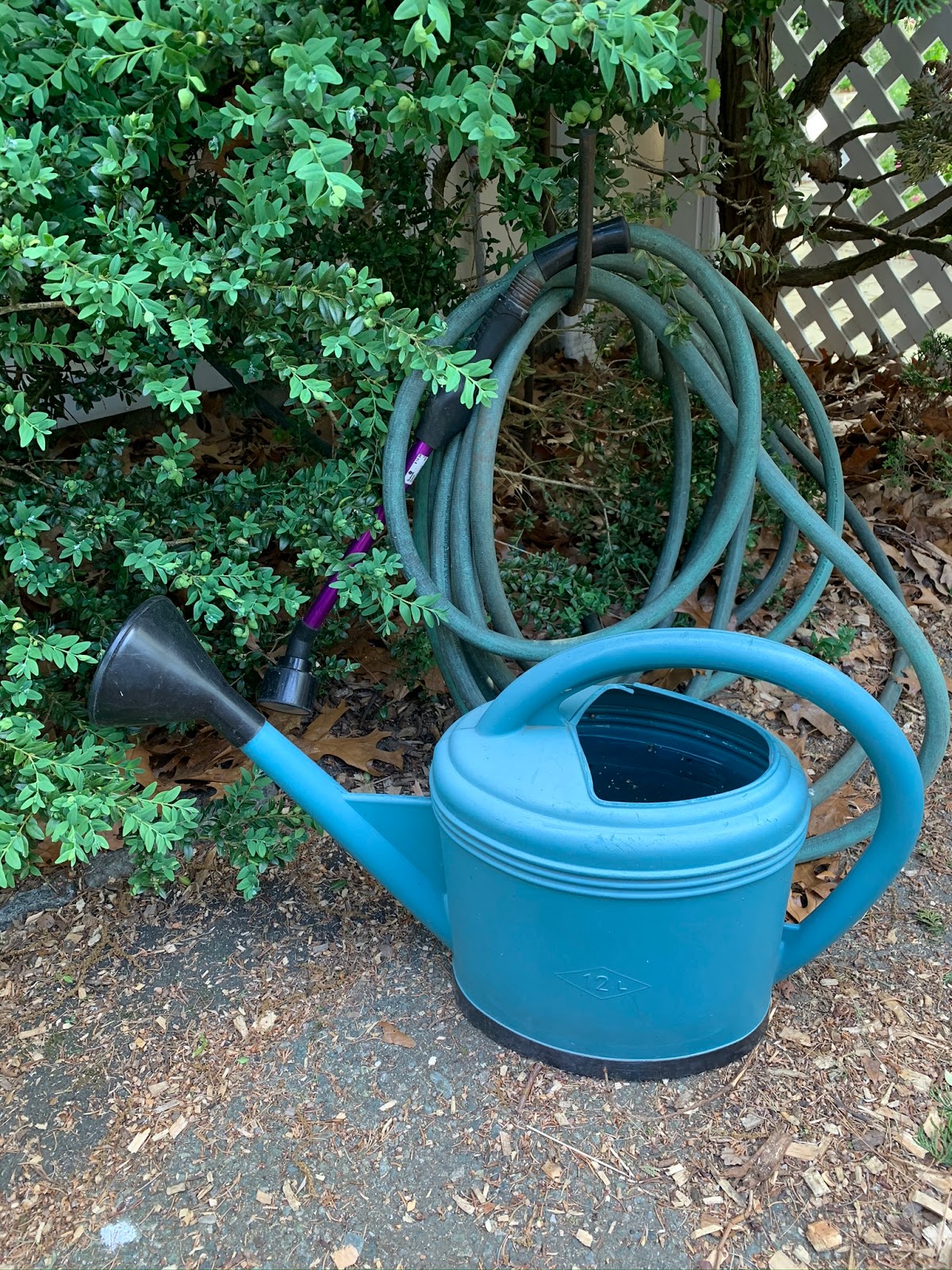

Ready for summer

Hand watering has its pleasures, especially in summer’s soft morning and evening light. That’s often when I truly see these new arrivals to the garden. I notice the unique patterns of new leaves and register the weeds emerging alongside. I’m looking forward to observing more closely this summer.


Sunday, February 9, 2020

A curtain of vines

Thinking about ways to reduce our energy use for cooling next summer, I hit on the idea of shading some west-facing windows at the back of the house with foliage. I don’t want to block the three full-length windows that provide our main view of the garden. But a pair of windows near the southwest corner could use some summer shade. Vines could be just the thing.


These windows get a lot of afternoon sun in summer

    The Department of Energy explains that vines can lower the temperature of a house in three ways. In the process of evapotranspiration, plants actively transport water, and when it evaporates, it cools the surrounding air. Shade reduces solar gain, of course, and vines can blanket the side of the house, creating an insulating air space. Put together, these contributions can reduce temperature shifts by 50 percent.


Vines can keep a house cool-photo Michael Palmer

    I’m not proposing to cover the whole west side of the house in vines yet. My idea is to start with a large container of fast-growing vines to keep the sun off that pair of windows.


    When I put up supports, I’d like to leave space between the vines and the house to permit air flow. I’m picturing a wooden frame attached to the siding that would hold some lattice or wire fencing to support the vines. Maybe I can attach hinges at the bottom of the frame so I can swing it down when it comes time to paint the house again.


Lattice attached closely to the garage wall leaves little air space behind it

    I’ve learned a lesson from a large wooden planter I placed directly on the ground in a shady corner. Tree roots grew up into the potting mix, making it hard to remove and replace old growing medium in the spring. This time I’ll prevent that by standing the planter’s corners on bricks to leave an air space that the roots can’t jump.


    Next will come the fun part: choosing which vines to grow. I could go with classic fast-growing flowering climbers such morning glory (Ipomoea purpurea), moonflower (Ipomoea alba), or mandevilla (Mandevilla spp.). These all originate in Central America. I could choose edible options: scarlet runner beans, cucumbers or squash. 


Morning glories are lovely and grow fast

    But I'd prefer to use native vines. I’ve already got two trumpet honeysuckles (Lonicera sempervirens), a cross-vine (Bignonia capreolata), and a trumpet vine (Campsis radicans) close enough to the proposed site that I’d like to try something different.


Trumpet honeysuckle is going strong in a dry spot against the house

    Last summer I grew a blue passionflower (Passiflora caerulea) vine in a container on the deck, wrapping its long stems around a black metal obelisk stuck in the pot. That one’s from South America. There’s a native cousin called maypop (Passiflora incarnata) that looks pretty. It’s reportedly a woody vine in the Southeast that dies to the ground in colder areas, which would serve my purpose. Growing it in a planter would curb its tendency to aggressive root spread.


Maypop, a native passionflower-photo H. Zell

    Another native possibility is woodbine (Clematis virginiana), a vigorous grower with white flowers August to October that could accept cutting back in winter. A quick search uncovers warnings about its spreading by seed, though, so maybe not.


Sunday, February 5, 2017

Doing something about the weather

I thought snowdrops blooming this week were the earliest I’d recorded, but looking back I see I spotted some on January 31 in 2012, another winter with very little snow.

Snowdrops are blooming early

In recent years, I’ve noticed spring growth starting earlier. Scientific data confirms this trend is affecting wild plant populations. Our climate is changing, and gardeners are on the front lines.
 
Witch hazel buds are already opening

     I’m finding the lack of snow cover ominous this year. Is this the new normal? Last year demonstrated the kind of damage that our plants suffer when they experience blasts of cold weather without the insulating protection of snow.


    The New York Times recently reported that farmers in Kansas are talking about changes in the weather, although many still don’t blame human actions for causing global warming. One farmer they spotlighted also spoke about sequestering carbon in the soil. On a much smaller scale, that’s something we can do too in our backyards. 


     Brooklyn Botanic Garden offers The Climate Conscious Gardener, a handbook of useful approaches for minimizing the carbon footprint of your garden and sequestering carbon in your soil and plants. 

    With Congress and the Trump administration rolling back restrictions on methane leaking from oil and natural gas rigs and wells, it’s even more important for us to seize the opportunity to be good climate stewards. 


     Methane is a greenhouse gas 21 times more potent than carbon dioxide. Federal regulations restricting its release were intended to fight climate change. Now with climate change deniers having their way, oil drillers and frackers hope to be spared the trouble and expense of preventing methane release. The planet and everyone on it will pay the price.
 
Gas flare from North Sea oil drilling--photo by Varodrig

    Some of the steps the BBG handbook recommends:


Planting trees. We’ve all heard about this as a way to keep carbon out of the atmosphere. Long-lived trees are best.

 
The dense wood of this tall white pine sequesters lots of carbon

Siting trees and shrubs to provide windbreaks and shade. This will reduce your house’s energy needs for heating and cooling—and save you money. 


Minimizing digging or, even better, switching to no-till gardening. When we dig, we introduce oxygen that speeds up decomposition of organic material, releasing carbon into the air.


Recycling fallen leaves and garden waste as compost. When you keep organic material at home as compost, you’re holding onto carbon. 


Applying organic mulches. Mulches made from materials you can get close to home are especially carbon-thrifty. I like to mulch with shredded or whole leaves and arborist wood chips.

 
Wood chip mulch holds carbon

Shrinking your lawn
. Every other landscape feature requires less energy, petrochemicals, and water for maintenance.


Skipping peat-based potting mix
. Peat bogs are a major carbon sink, sequestering more carbon worldwide than trees. When peat is extracted, carbon is released, and the carbon sink it provided is lost. It’s easy to make homemade potting mix from compost and coir (coconut fiber).


By following some of these recommendations, we can be part of the solution locally, even when the federal government is going in the wrong direction globally.


Neck deep in the Big Muddy