My book and web site

Check out my book, The Sustainable-Enough Garden, available on Amazon, and the book's web site at www.thesustainable-enoughgarden.com. See more plant photos on Instagram.
Showing posts with label acorns. Show all posts

Sunday, September 10, 2017

Gypsy moth: more complicated than you'd think

While waiting last week for my computer to return from urgent care, I contemplated a talk about biological controls by Joseph Elkinton, a professor of environmental conservation at the University of Massachusetts, that I heard last November. 

Gypsy moth caterpillar

    What Elkinton said about the history of gypsy moth in North America turns out to be unexpectedly relevant. We had a gypsy moth surge in 2016, and this year there has been significant defoliation by gypsy moth caterpillars, especially in southeastern Massachusetts.

Voracious gypsy moth caterpillars shred leaves

    A complicated web of factors influences the gypsy moth population. It all goes back to acorns.


    Gypsy moth (Lymantria dispar), native to Europe, was introduced to Medford, Massachusetts by Étienne Léopold Trouvelot, an astronomer dabbling in silk worm breeding. He thought he could cross the gypsy moths with native silk moths to produce silk in the US. The insects escaped from his home in the 1860s, and over 50 years they slowly established themselves in the wild. They’ve spread as far as Minnesota and North Carolina.


Life stages of the gypsy moth

    Elkinton explained that until 1989, gypsy moths experienced population outbreaks about every 10 years. Throughout the twentieth century, predator insects were introduced in hopes of controlling the gypsy moth population, but none did enough.


Predatory wasps kill caterpillars, but not enough

     Meanwhile, research into the ecology of the gypsy moth uncovered a system of natural controls. Robert Campbell of the US Forest Service found that the white-footed mouse was the most significant predator of the caterpillars, with birds less of a factor.

White-footed mouse, Peromyscus leucopus, in captivity

     Mouse populations rose and fell with the supply of their main food, acorns, which fluctuated with weather conditions. The mice couldn’t expand their population enough to control gypsy moth outbreaks, when caterpillar numbers spiked exponentially.

    Outbreaks were brought to an end by Nuclear Polyhedrosis Virus (NPV), which eventually killed up to 99 percent of the horde of larvae.


    This cycle continued until another accidental foreign introduction in 1989: Entomophaga maimaiga, a Japanese fungus. Infected by the fungus, gypsy moth caterpillars suddenly died all over southern New England.


    So with mice, viruses and fungi controlling its population, why is gypsy moth surging again? The levels of fungus are highest in wet years. Last year’s severe New England drought allowed the gypsy moth population to escape from its fungal control. This summer, caterpillars chomped foliage until June, when they started to die off. Caterpillars examined by Elkinton’s team showed a combination of viral and fungal infections. Wet weather had turned the tide.


    This means, thank heavens, that we don’t have to make the difficult decision whether to spray for gypsy moth.


    The future outlook for New England trees is mixed. Gypsy moths won’t die out completely, and our trees face a number of stresses from drought and other nonnative insect attacks. A tree can survive one defoliation, but repeated losses deplete its energy stores. Elkinton worries about major losses of native oaks, which the caterpillars particularly enjoy. Then what will happen to the white-footed mice?


 

Sunday, August 27, 2017

Squirreling away acorns for winter

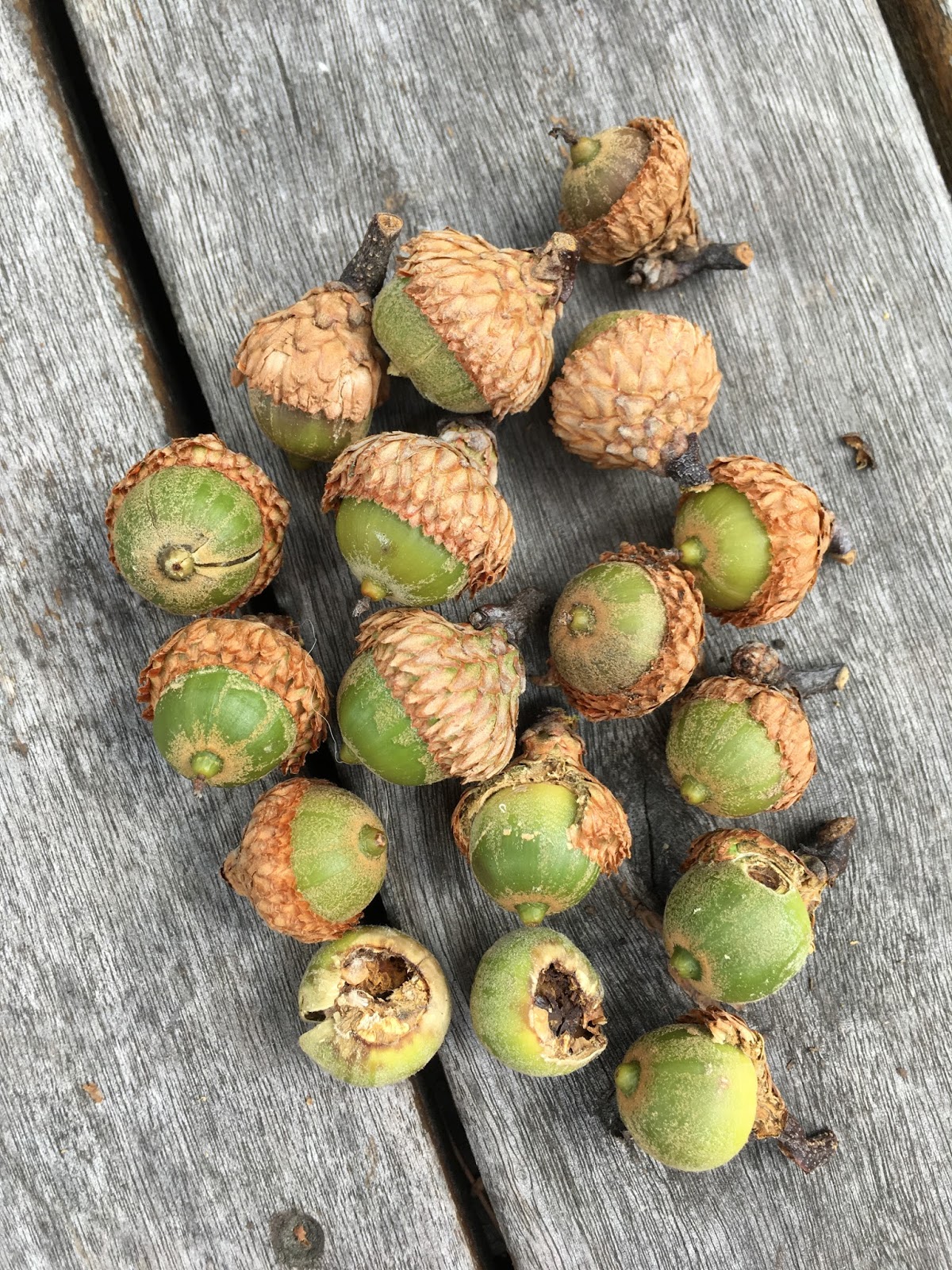
Acorns are falling. I swept the deck yesterday afternoon, and by this morning a few dozen more acorns dotted the surface. They’re a sign that autumn isn’t far off, and for squirrels, they’re the start of the fall harvest.

Red oak acorns


    Gray squirrels are so much part of our suburban surroundings that we tend to overlook their activities. To remedy this, I opened North American Tree Squirrels, by biologists Michael Steele and John Koprowski. Steele and his colleagues and students designed clever experiments to elucidate the feeding behavior of squirrels they found on their campus at Wilkes University in Pennsylvania.


Eastern gray squirrel (Sciurus carolinensis)

    For gardeners who like oaks, it was good news that acorns can be half eaten and still germinate and produce seedlings. Steele noticed that in early fall, when acorns were plentiful and the weather was still warm, squirrels usually ate acorns of white oaks but cached red oak acorns for later. White oak acorns are programmed to germinate in the fall.


Squirrels may pretend to bury acorns in decoy locations


    The red oaks play a longer game. Their acorns contain higher levels of tannin, a nasty-tasting chemical that protects seeds from predators. They’ve evolved to germinate in spring after a necessary cold period. The researchers observed that later in the fall, squirrels started removing the acorn caps to eat just the tops of the red oak acorns, which contained more high-calorie lipids and less tannin. As winter set in, they were willing to eat the whole red oak acorn, tannin and all. Apparently like us, squirrels balance tastiness versus health factors when they choose food.


Health food or tasty treats? It depends on the time of year

    Do gray squirrels remember where they hide their acorns? It was long thought that they didn’t and had to sniff out buried acorns. Lucia Jacobs, then at Princeton University, showed through an ingenious experiment that squirrels found their own cached acorns more readily than those hidden by other squirrels, although others’ caches might be quite nearby. 


Squirrels remember where they hid their nuts--photo by Juraj Patekar

    As a directionally challenged navigator, I’m awed by squirrels’ ability to recover their hidden nuts. Scientists asked whether squirrels were just good at retracing their steps—I can usually do that—and were finding their caches that way. Or were they constructing a three-dimensional mental map that allowed them to locate their hidden acorns? 


    Another of Jacobs’ lab experiments confirmed the latter. If she trained squirrels to find a nut in a maze and then kept the nut in the same location but changed the way to get there, the squirrels still found the nut. They’d retained its location, not just the directions for getting there.


    Although squirrels recover most of the acorns they store, they do serve red oaks by dispersing their seeds. A study of white versus red oak seedlings found that most of the white oaks sprouted close to the parent trees, whereas red oak seedlings appeared three to six times farther from the mature trees, their acorns having been moved by squirrels and other animals. In this way, squirrels contribute to the development of our forests.