My book and web site

Check out my book, The Sustainable-Enough Garden, available on Amazon, and the book's web site at www.thesustainable-enoughgarden.com. See more plant photos on Instagram.
Showing posts with label lawn care. Show all posts

Sunday, July 25, 2021

Woman-powered mowing

 After promising to pare down our lawn for at least ten years, I’ve now got its area down to about 200 square feet. This year’s big reduction didn’t happen because of any strong environmental commitment, though. It was all about accommodating a new family member, our young dog Lola.

Lots of wood chips and very little grass

    Since we installed gates between three yards to let Lola play with her neighbor dogs, prospects of a happy life for turf grass on our property have gone from dodgy to downright dismal. Thundering dog feet quickly tore away most of the existing lawn. Making the best of a bad situation, I covered the bare, muddy soil with a thick layer of arborist wood chips. What’s left is a few areas where the dogs move more slowly, next to the garden pond and along the vegetable garden fence.


This remaining strip doesn't merit a power mower

    With so little grass, I couldn’t see hiring someone to do the mowing. Instead, I’ve started a new chapter in my life as a lawn owner by buying a reel mower. I chose a Scotts model because it was cheap and lightweight. 

Easy to push
 

No one will ever mistake our patches of grass for a golf course, but so far the little mower seems to be doing the job well enough. If you look at the grass from the house, as we usually do, it looks mowed. It’s only up close that you see the uneven haircut I’ve produced.


    Until this year, I managed to get through life doing very little lawnmowing. When we moved into our house in 1985, my husband Steve took on the mowing job. He soon switched from a gas mower to a rechargeable electric model. I tried running it a few times and found it extremely heavy to drag around in the hot sun. No wonder so many young boys have hated this task! 

Our backyard in 1986, before we bought our first mower
 

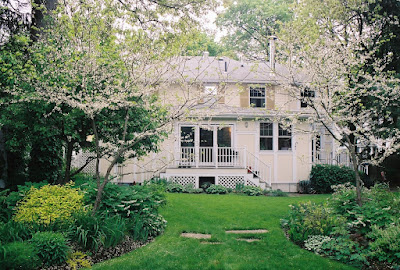
When we expanded our yard and added more lawn, we hired a landscape contractor to do the mowing. That was the situation, with a recent switch to an organic practitioner, until this year.


The lawn in 2005 with unharmed perennial beds
 

    There’s a lot to be said for mowing with elbow grease rather than fossil fuels. In the United States alone, small gas engines running lawnmowers, string trimmers and leaf blowers emit 20 million tons of carbon dioxide every year, equivalent to about 4 million cars. 


Lawn perfection comes with a steep environmental price
 

Lawnmowers give off other chemicals too that contribute toward climate change and health risks: volatile organic compounds, hydrocarbons, nitrous oxides, and particulate matter. Just refilling those engines’ gas tanks, Americans spill more gas than the Exxon Valdez every year.


    Rechargeable electric mowers do the job more efficiently and generate much less pollution. But doing the mowing myself is even more climate friendly. It generates only the carbon cost of the very few calories I expend on the job.


    This is how I’m comforting myself for the scruffy look of the garden this year. By growing less lawn and pushing that little mower, I’m adding my tiny contribution to the effort to heal the climate.

Dogs eat leaves of Siberian bugloss (Brunnera macrophylla)


Sunday, September 22, 2019

Lots to love about leaf mulch

The word is out: leaf mulch is great. 

Shredded leaves make high-quality, free mulch

   I’ve been chopping up fall leaves for mulch since sometime in the 1990s. These days I mulch most beds with whole leaves, because they provide shelter for over-wintering insects. I still use chopped leaves for areas near the lawn, because they don't blow around. 

     Many people chop leaves with the lawnmower. I prefer to use a standing leaf shredder, essentially a string trimmer in a drum. Plastic filaments whirl around and chop the leaves into small shreds. The resulting mulch is pretty, it doesn’t blow around like whole leaves left on the ground would, and it’s great for building soil fertility. And the electric-powered shredder doesn’t generate exhaust.

Electric leaf-shredder doesn't pollute the air

    The Rose Kennedy Greenway, the linear Boston park created in 2008 when the Big Dig moved the highway underground, uses organic methods and has recently experimented with switching from bark mulch to shredded leaves. The product they apply, which you can now buy from landscapers, has a step added to my process. After the leaves are chopped, they’re composted for a year. Horticulturists for the Greenway find the composted leaf mulch is full of beneficial soil organisms.


Rose Kennedy Greenway-photo Tim Grafft/MOTT

    As their test area, the Greenway chose a section of the garden devoted to New England native plants. After three years, they’ve found substantial benefits. In the leaf mulch beds they’ve measure increases in soil organic matter. They’ve also found increased cation exchange capacity, which allows soil to hold on to nutrients and buffers it against excess acidity. In fact, the soil in these beds has improved so much that Greenway staff have to consider whether the soil may become too rich for their native plants.


    One of the few drawbacks of leaf mulch at the Greenway has been small fires in the mulch from discarded cigarettes, which apparently isn’t a problem with bark mulch. Let’s hope visiting smokers can learn not to throw cigarette butts into the garden!


It counts as littering

    The City of Newton passed on a recommendation from Michigan State University for mulching lawns with chopped leaves. Lawn lovers hate the idea of letting leaves lie on lawns through the winter, where snow piled on matted leaves can kill the grass. That’s is one of the reasons for our suburban cultural taboo against letting fall leaves lie.

No fall leaves allowed on the lawn

    Instead of doing all that work raking and bagging the leaves, though, MSU turfgrass scientists found they could save time and improve lawns by chopping the leaves on the lawn with a few passes of a lawn mower. The little leaf fractions sift down out of sight among the turf plants, providing a mulching function that suppresses dandelions and crabgrass by up to 100 percent after three years. The decomposing leaf shreds also fertilize the lawn.

 
Chopping leaves with a lawnmower-photo Rebecca Finneran, MSUE


    My focus when I chop up fall leaves has been on improving the soil for shrubs, vegetables and perennials. The lawn is on its own. But after hearing the MSU results, I think I’ll set up my leaf shredder on the lawn this fall to spread some of those leaf bits around while I make mulch for the beds.


Perennials could share some leaf mulch with the lawn

    I’ll be demonstrating the leaf shredder in action at a hands-on sustainable gardening course in my yard Saturdays October 26 and November 2. You can sign up here through Newton Community Education.

Sunday, May 20, 2018

If all you have is a hammer, everything looks like a nail

Why are landscape contractors so attached to work they can do with machines? A recent conversation with a fellow gardener reminded me of this frustration. Her lawn service uses a weed wacker—a string trimmer—to cut back weeds in her yard instead of uprooting them. 

A string trimmer shortens weeds but doesn't remove them

As I pictured it, they’re leaving the weed plants a couple of inches tall. From the weeds’ point of view, this is helpful pruning. They marshal their underground resources and send up more growth. She finds the weeds are spreading. The crew leaves her property looking neat, but they’re not serving her gardening purposes.

    I have the same experience, and it’s getting more acute as I shift toward my version of sustainable gardening. I employ a landscape contracting company that I’ve known for years. I know that the leadership of the company includes several people with strong horticultural knowledge. The actual mowing, though, is done by a team of two or three young men with many stops on their schedule for the day and little time for tailoring their approach to suit my wishes.


Can I buy lawn care that's consistent with my sustainable approach?

    Last time they visited, I happened to be out in the garden. The team leader stood next to my new perennial bed, painstakingly mulched with shredded leaves, and asked whether I wanted them to use the leaf blower. He remembered that I’d said no to leaf blowers in the past, for which I’m grateful. But I had a strong feeling that if I hadn’t been at home, my leaf mulch would have been blown off the bed in a few seconds, and I’d have been stuck buying bark mulch from the garden center.


I put that leaf mulch down on purpose

    That would have wiped out all my efforts to mulch with materials I find near home, minimize carbon cost, and maintain habitat for native insects.


    I’ve talked with the supervisor of the team at least annually about how I want to maintain the garden. I’ve put up signs asking the men not to remove fallen leaves from the property. Things have improved, but there are regular relapses. My approach just doesn’t seem to compute for them.


    Another sore spot is grass clippings. It took effort to get across the message that I don’t want them removed from my yard. That’s organic material that should stay here and build soil. I ask to let the clippings lie on the lawn. 


Instead of moving clippings to the compost bin, you can let them compost in place on the lawn-photo anneheathen

Yet each spring I’ve had to call and beg for this request to be honored. It’s not the way the team is used to doing things, and it probably looks messy to them.

    It may be more efficient for landscape contractors to do the same work in every yard and to work with power tools—gas powered mowers, leaf blowers and string trimmers--despite the dust and exhaust the operators inhale and the hearing loss they incur from the noise. But we customers are paying for this one-size-fits-all service. It’s time for us to vote with our pocketbooks and seek out contractors who are equipped to accommodate a more plant-friendly and environmentally conscious approach.


Pushing up through the leaf mulch