My book and web site

Check out my book, The Sustainable-Enough Garden, available on Amazon, and the book's web site at www.thesustainable-enoughgarden.com. See more plant photos on Instagram.
Showing posts with label lawn alternative. Show all posts

Sunday, July 25, 2021

Woman-powered mowing

 After promising to pare down our lawn for at least ten years, I’ve now got its area down to about 200 square feet. This year’s big reduction didn’t happen because of any strong environmental commitment, though. It was all about accommodating a new family member, our young dog Lola.

Lots of wood chips and very little grass

    Since we installed gates between three yards to let Lola play with her neighbor dogs, prospects of a happy life for turf grass on our property have gone from dodgy to downright dismal. Thundering dog feet quickly tore away most of the existing lawn. Making the best of a bad situation, I covered the bare, muddy soil with a thick layer of arborist wood chips. What’s left is a few areas where the dogs move more slowly, next to the garden pond and along the vegetable garden fence.


This remaining strip doesn't merit a power mower

    With so little grass, I couldn’t see hiring someone to do the mowing. Instead, I’ve started a new chapter in my life as a lawn owner by buying a reel mower. I chose a Scotts model because it was cheap and lightweight. 

Easy to push
 

No one will ever mistake our patches of grass for a golf course, but so far the little mower seems to be doing the job well enough. If you look at the grass from the house, as we usually do, it looks mowed. It’s only up close that you see the uneven haircut I’ve produced.


    Until this year, I managed to get through life doing very little lawnmowing. When we moved into our house in 1985, my husband Steve took on the mowing job. He soon switched from a gas mower to a rechargeable electric model. I tried running it a few times and found it extremely heavy to drag around in the hot sun. No wonder so many young boys have hated this task! 

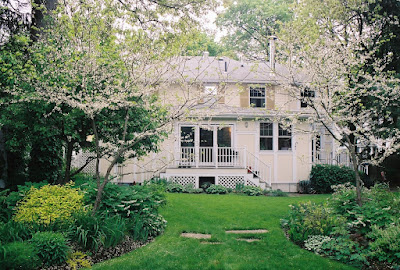
Our backyard in 1986, before we bought our first mower
 

When we expanded our yard and added more lawn, we hired a landscape contractor to do the mowing. That was the situation, with a recent switch to an organic practitioner, until this year.


The lawn in 2005 with unharmed perennial beds
 

    There’s a lot to be said for mowing with elbow grease rather than fossil fuels. In the United States alone, small gas engines running lawnmowers, string trimmers and leaf blowers emit 20 million tons of carbon dioxide every year, equivalent to about 4 million cars. 


Lawn perfection comes with a steep environmental price
 

Lawnmowers give off other chemicals too that contribute toward climate change and health risks: volatile organic compounds, hydrocarbons, nitrous oxides, and particulate matter. Just refilling those engines’ gas tanks, Americans spill more gas than the Exxon Valdez every year.


    Rechargeable electric mowers do the job more efficiently and generate much less pollution. But doing the mowing myself is even more climate friendly. It generates only the carbon cost of the very few calories I expend on the job.


    This is how I’m comforting myself for the scruffy look of the garden this year. By growing less lawn and pushing that little mower, I’m adding my tiny contribution to the effort to heal the climate.

Dogs eat leaves of Siberian bugloss (Brunnera macrophylla)


Monday, June 1, 2020

Native plants spreading good cheer

As we enter June with everything blooming, I feel like putting aside serious garden subjects to drink in the garden’s exuberance. So I thought I’d check on some of the native plants I’ve added in the past couple of years and show you how they’re doing.

    This week I was thrilled to see my cross vine (Bignonia capreolata) burst out with its coral, orange, and yellow trumpet-shaped flowers against the garage. I was expecting it to need more time to recover from transplantation and our northern winter. But no, it’s on the move and offering lots of opportunities for pollinators already.


Cross vine is a vigorous grower

    Nearby, a trumpet honeysuckle (Lonicera sempervirens) is covered with flowers. It seems to bloom more generously every year, although its roots are in a dry patch under the house’s eaves and surrounded on three sides by bluestone pavers. The long narrow flowers are popular with hummingbirds as well as insect pollinators.


Trumpet honeysuckle: easy and gorgeous

    Among the native shrubs, Carolina allspice (Calycanthus floridus) is putting on an unexpectedly uninhibited show. I’d planted one in deep shade a few years ago. It flowers, but sparsely. A newcomer added last spring gets much more sun, and it’s responded accordingly. The weird dark red flowers are fascinating, and I know they’re drawing native insects to the yard.


Carolina allspice has distinctive flowers

    Next to it is a flame azalea (Rhododendron calendulaceum) that I moved from where it was languishing in the front yard, struggling to compete with the roots of the Norway maple towering in the curb strip. When I dug the azalea up, I found it had very little root mass, although it had been there for years. Now it’s got more room to expand in looser soil, and it’s already blooming despite the trauma of last year’s transplantation.


I hope this flame azalea will flourish in its new location

    In the same area, a volunteer black cherry tree (Prunus serotina) is growing by leaps and bounds. This spring it’s showing its first flowers. The challenge with this tree will be to keep it and its offspring from taking over, but I’m encouraging it because of its superior wildlife value.


Black cherry hosts many native insects

    Bearberry (Arctostaphylos uva-ursi) is technically a sub-shrub, although it’s only about an inch tall. I chose this woody plant as a groundcover in a new sunny bed in 2018. It didn’t do much for the first year, but now it’s expanding in all directions, sending out branching stems bearing shiny new leaves. I love seeing this plant growing wild on Cape Cod, and I hope it will spread out even more as a lovely background to taller perennials.


Bearberry likes sandy soil and sun

    In a shadier section of the same bed, a single young creeping phlox (Phlox stolonifera) has emerged and flowered. I recently saw creeping phlox recommended as a groundcover in a Boston Globe story about lawn alternatives. My goal is to see this bed carpeted with a tapestry of groundcovers, so that no mulch is showing. That won’t happen soon, but the creeping phlox’s survival is a good sign.


Creeping phlox getting ready to creep

    Why are these plants doing so well this year? I don’t know, but I’m glad.

Sunday, July 9, 2017

Better than lawn

It took longer than I anticipated, but this week I finished planting my new perennials--and two shrubs--in new mostly-native beds next to the deck. They made it into the ground none too soon. Despite frequent watering, they were close to broiling where they stood, in planting position, in their containers in the July heat. 


Roots in the ground just in time

     The layer of black loam the contractors had spread was just starting to sprout weeds when I eked out a thin layer of pine-spruce bark mulch from seven large bags from the garden center. It didn’t feel right using purchased mulch, but last year’s leaf mulch was all gone.

     I was standing in the kitchen looking out over the new beds when I had an attack of buyer’s remorse. Had I made a terrible mistake? Now we won’t be able to seat guests in lawn chairs on that erstwhile patch of grass. 


Studying on the lawn circa 2003

They can sit on the wide bluestone path, or we can put chairs on the lawn circle that’s farther from the house. But a party tent over the deck is no longer an option. Had I spent money, fossil fuel energy, and many hours of work in the hot sun on a folly?

     While I was fretting about this, I noticed a swarm of bumblebees eagerly working a new St. John’s wort (Hypericum ‘Magic Universe’). The yellow flowers were already open, and the bees were making the most of them, circling as they searched for the best landing spots.


Bumblebee loading up on pollen

     In all the decades that the same area was covered with lawn grass, I’d never seen pollinators get any benefit from it. Those bumblebees reminded me of why I’d made the change. It wasn’t just for fun. I got a lot of enjoyment from picking out the new plants. Watching them grow, bloom, and fill in is going to be a pleasure. But the new beds are also designed to offer food and shelter for the bugs.


    When I started my garden in the 1980s, English-style perennial borders were all the rage. I was going to emulate Gertrude Jekyll and Vita Sackville-West with elegant perennial beds. 


Not my yard

To my disappointment, that was not to be. Even if I’d had the skills, we didn’t have the space or the unobstructed southern exposure for those long sunny borders. I spent the next 30 years learning about what to grow in part to full shade.

Shade has its rewards, such as this bloodroot in early spring

    This summer’s new beds represent a paradigm shift, as well as a new time of life. Since the seismic change in my gardening point of view induced by reading Doug Tallamy’s Bringing Nature Home, I’ve started seeing my garden as a community of plants and animals, not just my own personal play space and blank slate for design experiments.


    In 1985 I might have seen those bumblebees as stinging pests. Now they’re very welcome harbingers of a new era, with pollen and nectar for all.


Sunday, May 21, 2017

Less lawn, new beds

With a surge of spring energy, I’m launching a project I’ve been mulling over for months. I’m going to eliminate some lawn and open up a new planting opportunity!

    I’ve been wondering what to do about the lawn closest to the house. For several years this grass has been looking particularly woebegone. It’s partly because I walk on it so much traveling from the utility area at the side of the house to the rest of the garden.


Nice flowering trees, but see that patchy lawn in the foreground?


     One day inspiration struck. I could tear out that whole piece of lawn, put in a generous wood chip path to walk on and trundle wheelbarrows over, and still end up with some sizeable new beds. At this point in my garden’s history, I don’t get many chances to plant new areas, so this is an exciting moment.


The grass next to the deck will be replaced with paths and a new planting bed


     It's been a long-term goal to shrink my lawn. Just about every other use of yard space has lower environmental costs than a lawn maintained with regular inputs of water and chemicals and groomed with machines powered by fossil fuels. 


Green, lush, and sterile--photo by Andrew Vicars

Even my lawn, innocent of chemical inputs, offers little to the community of organisms that share my yard.

    To test out my brainstorm, I rolled out hoses on the ground to outline different configurations for the new paths and beds. This is a technique often recommended by basic landscape design texts. I’d never used it before, and I can now testify that it works well. With lines of orange hose on the lawn, I could step back and judge whether paths were wide enough. I could easily nudge the hose around to adjust the size and shape of the beds.


Hose as design tool

     What looked best to me was a five-foot-wide mulched path along the curve of the present beds. Two other paths will be paved in bluestone, reusing the stones that currently surround the deck. A straight eight-foot-wide bluestone path will extend from the outer edge of the deck to the next garden “room,” a circle of lawn surrounding a rectangular pond. 


     The second stone path will lead from the back door of the house to the utility area. Together the three paths will define two planting areas adjacent to the edge of the deck, one large and in partial shade, the other rather small but in prized sunny territory near the garage.

     To save my design until the work starts after Memorial Day, I sprayed the grass alongside the hoses with marking paint. That’s the non-permanent stuff used to paint lines on athletic fields. 


Rough outline of the proposed small sunny bed

Meanwhile, I have the fun of choosing which plants to use and where to source them.

     I’m picturing low plants that won’t block the view from the deck, some gray foliage and ornamental grasses, and an emphasis on native plants. 


New York's High Line--a garden style to aspire to

I’ll be on the lookout for neonic-free sources. More to follow as plans develop.