My book and web site

Check out my book, The Sustainable-Enough Garden, available on Amazon, and the book's web site at www.thesustainable-enoughgarden.com. See more plant photos on Instagram.
Showing posts with label replacing lawn. Show all posts

Sunday, July 25, 2021

Woman-powered mowing

 After promising to pare down our lawn for at least ten years, I’ve now got its area down to about 200 square feet. This year’s big reduction didn’t happen because of any strong environmental commitment, though. It was all about accommodating a new family member, our young dog Lola.

Lots of wood chips and very little grass

    Since we installed gates between three yards to let Lola play with her neighbor dogs, prospects of a happy life for turf grass on our property have gone from dodgy to downright dismal. Thundering dog feet quickly tore away most of the existing lawn. Making the best of a bad situation, I covered the bare, muddy soil with a thick layer of arborist wood chips. What’s left is a few areas where the dogs move more slowly, next to the garden pond and along the vegetable garden fence.


This remaining strip doesn't merit a power mower

    With so little grass, I couldn’t see hiring someone to do the mowing. Instead, I’ve started a new chapter in my life as a lawn owner by buying a reel mower. I chose a Scotts model because it was cheap and lightweight. 

Easy to push
 

No one will ever mistake our patches of grass for a golf course, but so far the little mower seems to be doing the job well enough. If you look at the grass from the house, as we usually do, it looks mowed. It’s only up close that you see the uneven haircut I’ve produced.


    Until this year, I managed to get through life doing very little lawnmowing. When we moved into our house in 1985, my husband Steve took on the mowing job. He soon switched from a gas mower to a rechargeable electric model. I tried running it a few times and found it extremely heavy to drag around in the hot sun. No wonder so many young boys have hated this task! 

Our backyard in 1986, before we bought our first mower
 

When we expanded our yard and added more lawn, we hired a landscape contractor to do the mowing. That was the situation, with a recent switch to an organic practitioner, until this year.


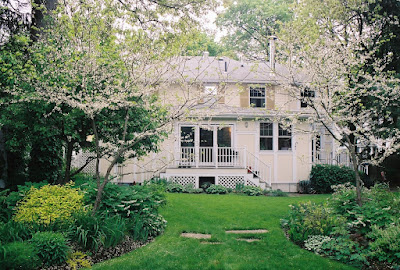
The lawn in 2005 with unharmed perennial beds
 

    There’s a lot to be said for mowing with elbow grease rather than fossil fuels. In the United States alone, small gas engines running lawnmowers, string trimmers and leaf blowers emit 20 million tons of carbon dioxide every year, equivalent to about 4 million cars. 


Lawn perfection comes with a steep environmental price
 

Lawnmowers give off other chemicals too that contribute toward climate change and health risks: volatile organic compounds, hydrocarbons, nitrous oxides, and particulate matter. Just refilling those engines’ gas tanks, Americans spill more gas than the Exxon Valdez every year.


    Rechargeable electric mowers do the job more efficiently and generate much less pollution. But doing the mowing myself is even more climate friendly. It generates only the carbon cost of the very few calories I expend on the job.


    This is how I’m comforting myself for the scruffy look of the garden this year. By growing less lawn and pushing that little mower, I’m adding my tiny contribution to the effort to heal the climate.

Dogs eat leaves of Siberian bugloss (Brunnera macrophylla)


Sunday, June 25, 2017

Planting party

What a week! On Wednesday, Kevin Newman’s team finished work on my yard. They left me with two new beds filled with beautiful black loam, ready to be planted. On Friday I set out on a shopping binge, and now I’m shuffling the plants around, designing the new plantings. Chances to plant a whole new area come along once in a decade. I’m having a blast! 


Trying out arrangements of new perennials for sun and part shade


    The first stage of the renovation started Monday morning, with the men rapidly scraping away the lawn around the deck. In a couple of hours, the grass was gone. Then they cut down five hemlocks at back corners of the lot (more on this in a future post), dragged the pieces out to the chipper parked in the driveway, and reduced them to wood chips. They returned the chips to the yard, using them to cover two new paths. 


Wood chip path for trundling wheelbarrows

Paths made from our own wood! You can’t get more sustainable than that! [note the presidential punctuation].

     The longest phase involved the heavy work of lifting large bluestone pavers from around the deck and putting in a new stone path leading toward the garden.

    What’s going into the new beds? They’re partly in sun, which means a chance to grow flowers that can’t thrive in most of the garden because it’s too shady. I had so many perennial darlings on my wish list that the problem was to pare it down. One of everything is not a good design principle. 


    I was looking for plants that stay low, so they won’t block the view of the garden from the deck. I thought back to a successful bed that designer Betsy Brown created for us in 1994 for a hot, dry west-facing spot. This time natives were a priority, but I couldn’t bear to leave out a few imports that had been stars of Betsy’s design.


Lady's mantle (Alchemilla mollis) had to be included--photo by Anneli Salo

    So far here are some high points of what I’ve chosen: For the sunniest area, Achillea ‘Coronation Gold,’ a yarrow with gray foliage and flat yellow flower heads in a subtle shade of yellow, 


'Coronation Gold'

an elegant St. John’s wort (Hypericum ‘Magic Universe’) with golden flowers, dark red fruits, and foliage with tones of red and blue, 

St. John's wort fighting off depression

prairie dropseed (Sporobolus heteroleptus), a native grass that will contribute panicles of pinkish-tan flowers in late summer, and a low-growing blue juniper (Juniperus squamata ‘Blue Star’) for winter interest.

     For the partly shaded section, a few I have high hopes for include the red-gold flowers of sneezeweed (Helenium ‘Short ‘n’ Sassy’), 


A similar sneezeweed--photo by Dietzel

a nice goldenrod (Solidago odora), and some blues in the form of Stokes aster (Stokesia laevis ‘Blue Danube’) and Canadian phlox (Phlox divaricata ‘Blue Moon’). Among these I have a chance to intersperse some of my favorite ground covers: bearberry (Arctostaphylos uva-ursi), wintergreen (Gaultheria procumbens), and a multi-colored bugleweed (Ajuga reptans ‘Burgundy Glow’).

Gaultheria procumbens does well in part shade

     This is just the first pass. Stay tuned for the editing process.