My book and web site

Check out my book, The Sustainable-Enough Garden, available on Amazon, and the book's web site at www.thesustainable-enoughgarden.com. See more plant photos on Instagram.
Showing posts with label gardening for birds. Show all posts

Sunday, June 23, 2019

A native plant inspiration

This weekend I visited a beautiful garden full of native plants in one of Boston’s western suburbs, opened to the public for one afternoon by its owner and designer, Joanne, to teach visitors how pleasing native plants can be.
 
Joanne's garden illustrates how to use native plants beautifully


     There’s so much to admire about Joanne’s garden that it’s hard to know where to start. What struck me first was the beautiful design. It had great “bones” provided by a selection of striking trees, big and small.

    Joanne moved into the house in 1990 and set out to create a garden on the quarter-acre lot. In the sunny front yard, she replaced much of the lawn with four planting beds. A drought-tolerant pollinator garden beside the foundation provides a lesson in how to combine native perennials and shrubs attractively. 


The drought-tolerant pollinator bed combines native and nonnative perennials and shrubs

I was particularly interested to see two chokeberries (Aronia arbutifolia ‘Brilliantissima’) that by fall will be covered with red fruits for birds to eat. 

Chokeberries

I see that I’ll need to move the chokeberry I planted to a sunnier spot.

    Heading through a gate and along the side of the house, I spotted an unfamiliar shrub with large shiny leaves and flat-topped flower clusters about to open.


Possumhaw viburnum

This was possumhaw viburnum (Viburnum nudum ‘Winterthur’), and it was romantically draped with two kinds of native clematis vines. 

These clematis flowers will turn from green to white

Like the chokeberries, the viburnum provides fruit for wildlife. The berries start out pink and turn blue, Joanne explained.

    The backyard was unexpectedly different from the front. As you enter, there’s a midsummer meadow garden of mostly native plants. 


The meadow garden

In a nearby spring and late summer bed, we spotted a robin foraging for fruit in a serviceberry tree (Amelanchier lamarckii).


Serviceberry fruit

    Opposite the back of the house, Joanne had set two levels of terraced planting beds into a steeply pitched hillside, with stone steps curving up the slope beside them. 


Terraced beds make planting space on the hillside

Above is a woodland garden, where I recognized some plants I grow in my own shady lot. At every turn there were beautiful specimens of native understory trees, shrubs, and shade perennials, some I’d only read about.

Mapleleaf viburnum in the woodland garden

    Joanne’s gardening techniques are inspiring too. She uses no chemicals and has no irrigation system. She fills her watering can from four water barrels for spot watering and to establish new plants. 


Water barrels supplement rain

She only wants plants that are tough enough to thrive without supplemental watering, and clearly she’s chosen the right ones. She improves soil with compost and shredded leaf mulch. I was glad to know that in addition to straight native species, she grows (neonic-free) cultivars, and she finds that they attract plenty of insects and other wildlife. She blends natives with some nonnatives in a harmonious whole.

    Birds were everywhere in the garden. Joanne cuts back on filling birdfeeders in midsummer to encourage birds to eat insects. She kept two snags (dead trees) standing for the birds and insects.


    What a boost to my gardening motivation it was to see this lovely garden! You can do great things with native plants if, like Joanne, you have knowledge and an artist’s eye.


Sunday, June 9, 2019

Farewell to a tree I loved to hate

I'll be presenting a free Green Newton lecture on Beautiful Sustainable Gardens at the Newton Free Library this Monday June 10 at 7:00 p.m. See you there! 

In April, I received a letter informing me that one of our two street trees was going to be cut down. I’ve been wanting to get rid of this tree for years. It was a Norway maple (Acer platanoides) that had been losing branches over the years, until all that was left was a large limb angling toward the house. 

 
The doomed Norway maple in May
     
     We’re on the side of the street with the power lines, so over the years the utility company has been hacking away at this tree and its partner at the other end of our street frontage. A few years ago, I asked the city to inspect the tree because I thought it was liable to drop a heavy branch on a pedestrian or a parked car. At that time, they found it was still sound. Now, the letter said, it had “significant defects.”
 
Marked to be cut down

     The reason I resented this tree wasn’t just its species. Yes, I dislike Norway maples for their fecundity and voracious shallow roots. This tree also cast dense shade over the front yard. It had limited what I could grow under its branches to the standard broadleaf evergreens you see everywhere in the neighborhood. A couple of years ago I added an oakleaf hydrangea (Hydrangea quercifolia) that livened things up a little, but still.

Ho hum boxwood, Japanese pieris, and mountain laurel

    One morning last week, two trucks arrived, and the urban forestry team took down the tree. I darted in and out of the house taking pictures to document the big event. 


Avoiding wires to saw off chunks

A bucket truck allowed a man with a chain saw to maneuver around the wires and cut the tree apart piece by piece. Another man operated a giant arm picking up large branches to haul back to the city yard for chipping. 

Future wood chip mulch

After half an hour, all that was left was the newly cut stump.

Its center was hollow

    I had six weeks to anticipate it, but this event caught me off balance. I wasn’t prepared to be sad to see the Norway maple go. Although I’d wanted it gone, seeing it chopped up so fast reminded me of how it had stood there patiently through blizzards, hurricanes, droughts, and nonnative insect attacks. The tree was misshapen at the end, but that comes to all who live to old age.


    The other surprise was my lack of ideas for what to add to that corner of the front yard. Without the tree’s shade, there are so many more options, including native shrubs I’d like to try. I’m not used to selecting plants for sunny spots. I’ve often thought that more highbush blueberries (Vaccinium corymbosum) should be grown in front yards. They have small neat leaves like privet (Ligustrum vulgare) that turn a pretty red in fall. 

Blueberry foliage turns red in fall

Unlike privet, though, they’re natives and not invasive. It would be a friendly gesture toward both birds and walkers to offer blueberries along the sidewalk.

Neighbors could pick blueberries as they passed

    When it’s too hot to work outside this summer, I’ll consider what else I could plant in the new sunny clearing this fall.

Sunday, April 21, 2019

Nesting time

It’s great to hear the dawn chorus of bird song at this time of year and see birds collecting material from the garden for nests. 

When magnolias bloom, it's time for birds to build nests

    I’ve put out mesh balls filled with feathers again to aid in the nest-building effort. An attractive ball made from bent twigs filled with fluffy raw cotton that I bought a few years ago from a catalog and hung from a branch drew no bird customers at all. I noticed that birds seemed more interested when the ball contained feathers. 


Feathers make more popular nesting material than a wad of raw cotton

    That’s when I started saving onion bags and ordered a big bag of goose feathers from a company that sells them for topping up feather comforters. I fill the bags with feathers, close them with twist ties, and hang them from branches like Christmas ornaments.


Onion bag feather ball hanging in a Norway spruce

It’s fun to see a bird hover or cling to the mesh to snag a feather or two and then fly off purposefully to where the building project is underway.

    The bad news is that many of the birds taking me up on this offer are nonnative house sparrows (Passer domesticus). 


European house sparrow

This highly adaptable species originated in Eurasia and North Africa and now lives on six continents, everywhere but polar areas. Flocks of house sparrows evict native birds from their nesting sites and hog the food supply.

    My goal is to foster a generous garden ecosystem where a diverse range of bird species can find the plants, insects, water, shelter, and nesting opportunities that they need. For that reason, I’ve tried to stop inviting these sparrows to my yard. Not filling birdfeeders during the growing season has made a big difference. Once the feather balls come down this summer, I won’t do anything else to encourage house sparrows to return. 


    I’m encouraged to see birds using some garden debris for building nests. That’s what I hoped would happen with the transition to intentionally bird-friendly gardening (Grow Native Massachusetts offers this guide to providing food and habitat for birds in your yard).


    This week I’ve noticed American robins (Turdus migratorius) busily flying back and forth and scolding when I get near certain trees. On Saturday I spotted faded hosta leaves hanging from a nest in a tall Japanese cedar (Cryptomeria japonica). 


Hanging hosta leaves make this robin's nest noticeable


The penny dropped: that’s why last year’s hosta leaves are migrating around the yard and showing up draped over low branches. 


The robins are picking them up to carry to their chosen nest spots, dropping some along the way. Even wilted and dried out, those large leaves must make a heavy load for a 3-ounce robin. 


I noticed hosta leaves woven into another nest located on a downspout under the eaves of the house. Saving the garden clean-up for later this spring has allowed nest-building robins to make use of last year’s leaves, stalks and twigs.

    True, hostas are Asian imports, not native to New England. If they’re useful to the robins, though, I feel their inclusion in the garden is sustainable enough. That’s fortunate, because they’re pretty too. 


Nonnative hostas and flowering astilbes in July
 

Friday, December 21, 2018

Feeding the birds

With the trees bare, I have more opportunities to see the birds that are flitting around my leaf-covered backyard. On one memorable afternoon, I saw a flock of dark-eyed juncos foraging in the leaves on the ground while two blue jays flew back and forth from the birdbath to the big oak near the garage. 

I usually see juncos in flocks

A chickadee hopped along the oak trunk, jumping between the protective horizontal shoots of a climbing hydrangea. Meanwhile a cardinal couple appeared and disappeared among the dense evergreen needles of a large nearby yew.

This husky hydrangea vine provides cover for birds even after its leaves drop


     A week later at twilight, my attention was drawn to a loud chirping from the newel post of the front steps railing. I was able to identify the small bird that perched there, vocalizing officiously, as a house wren, Troglodytes aedon


House wren - photo JanetandPhil

This is not a rare species, but it’s not one I’ve seen in my yard before. I was proud to read on the Audubon Bird Guide app that this bird feeds on insects and likes to forage on the ground where there’s dense low growth—like here! 

     The house wren reportedly has a distinctive bubbling song. What I heard instead was its “excited chit call.” Listening to a recording on the app confirmed my bird identification. House wrens spend the breeding season all over North America, from southern Canada to the Mexican border. My wren may have been on the way to winter grounds in the southern US or Central America, migrating by night. How a five-inch bird weighing a few ounces can accomplish this long journey remains a wonder to me (For more on birds’ amazing powers, don’t miss The Genius of Birds, by Jennifer Ackerman).


     All these bird sightings seem to vindicate this year’s plan of piling up fall leaves on my garden beds. The reason for doing this instead of sending them out as yard waste or shredding them for mulch was to provide shelter for insects through the winter. When I see birds busily foraging in the yard, I can believe that leaf litter is doing its job.


Insects weather the winter among the fallen leaves--unless predators find them

     It turns out that those chickadees I see on the oak trunk are champions at coping with the cold. They can’t put on a lot of extra fat or a down layer like larger birds, because that would mess with their aerodynamics. Many small birds adapt by fluffing up their feathers, huddling together, and shivering in a special way by activating opposing muscle groups. Chickadees go further, dropping their nighttime body temperature by as much as 22° Fahrenheit in what’s called regulated hypothermia.


Chickadees are ready for the cold - photo USFWSmidwest

     How can we not want to help these birds with some winter calories to keep them warm? I’ve stopped filling my bird feeders during the warmer months, but now they’re back in action, and birds are using them. It’s encouraging to see them also hunting insects in those piles of fall leaves. This is the balance I’m aiming to achieve.


Coming soon


I'm off to visit the kids. See you in the New Year!

Sunday, September 2, 2018

Spare those weeds

Pulling out weeds always seems like a virtue, and letting them grow a sign of slovenliness. But it turns out that a few weedy patches promote biodiversity in the yard. 

A neighbor has let these weeds take over a stretch of curb strip

When we removed large hemlocks last year to avoid spraying them for hemlock woolly adelgid, we were left with two sunny clearings. I planted native shrubs and small trees, but it’ll be a few years before they grow big enough to fill the space. Meanwhile, lots of weeds have stepped forward to fill the open space.

A stand of what I think is hawkweed taking over some newly sunny ground

    With the idea that this could be a good, I’ve been looking up our weeds in Wild Urban Plants of the Northeast, Peter Del Tredici’s guide to “spontaneous urban vegetation.” Many are listed as “disturbance-adapted colonizer of bare ground,” true to their behavior in my yard.


    One of their useful functions is to provide food and habitat for beneficial insects, the ones that prey on leaf-eaters. Although these insects are predators in at least one life stage, they often need nectar and pollen in another. That’s one way that weeds such as lamb’s quarters and chickweed can be a plus.


Lamb's quarters wilting in this week's heat

Their flowers provide extra forage and fill in during the lean times when our preferred flowers aren’t blooming. Weeds may also attract prey insects that the beneficials need to eat or parasitize. 

    Here are some of the weeds that have popped up where the hemlocks grew:


Pokeweed (Phytolacca americana): This is a North American native that, although toxic to mammals, has fruits that birds love. At least 30 bird species use pokeberries as a major food source. 


Pokeweed grows quickly into a substantial presence

Warblers and other migratory birds eat them on their flights south. The berries help mockingbirds, cardinals, cedar waxwings, and others to get through the Northeastern winter. Pokeweed is larval food for several moth and butterfly species, including the giant leopard moth. Bees feed on its pollen.

Giant leopard moth-photo NPS Phillip Brown

Yellow woodsorrel (Oxalis stricta): Also a native, this low perennial shows up all over my garden. At summer camp we called it sour grass and chewed on the leaves when we were thirsty on a hike. 


Recognize this yellow woodsorrel? It's all over the place.

The plant’s tissues are high in oxalic acid, so it’s better to sample the leaves in moderation. It too provides seeds for birds, pollen for native insects, and leaves for butterfly and moth caterpillars.

Devil’s beggarticks (Bidens frondosa): This native annual gets the prize for its many colorful names: sticktight, devil's bootjack, pitchfork weed, Spanish needles. You can see it hasn’t made a lot of friends among gardeners, but it provides pollen for bees and, interestingly, food for muskrats when it grows near water.


Devil's beggarticks has pretty flowers; its bad rep comes from the burrs that follow.

    These weeds are easy for me to pull out, especially because they’re growing where I previously put down a layer of wood chip mulch. Under the wood chips, the soil stays soft. I’ll remove some weeds that are shading my squash and melon plants (a story for another day), but now I know to leave some for their contribution to the garden’s ecology.

Sunday, July 29, 2018

To deadhead or not to deadhead

Lots of flowers in my new bed means lots of decisions about whether to deadhead, or remove spent blossoms. 

Ox-eye sunflower and butterfly weed

Conventional garden wisdom rates deadheading as a necessity. It neatens up the garden, and more importantly, it’s intended to trigger the plant to make more flowers instead of channeling its energy into transforming fertilized flowers into seeds.

    As the flat yellow yarrow blossoms (Achillea ‘Coronation Gold’) turn brown, should I leave them to go to seed? 


Yarrow flowers this week

A trusted reference on perennials, Tracy DiSatabo-Aust’s The Well-Tended Perennial Garden, firmly dictates deadheading these flowers and promises they’ll be followed by new blooms from lateral buds and possibly from the plant’s base too.

Deadheading-photo Helen Harrop/Flickr through a Creative Commons license

    More flowers will provide more pollen for native insects. Jessica Walliser, in her book Attracting Beneficial Bugs, explains that native common yarrow (Achillea millefolium) is favored by lacewings, ladybugs, syrphid flies, parasitic wasps, and damsel flies—all predators that consume leaf-eating insects, keeping the garden’s insect population in balance.


Green lacewing, a beneficial predator

     My yarrow is related to fern-leaf yarrow, a European introduction (Achillea filipendula). I hope it attracts most of the same bugs as the native. Jess observes minute pirate bugs, very active predators, living in the flowers of this cultivar. Insects benefiting from the flowers add reasons to go ahead and deadhead the yarrow in hopes the plants will flower again.

    On the other hand, in Gardening for the Birds, George Adams writes that many birds eat the seeds of common yarrow. He adds that some cavity-nesting birds harvest its foliage to line their nests. It seems that the strongly scented foliage repels parasites, so by making this choice, the birds as “self-medicating.” 


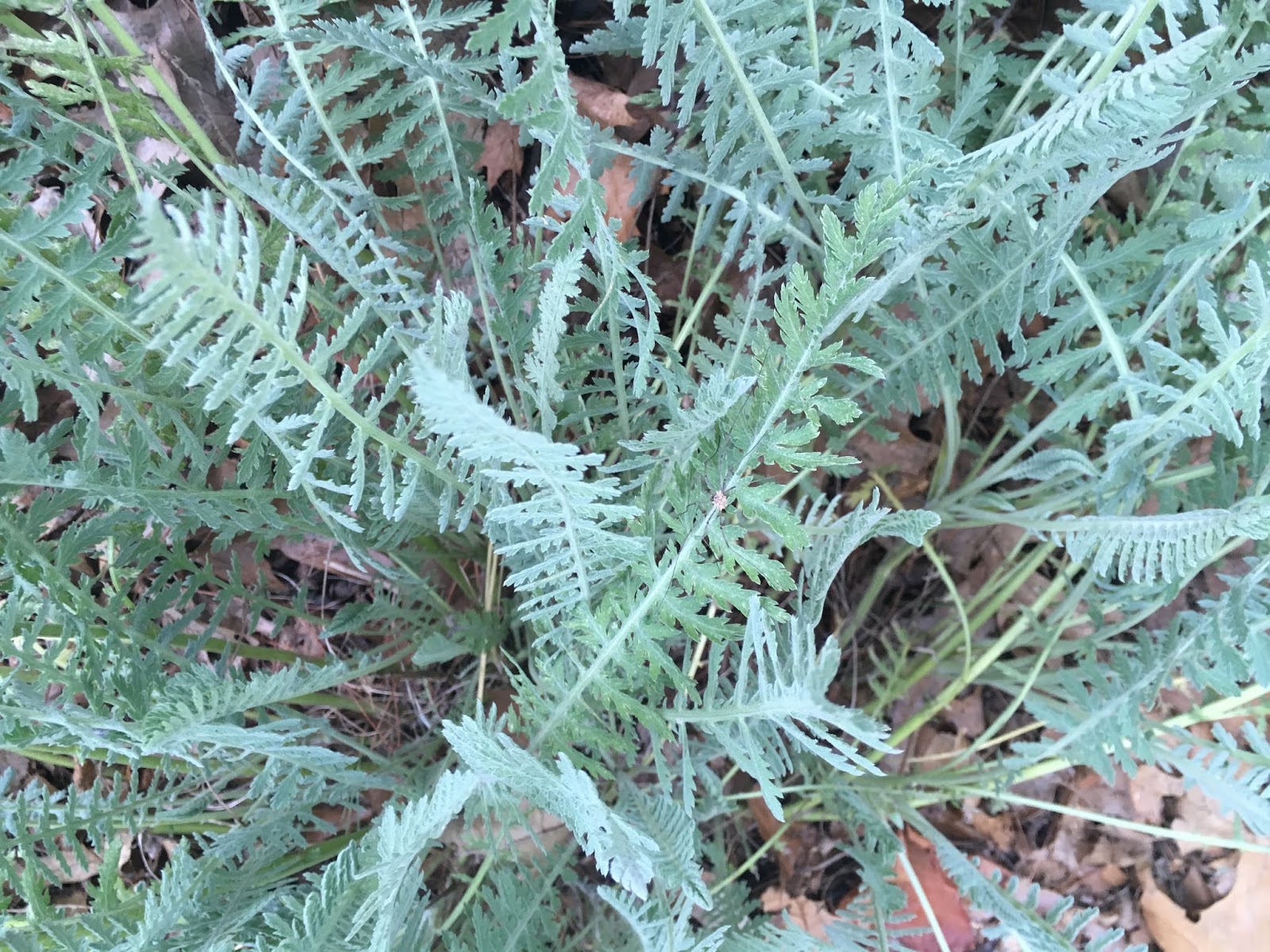
My yarrow's fern-like leaves

    But George Adams also notes that birds feed on the insects that are drawn to yarrow flowers. This summer and last, following his advice, I’ve put a moratorium on filling bird feeders with seed. This way birds are supposed to turn their attention to eating seeds and insects they find in the yard, rather than just birdseed I put out.


    Last summer I noticed that birds continued to visit the yard without finding seed in the feeders. One side benefit was the disappearance of European house sparrows, nonnative birds notorious for muscling aside native species and hogging all the food. I guess the sparrows aren’t interested in foraging for food and prefer to go where the pickings are lusher.


European house sparrow

    This is one of those environmental decisions with pros and cons on both sides. I can deadhead to offer more flowers for the insects, or let the flowers go to seed for the birds. If I deadhead, I should get to enjoy some more of the pretty yarrow flowers.


'Coronation Gold'

     You can probably tell which way I’m leaning. I think I’ll deadhead now and call it a scientific experiment. I'll see how many more blooms I get after deadheading. I’ll plan to let the flowers go to seed at the end of the summer, leave them standing, and see if I spot birds eating the seeds. That way we all win.

Common yarrow

Sunday, December 31, 2017

Less is more

Happy New Year! Amy Andrychowicz advises in the Savvy Gardening Newsletter that gardeners write “garden reflections” at the end of each year, documenting what went well and badly in this year’s garden and what can be improved next year. Here are some of mine:

    What went well? A lot that wasn’t in my control. We got plenty of rain! That kept the garden lush and flourishing. 


Rain made everything grow

    Also good was that the destructive nonnative winter moth dwindled my area. Tachinid flies (Cyzenis albicans) released by UMass professor Joe Elkinton are killing winter moth larvae. I counted three or four moths at the front porch lights this fall, nothing like the clouds of them we’ve seen in previous years. With so few parent moths, I predict few caterpillars will show up next spring to defoliate and weaken our trees.


There should be less winter moth damage next year
  
    Thanks to a much-abbreviated work schedule, I was in the garden most days all season. That gave me a chance to start addressing a list of dozens of tasks and projects I’d put off over the past decade. 


    This year I got to tear out a big patch of lawn and replace it with new perennials, mostly native species. It doesn’t look like much yet, with little plants surrounded by wide stretches of mulch. In three years when it’s filled in, I’m expecting a lush habitat for birds and native insects, as well as a pretty sight from the back of the house and the deck.


With luck, these little plants will grow wide and tall


    Restricting my container choices to neonicotinoid-free plants also turned out well, better than I’d expected. Maybe a smaller palette of choices prevented over-complicated compositions.


Simpler container combinations did better

    What didn’t go so well? Despite the plentiful rain, my vegetable garden didn’t produce a lot. Two problems stick out. First, I planted intensively with not much space between plants and rows because I’ve got so little sunny ground. That meant overcrowded plants didn’t get all the sun they needed. I didn’t leave enough space for paths, so while trying to spring lightly in and out of the beds, I stepped too close and packed down soil where roots were trying to grow.


Tight quarters in the vegetable garden

    This was the year I noticed my trees were crowded too, bent out of shape by competing to reach the light. That’s because of mistakes I made twenty years ago planting them too close together, like those vegetables. Having done that, I could have pruned more aggressively than I did. Back when the trees were young, I was afraid I’d kill them if I cut back their young branches to direct their growth. Now I know better.


Cramped trees

    The takeaway? Less is more. Make the hard choices and plant what I really have room for. Plan for the full-grown size, whether of 12-inch-tall bean plants or trees that will reach 60 feet. Failing that, don’t be too sentimental to thin out the extras when it’s time. Will I live by this insight and refrain from overcrowding the new perennial bed? Time will tell.