My book and web site

Check out my book, The Sustainable-Enough Garden, available on Amazon, and the book's web site at www.thesustainable-enoughgarden.com. See more plant photos on Instagram.
Showing posts with label Oriental bittersweet. Show all posts

Sunday, September 1, 2019

Corralling climbers

As a garden fills up at ground level, it’s tempting to go for vertical growing space by adding vines. I’ve done my share of this in recent years. I’ve learned that their vitality and vaulting ambition can be either a boon or a disaster.


Honeysuckle can be a pleasure or a monster, depending on conditions

    Take hardy kiwi (Actinidia arguta). I’d received a specimen of its variegated cousin, Actinidia kolomikta, as a membership bonus from the Arnold Arboretum.


Variegated hardy kiwi-photo David J. Stang

It grew moderately where I planted it against a north-facing wall along the driveway. I thought another member of the genus would be similarly docile, and I ordered male and female seedlings so that hardy kiwi could produce grape-sized kiwi fruit.

'Weiki' hardy kiwi
 
     Too bad I didn’t investigate the vines’ growth habits, because both hardy kiwis grew far too vigorously for my purposes. They quickly grabbed low-hanging spruce branches, and they looked ready to conquer the 40-foot spruce within a season. In the wilds of East Asia, they can reach 100 feet by scaling tall trees.

Hardy kiwi reaching for the sky-Jo Zimny photos

    My climbing hydrangea (Hydrangea petiolaris) is the apple of my eye. But it too was a lot more ambitious than I expected. In its first 10 years, the vine got a firm hold on an adjacent oak. It began producing its romantic clouds of white flowers in June. 


Climbing hydrangea in bloom

Instead of twining like the kiwis, climbing hydrangea attaches to its supports with adhesive disks called holdfasts. While covering more of the trunk every year with flowers, it’s also formed a mat on the metal garage roof, creating a microenvironment where Oriental bittersweet (Celastrus orbiculatus), a nonnative invasive vine, has found a foothold. 

At 20 years, the climbing hydrangea has taken over the garage as well as the oak trunk

     Birds must have dropped bittersweet seeds on the roof, and now bittersweet wands are reaching for oak branches. 

Bittersweet berries attract birds, as well as makers of holiday centerpieces

These strangling vines really could kill the tree. I think the only definitive solution will be to cut the hydrangea vine off the roof to eliminate the trap for leaf litter that incubates bittersweet seedlings.

    Less vigorous are the many varieties of clematis I’ve planted. Their flowers are so enticing that I can’t resist buying new ones. Clematis are reputed to prefer having their heads in the sun and their feet in the shade. I’ve found that they also need a minimum of competition and plenty of coddling. I’ve had best luck with an old-fashioned variety, Clematis ‘Jackmanii’. 


Clematis 'Jackmanii'-photo k yamada

It flowers reliably in a sunny spot along the driveway. More recently I’ve tried training clematis up trees and shrubs. They hold on by wrapping their petioles (leaf stalks) around twigs, so they don’t kill supporting plants. 

    As with so many plants in my yard, the controlling factor for my vines is how much sun they get. A clematis growing in sun on a tuteur in the insectary bed produces bounteous elegant blue flowers in May.


Clematis in its happy place

Other clematis vines grow lots of stems and foliage but not many flowers as they climb under the shade of supporting trees. Those too-shaded clematis may not flower profusely, but they don’t try to take over. It’s a delicate balance.

Would you like to see how the sausage is made? I'm offering a fall gardening course in my yard on Saturdays October 26 and November 2. You can sign up through Newton Community Education here.


Sunday, July 24, 2016

Invasives are here to stay

I hate to say this, because I think it will make some people mad, but I don’t think there’s any hope we can eradicate invasive nonnative plants from our landscape.

    This is an area of hot controversy. Many admirable volunteers spend their weekends pulling out invasive plants that grow on public land. 


Volunteer at a garlic mustard pull in Washington state

These are plants that cause environmental damage, out-competing natives and endangering local insects and animals because they don’t provide them with food and shelter they need.

    People who devote their time to eradicating invasives reject tolerating these plants. But there is another perspective. As Hope Jahren points out in Lab Girl, “Humans are actively creating a world where only weeds can live and then feigning shock and outrage upon finding so many.” Cities are hotter, dryer and windier than the countryside they replace, and we keep tearing up the ground with new building projects. No wonder only the toughest plants survive.


    Even if public land were cleansed of invasives, it doesn’t exist in a vacuum. At the Garden Bloggers Fling in Minneapolis, I heard that the Eloise Butler Wildflower Garden  had to have volunteers scour garlic mustard (
Alliaria petiolata) from a buffer zone around the 15-acre garden to keep it from migrating into the reserve. Yet every year their staff still has to patrol the property for garlic mustard seedlings. 

 
Native black-eyed Susans and bee balm at Eloise Butler Wildflower Garden


    Garlic mustard crowds out other herbaceous plants and excretes antifungal chemicals that disrupt connections between soil fungi and native plants, suppressing growth. 


Garlic mustard in bloom

What is the chance that every Newton homeowner will police her property and catch every garlic mustard plant before it sets seed? Not since Maoist China has social engineering on that scale been feasible.

    Here’s a case in point. Across the street from my house, a neighbor’s fence runs parallel to the sidewalk. In the few inches of soil between the fence and the pavement, a panoply of invasives has taken root. There’s garlic mustard, Oriental bittersweet (
Celastrus orbiculatus), Norway maple (Acer platanoides), and black swallowwort (Cynanchum louiseae). Yes, I uproot them as I walk by. But all over town the same situation is occurring, and in most places no one notices or cares.

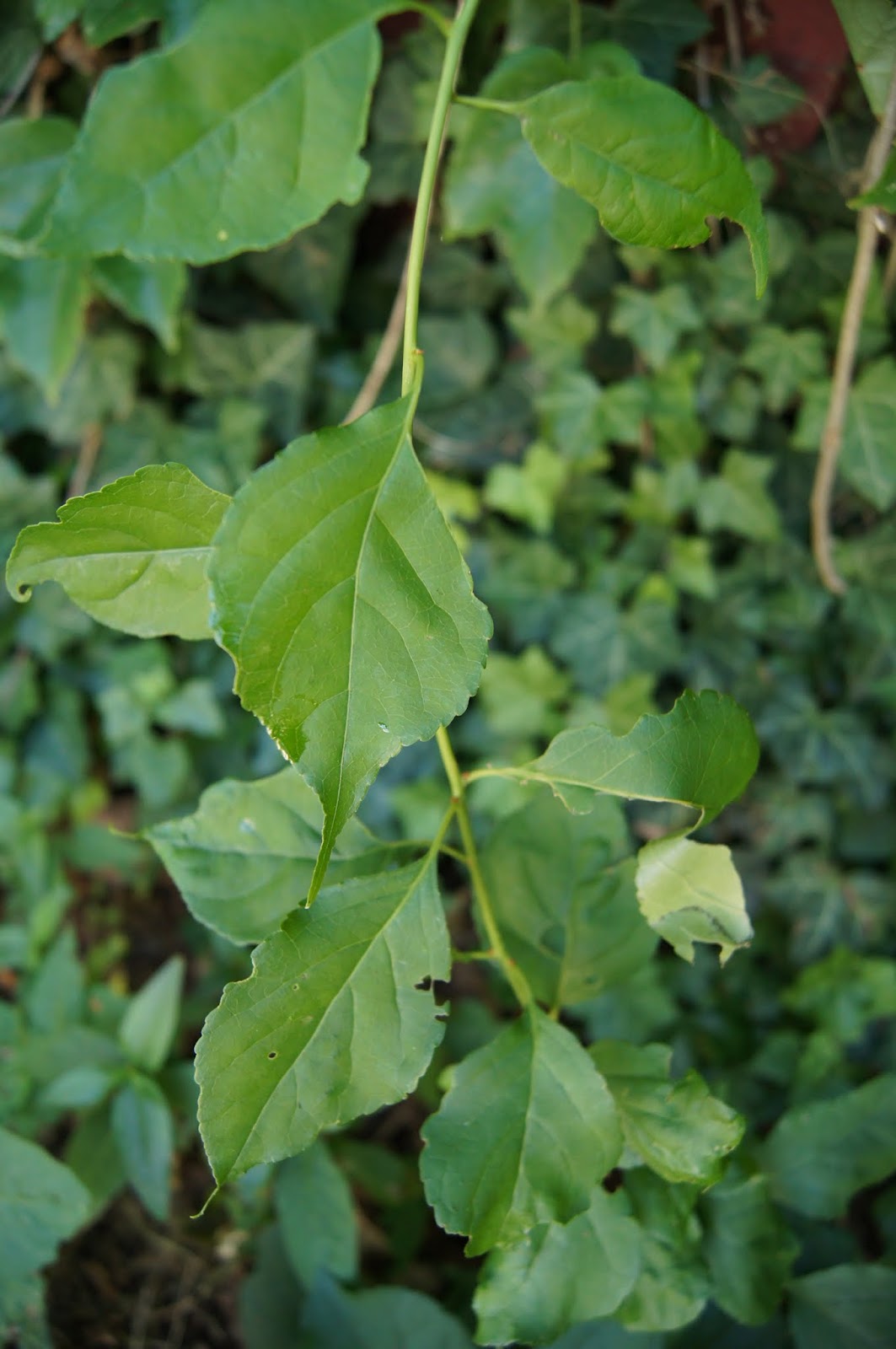
Oriental bittersweet

Norway maple
Black swallowwort
So if we can’t kill all the invasives, what are we supposed to do? Are we willing to let them take over and accept simplified landscapes without the biodiversity needed to maintain native animals? 

Actually we already have. A stroll in any local park confirms the presence of large populations of invasives. 
    
     I may be unrealistic, but I prefer to think that by planting natives in our own yards and fostering their growth on public lands, we can restore some balance between natives and aggressive nonnatives. If not, we’re going to spend all our gardening time at war, and that’s a condition I can’t accept.


Native red oak in my yard. This is a popular host plant for native insects