My book and web site

Check out my book, The Sustainable-Enough Garden, available on Amazon, and the book's web site at www.thesustainable-enoughgarden.com. See more plant photos on Instagram.
Showing posts with label garlic mustard. Show all posts

Monday, April 15, 2019

Stalking invasives--in moderation

At this time of year, every morning there’s something new happening in the garden. This weekend daffodils and magnolia blossoms opened. 

 
Star magnolia and Magnolia 'Leonard Messel' popped into bloom overnight


Also burgeoning: invasive plants. These super-survivors start early and finish late, sprinting out of the starting blocks while competitors are still dormant.

My arch-nemesis, Norway maple, gets a jump on the season

    Before everything else leafs out, providing camouflage, it’s relatively easy to spot the nonnative problem plants. Now is also I time when I’m not dizzily spinning from task to task, as I will be in May.


    First on the list, I need to check on Japanese knotweed (Fallopia japonica) that’s surfaced along the south fence line. This could be the year I stick to my plan to foil this potentially powerful land grab. I’m sure you’ve seen Japanese knotweed, because it lines highway shoulders and any other areas where soil is disturbed and then left uncovered. 


Japanese knotweed seizes any open ground

Once it starts growing, it’s almost immortal. Like many invasives, it makes lots of seeds. The underground part of the plant is the real menace, though. To eradicate stands of Japanese knotweed, the Massachusetts Department of Transportation has to remove all soil down to 3 feet and burn it. That’s because if even a nubbin of root is left, the plant will grow back. My strategy for Japanese knotweed is to cut it to the ground every two weeks. Eventually if it can’t make energy through photosynthesis, it should dwindle and die. At least that’s the theory.

Last fall I tagged this sprig of Japanese knotweed so I won't miss it

    Garlic mustard (Alliaria petiolata) is another rapid spreader in our area. It’s easy to uproot. I need to catch it all before it flowers and sets seed in its second year, though, or it’ll take over. Garlic mustard emits allelopathic chemicals that suppress other species’ growth. This is one of the few invasive plants in North America that thrives in a shady forest habitat, such as what prevails in much of my yard.


Garlic mustard impersonating an early perennial

    When I pull or cut down these plants, I can’t throw them on the compost pile. If I did, I’d be spreading the unwanted plants whenever I distribute compost. It goes against the grain to bag invasives and throw them in the regular trash, but adding them to the yard waste would pass them on to someone else’s garden.


Volunteer pulling garlic mustard at Cuyahoga Valley National Park-photo NPS/Arrye Rosser

    Of course, officially recognized invasives aren’t the only plants growing aggressively in my garden. Lots of plants I chose myself, including native smooth Solomon’s seal (Polygonatum biflorum), have turned out to be thugs that I have to beat back every year.


Smooth Solomon's seal shooting up from the leaf litter this week

    I don’t like to get too hysterical about invasive plants. They’re mostly responding to human alterations of plant habitat, diving in to pioneer newly disturbed soil. The nonnative invasives in my yard didn’t parachute in from abroad, they just made it under the fence from adjoining properties where people are less interested in policing the landscape. Spending some gardening time keeping them at bay does seem worthwhile, though. The more garden space they claim, the less there’ll be for a diverse landscape that includes native plants.


With help, I hope native inkberry will grow instead of  Japanese knotweed


Sunday, July 24, 2016

Invasives are here to stay

I hate to say this, because I think it will make some people mad, but I don’t think there’s any hope we can eradicate invasive nonnative plants from our landscape.

    This is an area of hot controversy. Many admirable volunteers spend their weekends pulling out invasive plants that grow on public land. 


Volunteer at a garlic mustard pull in Washington state

These are plants that cause environmental damage, out-competing natives and endangering local insects and animals because they don’t provide them with food and shelter they need.

    People who devote their time to eradicating invasives reject tolerating these plants. But there is another perspective. As Hope Jahren points out in Lab Girl, “Humans are actively creating a world where only weeds can live and then feigning shock and outrage upon finding so many.” Cities are hotter, dryer and windier than the countryside they replace, and we keep tearing up the ground with new building projects. No wonder only the toughest plants survive.


    Even if public land were cleansed of invasives, it doesn’t exist in a vacuum. At the Garden Bloggers Fling in Minneapolis, I heard that the Eloise Butler Wildflower Garden  had to have volunteers scour garlic mustard (
Alliaria petiolata) from a buffer zone around the 15-acre garden to keep it from migrating into the reserve. Yet every year their staff still has to patrol the property for garlic mustard seedlings. 

 
Native black-eyed Susans and bee balm at Eloise Butler Wildflower Garden


    Garlic mustard crowds out other herbaceous plants and excretes antifungal chemicals that disrupt connections between soil fungi and native plants, suppressing growth. 


Garlic mustard in bloom

What is the chance that every Newton homeowner will police her property and catch every garlic mustard plant before it sets seed? Not since Maoist China has social engineering on that scale been feasible.

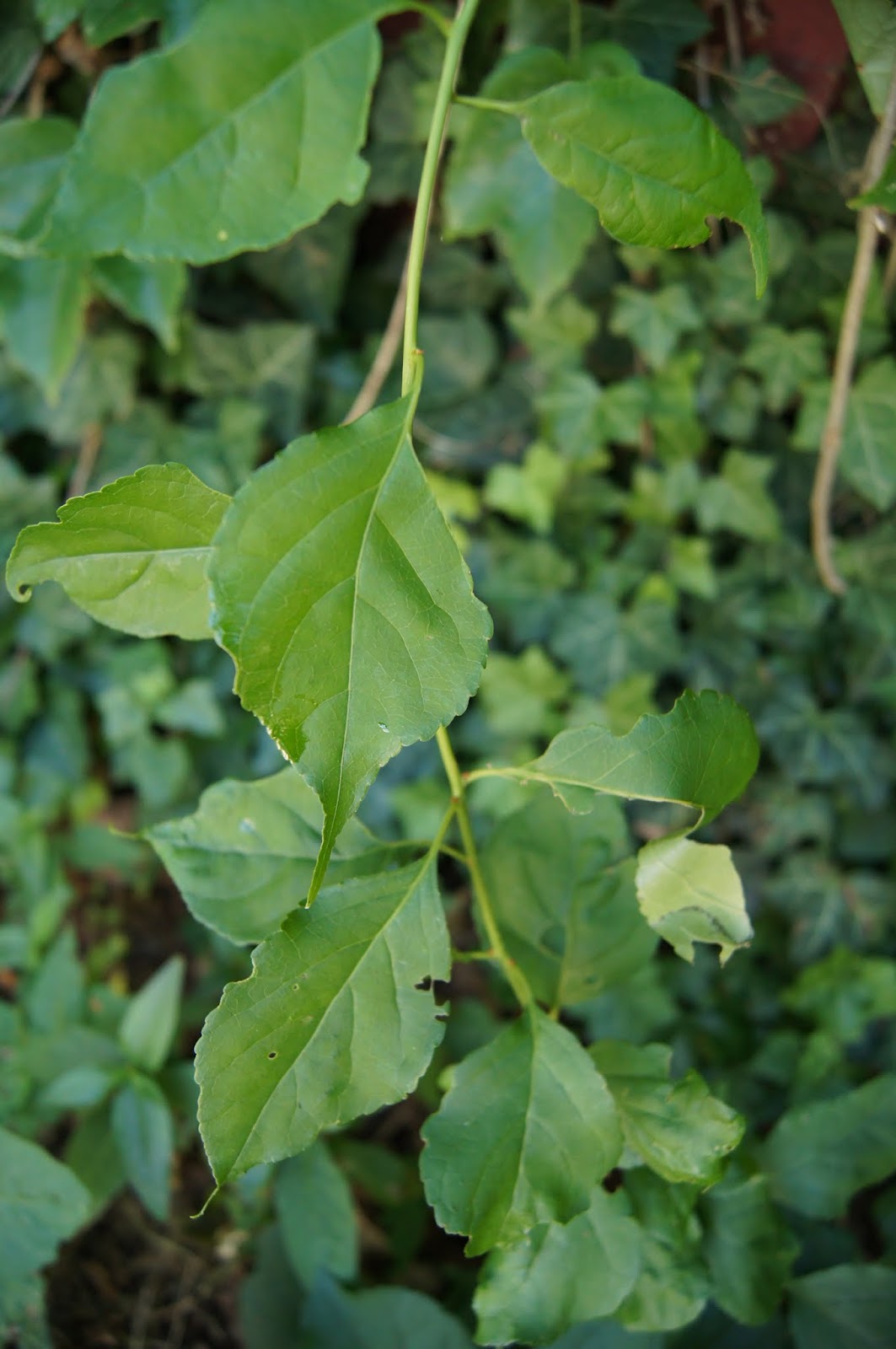
    Here’s a case in point. Across the street from my house, a neighbor’s fence runs parallel to the sidewalk. In the few inches of soil between the fence and the pavement, a panoply of invasives has taken root. There’s garlic mustard, Oriental bittersweet (
Celastrus orbiculatus), Norway maple (Acer platanoides), and black swallowwort (Cynanchum louiseae). Yes, I uproot them as I walk by. But all over town the same situation is occurring, and in most places no one notices or cares.

Oriental bittersweet

Norway maple
Black swallowwort
So if we can’t kill all the invasives, what are we supposed to do? Are we willing to let them take over and accept simplified landscapes without the biodiversity needed to maintain native animals? 

Actually we already have. A stroll in any local park confirms the presence of large populations of invasives. 
    
     I may be unrealistic, but I prefer to think that by planting natives in our own yards and fostering their growth on public lands, we can restore some balance between natives and aggressive nonnatives. If not, we’re going to spend all our gardening time at war, and that’s a condition I can’t accept.


Native red oak in my yard. This is a popular host plant for native insects