My book and web site

Check out my book, The Sustainable-Enough Garden, available on Amazon, and the book's web site at www.thesustainable-enoughgarden.com. See more plant photos on Instagram.

Sunday, July 29, 2018

To deadhead or not to deadhead

Lots of flowers in my new bed means lots of decisions about whether to deadhead, or remove spent blossoms. 

Ox-eye sunflower and butterfly weed

Conventional garden wisdom rates deadheading as a necessity. It neatens up the garden, and more importantly, it’s intended to trigger the plant to make more flowers instead of channeling its energy into transforming fertilized flowers into seeds.

    As the flat yellow yarrow blossoms (Achillea ‘Coronation Gold’) turn brown, should I leave them to go to seed? 


Yarrow flowers this week

A trusted reference on perennials, Tracy DiSatabo-Aust’s The Well-Tended Perennial Garden, firmly dictates deadheading these flowers and promises they’ll be followed by new blooms from lateral buds and possibly from the plant’s base too.

Deadheading-photo Helen Harrop/Flickr through a Creative Commons license

    More flowers will provide more pollen for native insects. Jessica Walliser, in her book Attracting Beneficial Bugs, explains that native common yarrow (Achillea millefolium) is favored by lacewings, ladybugs, syrphid flies, parasitic wasps, and damsel flies—all predators that consume leaf-eating insects, keeping the garden’s insect population in balance.


Green lacewing, a beneficial predator

     My yarrow is related to fern-leaf yarrow, a European introduction (Achillea filipendula). I hope it attracts most of the same bugs as the native. Jess observes minute pirate bugs, very active predators, living in the flowers of this cultivar. Insects benefiting from the flowers add reasons to go ahead and deadhead the yarrow in hopes the plants will flower again.

    On the other hand, in Gardening for the Birds, George Adams writes that many birds eat the seeds of common yarrow. He adds that some cavity-nesting birds harvest its foliage to line their nests. It seems that the strongly scented foliage repels parasites, so by making this choice, the birds as “self-medicating.” 
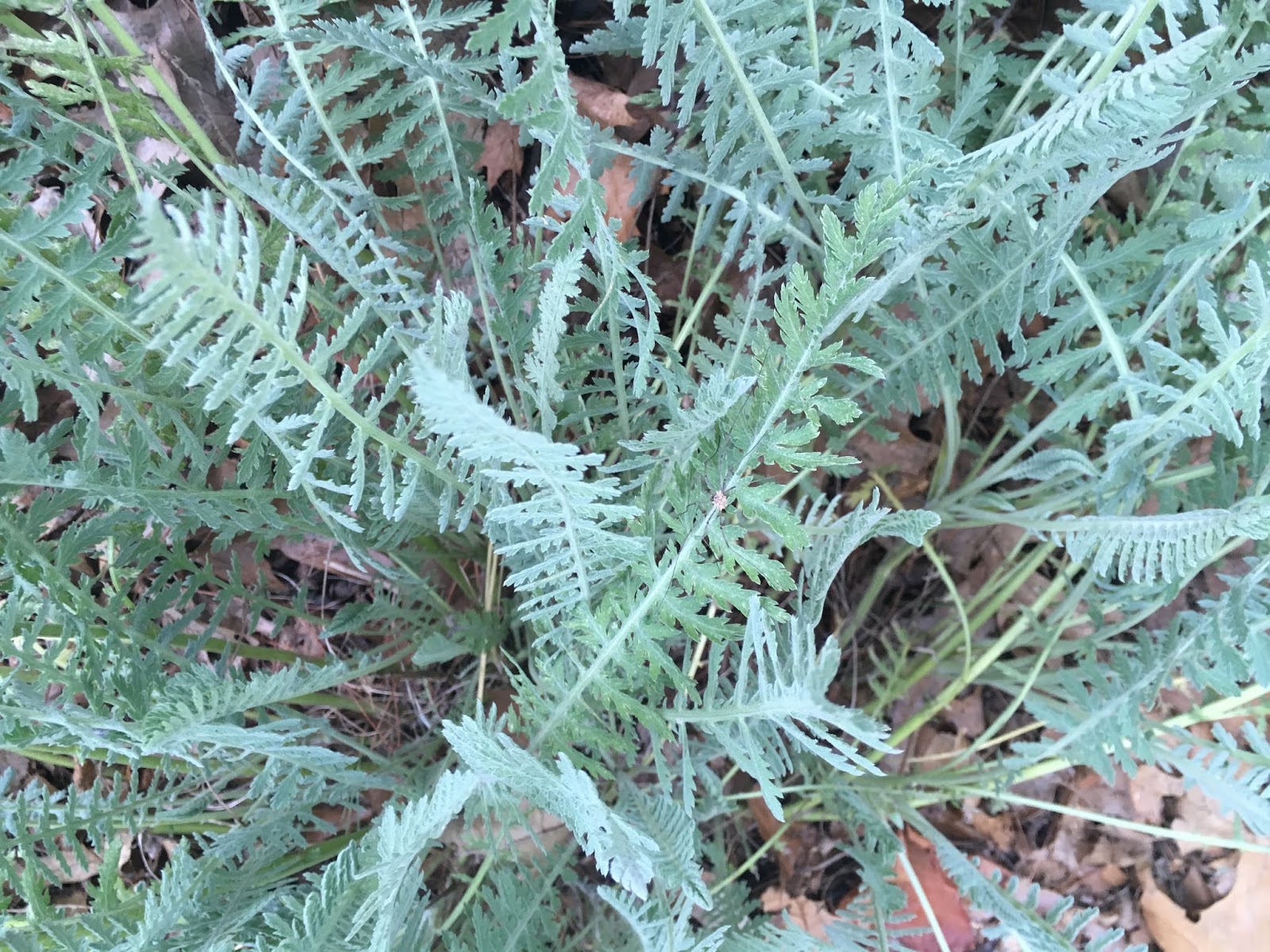

My yarrow's fern-like leaves

    But George Adams also notes that birds feed on the insects that are drawn to yarrow flowers. This summer and last, following his advice, I’ve put a moratorium on filling bird feeders with seed. This way birds are supposed to turn their attention to eating seeds and insects they find in the yard, rather than just birdseed I put out.


    Last summer I noticed that birds continued to visit the yard without finding seed in the feeders. One side benefit was the disappearance of European house sparrows, nonnative birds notorious for muscling aside native species and hogging all the food. I guess the sparrows aren’t interested in foraging for food and prefer to go where the pickings are lusher.


European house sparrow

    This is one of those environmental decisions with pros and cons on both sides. I can deadhead to offer more flowers for the insects, or let the flowers go to seed for the birds. If I deadhead, I should get to enjoy some more of the pretty yarrow flowers.


'Coronation Gold'

     You can probably tell which way I’m leaning. I think I’ll deadhead now and call it a scientific experiment. I'll see how many more blooms I get after deadheading. I’ll plan to let the flowers go to seed at the end of the summer, leave them standing, and see if I spot birds eating the seeds. That way we all win.

Common yarrow

Sunday, July 22, 2018

Attracting native insects

I just got back from Oregon, where shade plants that are expensive and finicky in the Northeast grow as wildflowers on the forest floor.


Trillium everywhere

It must be fun to garden in that ecosystem. Arriving home, I was eager to see how my new perennial bed was faring after a dry July week. 

    So far so good. The yarrow flowers (Achillea ‘Coronation Gold’) are still yellow, just starting to turn brown as seeds form. St. John’s wort’s (Hypericum ‘Universe’) sunny blooms have given way to handsome fruits that will persist into winter.


Yarrow flowers have lasted a month

     Balloon flower (Platycodon grandiflorus) is blooming now. Most of mine are blue, but one mislabeled white-flowered specimen came home with me, and I moved it into the new bed, where it’s settling in happily. 

White balloon flowers

Goldenrod (Solidago odora) and dwarf goat’s beard (Aruncus aethusifolius) are getting ready to flower. The grasses and clumps of iris are expanding, filling in some of the blank spaces.

    Back next to the vegetable bed, plants I chose to benefit native insects are going strong. Swamp milkweed (Asclepias incarnata), purple coneflower (Echinacea purpurea), white-flowered Phlox 'David', and black-eyed Susan (Rudbeckia hirta) are blooming generously. Dusty pink Sedum ‘Autumn Joy’ will open next.


Insectary bed blooms

    As I’d hoped, the flowers are attracting lots of pollinators. Bees are flying from blossom to blossom. We spotted a hummingbird last week, and monarch butterflies have visited on their way through town.


A monarch touches down

    Beneficial insects are gathering too. A dragonfly staked out a perch on top of a tuteur supporting cucumber vines. Presumably a high perch allows insect predators to scan for their prey, like raptors on high dead tree branches. With plants attracting a broad array of native insects, I shouldn’t have to buy beneficial insects such as ladybugs and parasitic wasps. They’ll be drawn to my yard if I offer them enough of the right prey.


    Leaf-eating insects are here too. They’re a little harder to feel good about, because they chew holes in leaves, but they’re important at the base of the food web. I notice that the foliage of the goldenrods I planted in the new bed is getting frayed. That’s good, because this genus supports 115 species of butterflies and moths by providing leaves for their larvae to eat. 


Goldenrod foliage and flowers provide for native insects

With a few goldenrods in the bed, the damage is spread around, and it doesn’t bother me. If I’m lucky, those monarchs may have laid some eggs on the three kinds of milkweed I’m growing so that their caterpillars can eat the leaves.

    Seeing insects and birds in the garden means I’ve got enough flowers blooming and enough of the vegetation they like to eat to make it worthwhile for these creatures to spend time in my yard. That was my hope when I chose the plants for the new bed and when I designed the insectary bed next to the vegetable growing area. I’ve come to believe that to be sustainable, a garden has to provide food and habitat for native insects.


Native plants for native insects

Sunday, July 15, 2018

Better use for front yards

Imagine a suburban front yard. Did you picture a lawn with some shrubs along the house foundation?

Typical front yard with lawn and foundation plantings

That’s certainly the standard issue in my neighborhood. Historians say that as American suburbs developed as a place for middle class people to live outside the city, it was considered selfish to fence in your lot European style. Lawns flowing into each other without boundaries were seen as a sign of good citizenship and showed that homeowners had nothing to hide.

    I notice a few neighbors who really seem to cherish their front lawns. They’re out each spring carefully filling in bare patches with topsoil, compost, and grass seed. A lot of others pay landscape contractors to maintain a green, closely clipped, weed-free lawns. 


Contracting out lawn care

That’s trading money for time, freeing up effort and focus for activities you care more about. If you just want your front yard to look acceptably neat, that’s what you’ll get from these services.

    When we moved to our house in 1985, we had a small, scruffy front lawn that languished under the shade of the street trees. Those Norway maples sucked all the water and nutrients from the soil. Realizing that I couldn’t grow lush green grass in that situation, I replaced the lawn with groundcover. That worked visually because there’s only 10 feet of front yard from the sidewalk to the house. Now instead of a front lawn, we have a uniform bed of periwinkle (Vinca minor). It grows happily in the shade of those maples.


Periwinkle has blue flowers in April


    Recently I’m fantasizing about revamping that quiet groundcover bed to be more like some front yards I’ve been admiring. 


    Doris Lewis, who lives a few blocks away, designed her front yard garden when she moved into a newly built house in 1998. She planted a mix of trees and shrubs: white pines, upright yews, a dogwood and a multi-stemmed shadbush, and groupings of low rhododendrons. 


Doris' lawn-free front yard

Roses, lavender, sedum, and clumps of Siberian and bearded irises provide colorful accents. Doris used periwinkle, pachysandra, and creeping speedwell as ground covers, and they’ve filled in densely. I admire her design every time I pass the house.

    Ted Chapman, whose permaculture garden I visited in 2011, also skipped the front lawn in favor of a pleasing mix of shrubs, trees and perennials. Some of his front yard plantings included a walnut, a pawpaw, dwarf evergreens, jostaberries (a cross between black currant and gooseberry), and a Korean pine with edible cones. A five-flavor vine (Schisandra chinensis) with red berries in hanging clusters like grapes grew on an arch next to the sidewalk.


Ted included numerous food plants


    Most recently I toured Robin Wilkerson’s sustainable garden. 


Robin's backyard

She too had filled her front yard with shrubs and perennials, emphasizing natives such as viburnums. 

     Like mine, Robin’s small front yard was shaded by tall trees, yet what she’d planted was much more interesting than my bed of periwinkle. I came away inspired to use the front yard as more space for interesting native plants. I think the neighborhood can stand it.

Sunday, July 8, 2018

Paradigm shift needed

One characteristic of the post-World War II era was cheery optimism about the potential for solving problems with synthetic chemicals. Perhaps the best example was DDT, which was going to rid the world of insect-borne disease. Look how well that turned out.


Spraying DDT over Oregon forest, 1955

    In the fifties and sixties, we all tended to trust safety and effectiveness claims for household and garden chemicals. Synthetic fertilizer was going to make soil stewardship irrelevant by spreading unlimited quantities of the basic plant nutrients, nitrogen, phosphorus and potassium. We learned that doing this destroys soil fertility while causing dead lakes and rivers as fertilizer runs off fields and lawns into nearby waterways.


Fertilizer runoff causing algae overgrowth and eutrophication

    There was 2,4-D, invented as a defoliant during the war and brought home as Scotts Weed and Feed to eliminate broad-leaved weeds from American lawns. 


     Imagine what would have happened if Scotts had brought home Agent Orange from the Vietnam War—by then, public attitudes toward war materials had shifted significantly. Since the 1940s, 2,4-D has taken us down a path toward increasing insistence on monocultural lawns, with all the water and chemical inputs necessary to maintain them.


Grass doesn't grow this way naturally

    The 1970s brought Roundup (glyphosate), marketed by Monsanto as a benign product to spare us the trouble of bending down to pull weeds. 


Roundup is ubiquitious

By the 1980s, genetically engineered “Roundup-ready” crops resistant to the herbicide enabled spraying this product on agricultural fields. Farmers took up the practice on a massive scale. As a result, we’re all eating Roundup, which a United Nations agency has declared a probable human carcinogen, a hormone disruptor, and a contributor to antibiotic resistance.

    Neonicotinoid pesticides, my garden nemesis, are the next in this series of chemicals first thought to be harmless. From the 1960s to the 1990s, the most commonly used pesticides were organophosphates, which had high toxicity for humans, other mammals, and birds. Neonics are safer for the people applying them, and since the nineties they have dominated the market, used for treating both seeds and growing plants. 


     Now we know that neonics are very persistent in plant tissues and toxic to many insects, including honeybees and other pollinators. 

Neonics poison pollinators


I recently learned that some insects have already developed resistance to neonics. That’s the predictable result of widespread use of any pesticide, analogous to development of antibiotic resistance in treated bacteria.

    Maybe we can stop thinking about living systems in such simplistic ways. Instead of charging in with blunt instruments like herbicides and pesticides, we need to think about what keeps natural systems in balance. Diverse populations and healthy growing conditions help plants to weather the onslaught of pests and diseases. Every organism has its place in a natural community.


Biodiversity protects plant health

    Insect populations are dropping worldwide. We need insects if we’re going to continue living on earth. Times have changed since the fifties. We’ve stopped watching TV Westerns. Let’s also stop thinking of plants and insects as good guys versus bad guys.

Monday, July 2, 2018

Summer gold

To my eyes, pink flowers look best in the soft light of spring. When summer sets in, I enjoy yellow and orange flowers more. I chose a yellow and blue color scheme for my new sunny perennial bed, with most of the flowering happening in June and thereafter. I’m admiring how the yellow flowers look in bright summer sun.

    The first yellow flowers of Rose ‘Kolorscape Yellow Fizz’ and cinquefoil (Potentilla atrosanguinea) have come and gone already, giving way to the deeper yellow of yarrow (Achillea ‘Coronation Gold’). 


Yarrow leaning over the deck

I’m happy to see these flowering profusely, showing that they’re getting enough sun in this location. The flat blooms are easy to see from the house as they lean away from the trees that overhang the far side of the bed. 

    Some extra color warmth is provided by the chartreuse flowers of lady’s mantle (Alchemilla mollis). I grow this plant mostly for its handsome round leaves, but the sprays of tiny flowers are charming too.


Lady's mantle has lots of small flowers

A spurge (Euphorbia x martinii ‘Ascot Rainbow’) adds its green and yellow bracts and yellow-rimmed leaves to the picture. While I wait for the perennials in this bed to fill in, I’m planning to use some of the open space to grow patty pan squash, which will also contribute yellow flowers. Meanwhile, on the deck I’m growing cucumbers, 

Squash flowers will be like these cucumber blossoms

black-eyed Susans (Rudbeckia hirta) to attract pollinators, and Mexican mint marigold (Tagetes lucida) for edible flowers.

I like black-eyed Susans, and pollinators do too

    One of my favorite weeds has volunteered again to add drama in several areas of the garden. Mullein (Verbascum thapsus) is a native of Europe, northern Africa and Asia that came to North America with European settlers and was adopted by Native Americans for medicinal uses. 


Young mullein getting ready to flower

If you’re in need of a poultice, this plant reportedly makes a good one, and it can also be used in remedies for colds, earaches, and asthma. I just enjoy its statuesque presence. In starts out as a rosette of woolly leaves, sending up a tall stalk of yellow flowers in its second year. 

Yellow mullein flowers opening along the tall stalk

Mullein pops up in disturbed ground, moving on when other plants settle in, so it’s never become a problem.

    Not everyone loves them, but I enjoy daylilies (Hemerocallis cvs). The first to bloom in my yard are yellow. 


An early daylily

I’ve planted a mix of colors in a narrow bed along the driveway where they get plenty of sun. Over the years they’ve formed fat clumps, and now we get lots of flowers through July and partway into August.

    A true orange flower is finally blooming in my insectary bed next to the vegetable garden. 


Butterfly weed, flowering at last

I’ve been trying for several years to grow butterfly weed (Asclepias tuberosa), but the plants dwindled, probably not getting enough water. Last year one took hold, and this spring it came back strong, grew bushy, and set flowers. Its cousin common milkweed (Asclepias syriaca) has also survived in another sunny spot. Between the two of them, I hope to provide food for monarch butterfly caterpillars.

Tuesday, June 26, 2018

Trees make good urban citizens

The Boston Globe recently checked in on the city of Boston’s promise to plant 100,000 trees by 2020 and found execution woefully lacking. Mayor Thomas Menino made the promise in 2008, responding to concern over climate change. Urban trees across the nation are aging and dying. Planting trees helps absorb carbon and reduce energy use. Last year Boston notched a net gain of only 4,000 trees.

What would Central Park be without its trees? New York is way ahead of Boston in planting new and replacement trees.

    My city's director of urban forestry, Marc Welch, reports he gets more requests to remove street trees than to plant them. Some residents regard trees as pests dropping leaves on their yards. Others want them out because of roots growing into pipes or making driveways and sidewalk surfaces uneven. Some of our street trees need to be removed because they’ve died, falling victim to drought, vehicle strikes, and nonnative insect pests such as winter moth and gypsy moth.


    Marc is pro-tree, though. He and the Newton Tree Conservancy are bucking the trend, planting new street trees since. In my post of May 14, I described the planting process.


Planted last month

    Trees do much more than offer shade in summer. One of my favorite garden authors, Toby Hemenway, describes the many ecological services provided by trees: 


• Creating insect habitat and hunting grounds for birds. One example: as the air warms in the morning, the leafy canopy stays cool longer than the air just above it. Insects swirl around in the layer of warm air, allowing birds to find food.


Cedar waxwing feasting on fruit of an amelanchier tree

• Conserving water. Soil stays moist under the shade of the tree’s leaves, watering plants and contributing to stream flow.


• Filtering groundwater. As leaves transpire, releasing water through pores in the leaves called stomata, the tree cleans out impurities from the water it draws up from the ground. 


• Making rain. Up to half of rain over tree-covered land comes from water transpired from leaves. In addition, pollen and dust that mixes with air as it flows through the leaves form nuclei for raindrops, seeding the clouds.


Trees make rain for the plants and creatures around them

• Harvesting moisture. Fog condenses on cool leaves, gathering water even without rain.


• Sequestering carbon. During photosynthesis, leaves take in carbon dioxide from the air and release oxygen.


• Stirring breezes in summer and blocking wind in winter. In warm weather, convection starts air moving when the tree absorbs sunlight and mixes warm air with cooler air near the ground. A tree can also act as a windbreak, reducing heat loss from buildings in winter.


Conifers make good winter windbreaks

• Preventing erosion. Leaves catch falling rain and funnel it toward the tree’s trunk, dispelling energy so that soil is not displaced. Leaf litter and roots keep soil in place.


• Making their own fertilizer. Pollen, dust, bird and insect droppings, bacteria and fungi collect on leaves and fall to the ground with rain, carrying plant nutrients and also organisms that will help break down organic matter in soil into forms roots can use.


Trees build soil

Our predecessors knew that trees enhance city life. By continuing to plant trees along our streets, we can maintain that environmental benefit.

Sunday, June 17, 2018

Milkweed's evil twin

I'll be selling gardeners' gift baskets at the farmer's market in West Newton, MA 9:30-12:30 on June 23, June 30, and every other Saturday thereafter until October 6. Stop by and say hello if you're in the neighborhood! The market is on Elm Street between Washington Street and Border Street.

Recognizing nonnative invasive plants can be discouraging. There are so many thriving along sidewalks, in parks, and on conservation land that it’s easy to feel that it’s too late. There’s no way to weed them all out. We have to pick our battles.

Japanese knotweed (Fallopia japonica) taking over a local parkway

    One manageable thing we can do in our own gardens is to keep an eye out for black swallow-wort (Cynanchum louiseae). 


A tangle of black swallow-wort vines

This vine is popping up all over my neighborhood. The reason it’s a problem, other than its swarming over shrubs and shading them out, is that it fools monarch butterflies. 

Monarch on a real common milkweed (Asclepias syriaca)

Females confuse it with native milkweeds, to which it’s related, and lay their eggs on the impostor plant, thinking it will provide food for their larvae. When the caterpillars hatch, they can’t live on black swallow-wort leaves, and they don’t survive.

    The first black swallow-wort vine I noticed in my yard grew up from the base of a particularly thorny rose bush and twined around the canes like a morning glory. I didn’t spot it until it was 3 feet tall. I never was able to uproot that plant. I couldn’t dig deeply without risking killing the rose. 


A hard place to dig

When I grabbed the base of the vine’s stem and tried to yank the roots out, it snapped at soil level. I keep working at it every year, watching for new tendrils as they appear in spring and pulling out as much of the plant as I can. Some year, I hope, it will run out of energy and die.

    Fortunately, that’s good enough to protect monarchs. Here’s a link to a helpful guide published by Newton Conservators, a local environmental group. As they explain, it’s useful to cut the plant to the ground. Later in the season, you can even help by cutting off the seed pods and throwing them in the trash to keep browsing animals from eating the fruits and then excreting the seeds to germinate somewhere else. Like other parts of invasive plants, the pods should go into the trash, not the compost or even the yard waste. They have awe-inspiring reproductive powers.


Butterfly weed (Asclepias tuberosa) is another milkweed relative and does support monarchs

    Down the block, black swallow-wort has overwhelmed a privet hedge that grows thinly because of the shade of a sugar maple. A net of vines drapes over the low hedge, hiding it completely. That means many seeds will be ready to spread around the neighborhood by the end of the summer.


    With that kind of population pressure, I can’t expect to keep black-swallow-wort out of my yard. I’ll just have to watch for it as I deadhead, prune, and weed. If I catch the sprouts when they’re small, I have a chance to keep them from taking over.


    Newton Conservators and other groups regularly mobilize teams to pull invasives on conservation land. Will this work have to be repeated every year to keep the culprits from growing back? Let’s hope volunteers replace the unwanted plants with native species vigorous enough to hold the ground.


Swamp milkweed (Asclepias incarnata), left,
or common milkweed (Asclepias syriaca), 
right, could be good replacements for black
swallow-wort