My book and web site

Check out my book, The Sustainable-Enough Garden, available on Amazon, and the book's web site at www.thesustainable-enoughgarden.com. See more plant photos on Instagram.

Monday, October 28, 2019

Big little choices

The other day I found myself dithering about covering our garden pond with netting. I hadn’t realized how much transitioning toward sustainable gardening has changed my thinking process.

This week in the garden

    Every fall I drag a lightweight frame made from plastic pipe and covered with bird netting over the 8- by 10-foot rectangular pond. The purpose of the pond cover is to minimize the number of falling leaves that end up in the water. 


The gray plastic pipe holds netting over the pond surface to keep out leaves

If leaves spend the winter on the bottom of the pond, their gradual decomposition will suck the oxygen out of the water, creating tough conditions for any animals living there. We don’t have koi anymore, but I buy five or ten tadpoles at the garden center each spring and enjoy their emergence as tiny froglets.

Tadpoles metamorphose in the course of the summer-photo Olaf Tausch

Adult frogs eat insects. I count them as part of my garden community.

I managed to photograph this frog from a distance before he jumped into the water

     My dilemma this fall was twofold. First, should I try to skim the floating duckweed off the surface of the pond before winter for aesthetic reasons? What if tadpoles were still depending on duckweed for food? What if I skimmed off frog egg masses with the duckweed? If I’d asked to know the scientific name of my tadpoles, I’d be more equipped to find answers to these questions. After a few passes with the net, I decided to leave the duckweed alone.

Duckweed on the pond surface provides high-protein tadpole food, prevents algae build-up by shading the water, and controls mosquito reproduction

    Second, if I covered the pond completely with the netting frame, how were those frogs going to get out of the water? I’d lowered the pots of water lilies to the bottom of the pond, so there were no lily pads on or near the surface where they could perch. The weather hasn’t gotten cold yet, so I didn’t think the frogs would be ready to go into their winter hibernation. Several small frogs are in the habit of sitting at the edge of the pond and swiftly jumping into the water if anyone approaches. I compromised by leaving a 1-foot opening where the pond was uncovered next to the frogs’ favorite sitting area.


Space for frogs to escape from the netting-covered pond

    Ruminating about the needs of frogs made me realize that my perspective has changed a lot in the last eight years. In shifting to seeing myself as part of a community of living things in the yard, I’ve opened up a lot of questions that never would have crossed my mind before. 


    How about this one: should I throw the cones dropped by our big white pine into the yard waste?


Pine cones: yard waste or winter forage?

I’ve done that for years, because I didn’t want the garden to turn into a white pine forest. This year for the first time I hesitated. Maybe those cones feed some animal during the winter. I compromised: I threw the cones lying on paths and lawn back toward the base of the tree.


My compromise is to move the cones back within the dripline of the pine

    Will I gradually stop being able to do anything in the yard except remove nonnative invasive plants? No, I insist on retaining the right to be a gardener! But I’m seeing a lot of my choices differently.


Monday, October 21, 2019

Climate action in the garden

It’s been a discouraging month of environmental news. The UN climate summit confirmed that there’s not a lot of time left for international action to prevent catastrophic climate change, but national governments, notably ours, are not making adequate commitments. 

Unlike polar bears, we humans do have the power to combat climate change-photo Gerard van der Leun

A group of ornithological organizations published a study estimating that we’ve lost 3 billion birds--29 percent of the bird population of the US and Canada--since 1970. Leading causes cited included habitat loss and widespread use of pesticides. The Audubon Society reported that by 2080, 389 out of 604 North American bird species will find most of their current ranges unlivable if the climate remains on track to rise by 3 degrees Celsius.

No more loons on US lakes unless we clean up our act-photo Bert de Tilly

    While our national leaders are dragging their feet, what can we gardeners do to address climate change? Collectively our gardening choices can make a real difference. We can do our part by holding carbon in soil and plants, planting strategically to reduce our homes’ energy needs, and choosing materials with less embedded carbon cost.


    You’ve undoubtedly heard that saving trees—for example not burning down the Amazon rainforest or clearcutting Forest Service land in the Northwest—can help combat climate change. The same principle operates in our backyards. Trees hold carbon and keep it out of the atmosphere for as long as they live. Perennial plants also contribute.


Big trees sequester lots of carbon-photo ukgardenphotos

    But you don’t have to hem in your yard with big trees. We can also help by following Earth-friendly gardening practices. Soil sequesters carbon, and the more organic material you add to it, the more carbon it will hold. That means keeping fallen leaves on your property makes even more sense. 


It's not waste, it's precious organic material

    If you’re planting a sizable tree, you can help even more by positioning it to reduce your energy use for heating and air conditioning. Deciduous trees shading the house in summer can provide substantial cooling, and in winter when leaves are down, they allow warming sunshine through. Evergreens that block winter winds can reduce energy needs too.


Trees shading the house save energy-photo American Society of Landscape Architects

    When we’re shopping for materials to use in the garden, we have a chance to avoid high embedded carbon costs. For example, did you know that those little white pellets of lightweight perlite that you see in bagged potting mix come to us from the Greek island of Milos, where volcanic glass is mined and heated to 1600 degrees Fahrenheit to puff like Rice Krispies? Meanwhile, stripping peat bogs for the peat moss in that commercial potting mix releases carbon into the atmosphere and eliminates the carbon sink they provided. 


Mer Bleue peat bog, Ontario

    Instead of buying bags of this environmentally costly stuff, you can make your own potting medium at home. Or you can choose Organic Mechanics potting mix, which is made from compost and coconut fiber, or coir.


Making peat-free potting mix at home

    If you’d like scientifically informed straight talk on how to make shrewd gardening choices that will help combat global warming, check out The Climate Conscious Gardener, published by Brooklyn Botanic Garden.


Sign for the April 2017 Climate March in Washington, DC

Sunday, October 13, 2019

The best time to plant a tree is yesterday

Four weeks ago we took down a big section of our 21-year-old wooden fence. Back in 1998, it was in tune with the gardening zeitgeist: an elegant six-foot white-stained construction with vertical slats on the bottom and a section of lattice on the top. For the first few years it looked great.

The wooden fence in 2004, bright and new

    In retrospect, though, I wish I’d chosen something less conspicuous. Soon the weather, acid rain, and tannins from overhanging oaks stained it gray, and frequent wetting by the irrigation system speeded the onset of rot. Sections started to lean crazily. For a while, we could salvage the fence’s integrity with reinforcing metal posts set in concrete. This year I noticed growing gaps between the posts and the panels of slats.


    Replacing the ornamental wooden fence would be prohibitively expensive—just disposing of the rotten fencing cost plenty. So with some trepidation, I opted for an unobtrusive black chain-link fence instead, a big change. Where our view of two neighbors’ yards had been blocked, it’s now open.

The same area as above: beautyberry in front of the new fence

    My plan was to plant some evergreens that would gradually screen our view through the fence and give the neighbors back their privacy. Accordingly, I started looking around for reasonably priced shrubs and small trees. Fortunately it was time for end-of the-season sales. 


    Did I choose all natives? Well, no. I was looking for shrubs or trees that would tolerate some shade and not grow too tall. I didn’t want to repeat my usual mistake and in 10 years find my vegetable and insectary beds languishing in deep shade from full-sized conifers.


November 2018: lots of trees means lots of shade

    A couple of years ago I’d planted two evergreen natives along this fence: an arborvitae said to grow to no more than 14 feet (Thuja occidentalis ‘Smaragd’) and a mountain laurel (Kalmia latifolia).


Smaragd is Old English for emerald

    This fall I was proud of myself for extracting a dwarf Alberta spruce (Picea glauca ‘Conica’) from its ceramic pot. Alberta spruce is a North American native from Canada and the northern states. It had been effectively living as a bonsai, trapped in its container for five years unable to grow tall. 


The dwarf Alberta spruce, left, in its pot, May 2018

With my formidable Japanese hori hori digging knife, I hacked away at the circling roots and managed to pry the plant loose. 

No one will mess with me when I'm wielding my Japanese digging knife

After some radical root pruning, I planted the spruce along the new fence, where I hope it will have a happier life.


The spruce in its new home

    What I ended up buying was another ‘Smaragd’ arborvitae, another dwarf Alberta spruce, and two dwarf Hinoki cypresses (Chamaecyparis obtusa ‘Nana Gracilis’ and C. obtusa ‘Tetragona Aurea’) whose ancestors hail from Asia. So of the seven evergreens along the fence, all but two are North American natives—a sustainable-enough solution, I thought.


Dwarf Hinoki cypress 'Tetragona Aurea' brightens the fence line

    It’ll be a long time before the new and relocated trees recover from transplant shock, start growing, and fill in the space between them to create a meaningful visual screen. Meanwhile, I’ll enjoy the extra light and the open feeling that comes with our new fence.


Take my sustainable gardening course Saturdays October 26 and November 2, and you can judge the young trees for yourself. Sign up here through Newton Community Education.

Sunday, October 6, 2019

A reminder: don't forget the pollen

This month I’m inadvertently demonstrating a point about nonnatives and double flowers. I bought some plants for their flower color, and the result reminds me to stick to my new selection priorities.

    Three weeks ago I realized that some of my container plantings were looking sad and could use an upgrade. Two were filled with variegated foliage of Swedish ivy (Plectranthus coleoides) for a shady spot near the front steps. After three months, the plants had grown large, but I was finding them boring. Meanwhile, in a pot on the back deck, a color clash had developed between two zinnias, one with sunflower-yellow flowers and the other salmon pink. I moved the yellow-flowered plant to the insectary bed.

Bees like it, but the color didn't work for me

    Then inspiration struck. I remembered that when local garden centers put out fall chrysanthemums, they’re usually accompanied by some asters loaded with buds and ready to bloom. A pink-flowered aster could add pizzazz to all three of these pots. Plants already covered in buds would bloom whether they got a lot of sun or not.


There might be some asters among the chrysanthemums-photo Elvert Barnes

    I went to my favorite neonic-free garden center looking for pink flowers. I seized on the only pink aster on offer, probably a Chinese aster (Callistephus chinensis). The plentiful buds hadn’t opened yet, but the label said they’d be pink. I brought three plants home and popped them into the pots that needed more zip.


    Now that the flowers have opened, I’d call the color magenta, not pink. The new asters brighten the pots, but they aren’t offering forage for pollinators the way I’d hoped they would. It’s especially obvious in the backyard. A few feet from the new blooms, the blue flowers of a single New England aster are drawing dozens of bumblebees. 


This single-flowered native aster draws lots of bees

The pompom flowers of the new plant just sit there in solitary, sterile splendor. That used to be fine with me, but it doesn’t mesh with my recent focus on supporting a diverse population of insects, especially pollinators.

Sparse pickings for pollinators

    I think there are two reasons that the new asters aren’t getting any visitors. First, they’re nonnatives, so they don’t offer pollen that native insects need. Second, the flowers are double. They have more petals than the nearby blue aster flowers but hardly any yellow central disk. They have little nectar for visiting insects. When growers breed plants for double flowers, the pollen-carrying stamens are often replaced by extra petals. Although the resulting flowers look fuller, they don’t do anything for pollinators. Better choices would have been single pink New England asters such as ‘Alma Potschke’ or ‘Harrington’s Pink’.


There are nice single-flowered pink asters out there

    One of the reasons I flubbed this flower choice is that there are so few local garden centers reliably offering plants that haven’t been treated with pollinator-killing neonicotinoid insecticides. I hope that by next fall more of the area’s garden centers will have announced that they’re neonic-free. Then the pollinators and I will have more options.

    The sustainable gardening course I’m offering in my yard is coming up soon, Saturdays October 26 and November 2. Check out the catalogue listing here through Newton Community Education.


Sunday, September 29, 2019

What I put up with for love

A new puppy is testing my tolerance for garden mayhem. Lola is a 4-month-old beagle mix who was brought up from Louisiana with her littermates to find adoptive homes in Massachusetts. She’s playful, affectionate, and all-around lovable. And she’s making a mess of the garden.

Lola's first day in her new home

    The first thing to go was a big puff-ball of ornamental grass, prairie dropseed (Sporobolus heteroleptus). When Lola first explored the yard, this plant attracted her irresistibly. Within in a few days, it was flattened. All the slender leaves were lying on the ground around the stubbly remaining base. Why this species and not a nearby dwarf fountain grass (Pennisetum alopecuriodes ‘Hameln’)? Search me.


Prairie dropseed trying to resprout

    Let’s face it, puppies chew and bite. Lola plucks leaves off container plants, chomps on sticks she finds on the ground, and gnaws on my gardening sneakers. That’s pretty much expected.


    Also predictable is how much she loves digging. The sight of me digging tempts her to join in. Rodent burrows drive her into a frenzy. 


Excavating a vole's burrow?

She’s developed a game: take a plush squeaky toy outdoors, dig a hole for it, drop it in and cover it by nosing soil back over it, then go back an hour or a few days later and “find” it, with great joy. Once she’s run around the yard with the muddy prize in her mouth, she starts digging another hole for it. This is cute when she chooses an inconspicuous digging spot behind large shrubs. It’s infuriating when she wants to uproot my favorite peonies to bury her treasure.

Please, not the peonies!

     I’m reduced to putting up mechanical barriers improvised from fencing and hoop stakes and applying bitter apple spray, which is supposed to make things taste bad—both only mildly successful. From what I’m learning, training is all about “capturing” the dog behavior you want and rewarding it. I guess that means when she digs in the right place, she should get a treat.

    My idea of a good digging spot would be the compost bin. Lola loves to pull out and chew half-made compost components such as rotting stems and chunks of turf. So far she hasn’t buried anything in the compost. That can be a goal to work toward.


How about burying things here?

    Usually I defend my garden fiercely. I shooed the kids out of the perennial beds. When my husband killed a succulent near the barbecue grill that he thought was a weed, I was hurt and indignant. A neighbor who cut back branches on my side of the fence got an angry letter.


    This feels different. Lola’s a baby, and I hope she’s going to grow out of her destructive ways. In the meantime, I’m glad it’s fall, because I can tell myself the foliage she plucks or tears was going to drop off soon anyway. The holes she digs will soon be camouflaged by falling leaves.


They can't fall too soon this year

    Spring will be the real test. Can I stand to watch her destroy fresh new leaves and flowers? I hope I won’t have to.


There’s still time. If you’d like to attend a sustainable gardening class in my yard Saturdays October 26 and November 2, you can sign up here through Newton Community Education.

Sunday, September 22, 2019

Lots to love about leaf mulch

The word is out: leaf mulch is great. 

Shredded leaves make high-quality, free mulch

   I’ve been chopping up fall leaves for mulch since sometime in the 1990s. These days I mulch most beds with whole leaves, because they provide shelter for over-wintering insects. I still use chopped leaves for areas near the lawn, because they don't blow around. 

     Many people chop leaves with the lawnmower. I prefer to use a standing leaf shredder, essentially a string trimmer in a drum. Plastic filaments whirl around and chop the leaves into small shreds. The resulting mulch is pretty, it doesn’t blow around like whole leaves left on the ground would, and it’s great for building soil fertility. And the electric-powered shredder doesn’t generate exhaust.

Electric leaf-shredder doesn't pollute the air

    The Rose Kennedy Greenway, the linear Boston park created in 2008 when the Big Dig moved the highway underground, uses organic methods and has recently experimented with switching from bark mulch to shredded leaves. The product they apply, which you can now buy from landscapers, has a step added to my process. After the leaves are chopped, they’re composted for a year. Horticulturists for the Greenway find the composted leaf mulch is full of beneficial soil organisms.


Rose Kennedy Greenway-photo Tim Grafft/MOTT

    As their test area, the Greenway chose a section of the garden devoted to New England native plants. After three years, they’ve found substantial benefits. In the leaf mulch beds they’ve measure increases in soil organic matter. They’ve also found increased cation exchange capacity, which allows soil to hold on to nutrients and buffers it against excess acidity. In fact, the soil in these beds has improved so much that Greenway staff have to consider whether the soil may become too rich for their native plants.


    One of the few drawbacks of leaf mulch at the Greenway has been small fires in the mulch from discarded cigarettes, which apparently isn’t a problem with bark mulch. Let’s hope visiting smokers can learn not to throw cigarette butts into the garden!


It counts as littering

    The City of Newton passed on a recommendation from Michigan State University for mulching lawns with chopped leaves. Lawn lovers hate the idea of letting leaves lie on lawns through the winter, where snow piled on matted leaves can kill the grass. That’s is one of the reasons for our suburban cultural taboo against letting fall leaves lie.

No fall leaves allowed on the lawn

    Instead of doing all that work raking and bagging the leaves, though, MSU turfgrass scientists found they could save time and improve lawns by chopping the leaves on the lawn with a few passes of a lawn mower. The little leaf fractions sift down out of sight among the turf plants, providing a mulching function that suppresses dandelions and crabgrass by up to 100 percent after three years. The decomposing leaf shreds also fertilize the lawn.

 
Chopping leaves with a lawnmower-photo Rebecca Finneran, MSUE


    My focus when I chop up fall leaves has been on improving the soil for shrubs, vegetables and perennials. The lawn is on its own. But after hearing the MSU results, I think I’ll set up my leaf shredder on the lawn this fall to spread some of those leaf bits around while I make mulch for the beds.


Perennials could share some leaf mulch with the lawn

    I’ll be demonstrating the leaf shredder in action at a hands-on sustainable gardening course in my yard Saturdays October 26 and November 2. You can sign up here through Newton Community Education.

Sunday, September 15, 2019

Vines with volunteer spirit

In addition to the vines I wrote about two weeks ago that I chose and planted, I’ve got several climbers growing in the yard that showed up on their own. The most useful of these volunteers is Boston ivy (Parthenocissus tricuspidata), the vine that gave the Ivy League its name.

Boston ivy 

    Our Boston ivy appeared on the fence that divides us from our neighbors to the south. It keeps the fence covered in green leaves through the growing season. It’s also acting as a groundcover in a corner where nothing else will grow. 


Boston ivy covers the ground in the dense, dry shade of Norway spruces

The three-pointed bright green leaves turn yellow to scarlet to red-purple in fall. It attaches to supports with holdfasts, sticky discs on the ends of its tendrils, and reportedly grows to 50 feet long. When I follow a shoot I want to remove from a bed or a tree trunk, I can testify that it reaches that length in my yard.

Boston ivy's romantic fall color

    The secret to this vine’s success is that birds like to eat the blue-black berries; Boston ivy is in the grape family. A native of Asia, not New England, the vine has spread around the area as birds drop seeds in favorable growing spots. I don’t regret having it in my garden, because I’d be hard put to find another vine that would cover that fence so thoroughly with so little help from me.


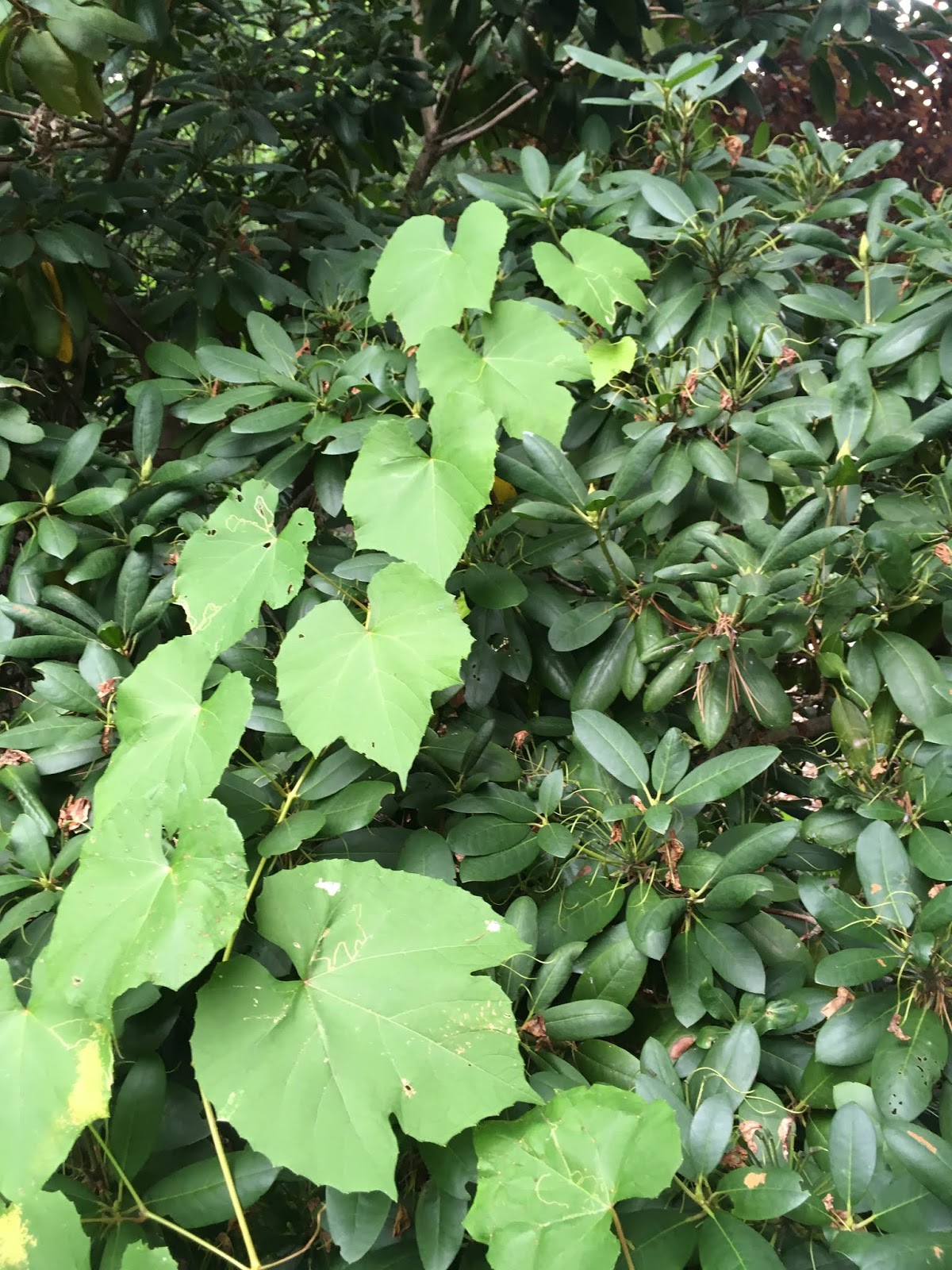
    Two other members of the grape family have also found a place in the yard. I recently spent some sweaty hours pulling wild grape canes (Vitis vinifera subsp. sylvestris) off the shrubs that overhang another section of the same fence. The vines had rooted behind a neighbor’s shed. 


Wild grapes climbing a truck-sized Catawba rhododendron

By the time I noticed them on an infrequent visit to check for places a new puppy could tunnel under the fence, they’d reached far over my head. I had to cut back the leatherleaf viburnum branches (Viburnum rhytidophyllum) that supported them and pull and hack off the vines that came down with them. 

    Wild grapes are nice looking, but I didn’t want their shade to kill the shrubs, and they were bidding fair to take over a large section of the canopy in our yard. Like Boston ivy, they’re imports, in this case from the Mediterranean, and like it they’re spread by birds. I’ll have to remember to be vigilant about checking every year to cut them back as they continue venturing over the fence.


    The third grape relative I’ve found in the garden is Virginia creeper (Parthenocissus quinquefolia, named for the five leaflets that make up its leaves), a cousin of Boston ivy. So far I’m only seeing little patches in uncultivated spots. 


Virginia creeper getting started in a shady area

I welcome this vine because it’s a native and because I love its bright red fall color. When we replace a rotting wooden fence with chain link later this month, I could move one of the young vines to the fence line to create some quick visual screening.

Virginia creeperr's autumn splendor-photo Moralist

Want to see the vines in their fall colors? Sign up here with Newton Community Education for a hands-on sustainable gardening course in my yard Saturdays October 26 and November 2.