My book and web site

Check out my book, The Sustainable-Enough Garden, available on Amazon, and the book's web site at www.thesustainable-enoughgarden.com. See more plant photos on Instagram.

Sunday, August 27, 2017

Squirreling away acorns for winter

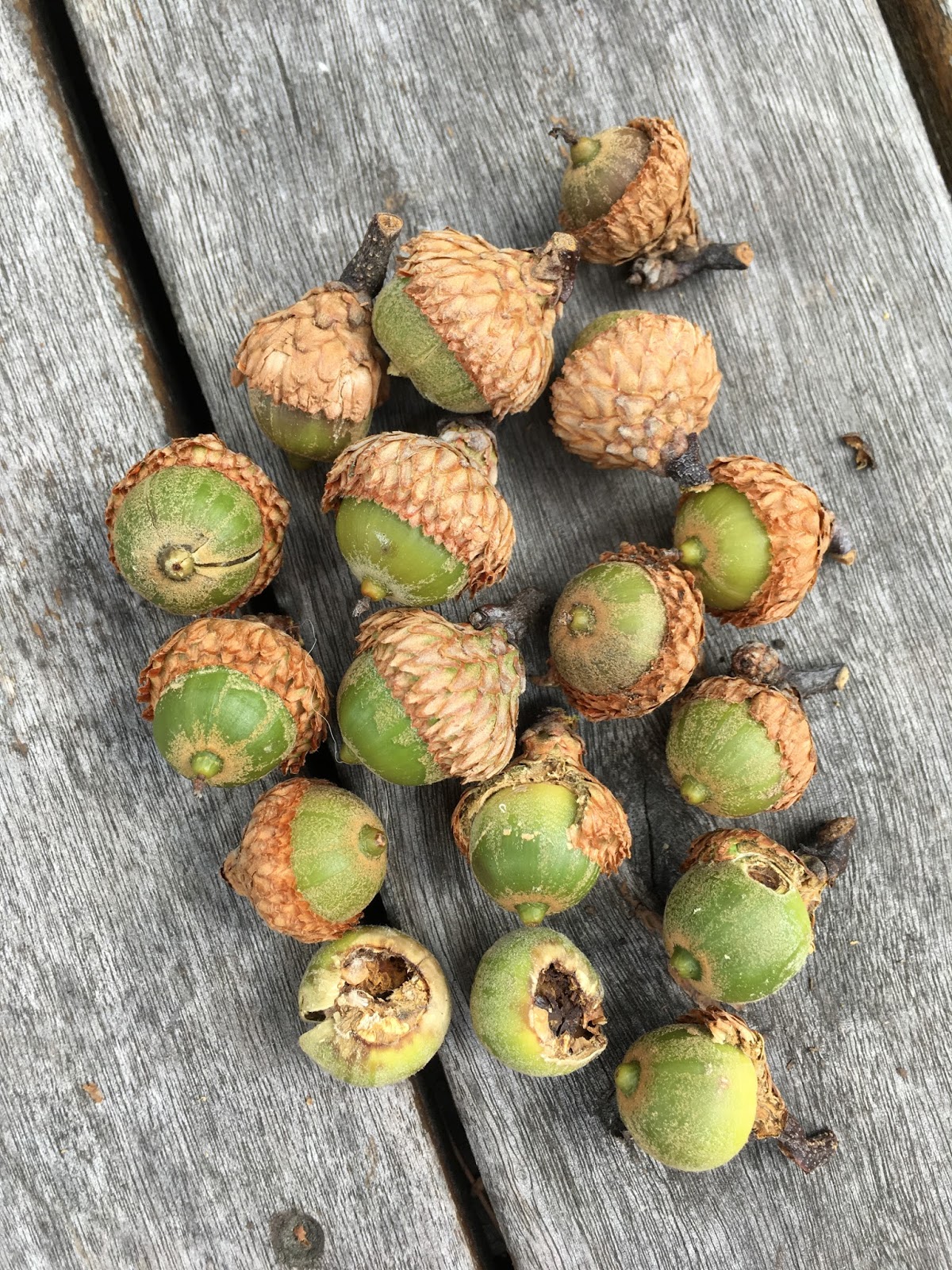
Acorns are falling. I swept the deck yesterday afternoon, and by this morning a few dozen more acorns dotted the surface. They’re a sign that autumn isn’t far off, and for squirrels, they’re the start of the fall harvest.

Red oak acorns


    Gray squirrels are so much part of our suburban surroundings that we tend to overlook their activities. To remedy this, I opened North American Tree Squirrels, by biologists Michael Steele and John Koprowski. Steele and his colleagues and students designed clever experiments to elucidate the feeding behavior of squirrels they found on their campus at Wilkes University in Pennsylvania.


Eastern gray squirrel (Sciurus carolinensis)

    For gardeners who like oaks, it was good news that acorns can be half eaten and still germinate and produce seedlings. Steele noticed that in early fall, when acorns were plentiful and the weather was still warm, squirrels usually ate acorns of white oaks but cached red oak acorns for later. White oak acorns are programmed to germinate in the fall.


Squirrels may pretend to bury acorns in decoy locations


    The red oaks play a longer game. Their acorns contain higher levels of tannin, a nasty-tasting chemical that protects seeds from predators. They’ve evolved to germinate in spring after a necessary cold period. The researchers observed that later in the fall, squirrels started removing the acorn caps to eat just the tops of the red oak acorns, which contained more high-calorie lipids and less tannin. As winter set in, they were willing to eat the whole red oak acorn, tannin and all. Apparently like us, squirrels balance tastiness versus health factors when they choose food.


Health food or tasty treats? It depends on the time of year

    Do gray squirrels remember where they hide their acorns? It was long thought that they didn’t and had to sniff out buried acorns. Lucia Jacobs, then at Princeton University, showed through an ingenious experiment that squirrels found their own cached acorns more readily than those hidden by other squirrels, although others’ caches might be quite nearby. 


Squirrels remember where they hid their nuts--photo by Juraj Patekar

    As a directionally challenged navigator, I’m awed by squirrels’ ability to recover their hidden nuts. Scientists asked whether squirrels were just good at retracing their steps—I can usually do that—and were finding their caches that way. Or were they constructing a three-dimensional mental map that allowed them to locate their hidden acorns? 


    Another of Jacobs’ lab experiments confirmed the latter. If she trained squirrels to find a nut in a maze and then kept the nut in the same location but changed the way to get there, the squirrels still found the nut. They’d retained its location, not just the directions for getting there.


    Although squirrels recover most of the acorns they store, they do serve red oaks by dispersing their seeds. A study of white versus red oak seedlings found that most of the white oaks sprouted close to the parent trees, whereas red oak seedlings appeared three to six times farther from the mature trees, their acorns having been moved by squirrels and other animals. In this way, squirrels contribute to the development of our forests.


Sunday, August 20, 2017

Pollinator-safe container plantings--do they work?

This spring I refrained from filling my shopping cart with brightly-flowering annuals at my favorite garden center. It felt like a deprivation, but I was trying to avoid bringing home plants treated with pollinator-killing neonicotinoid insecticides. 


What I aspire to--the pollinator garden at Locust Grove in Poughkeepsie

This meant changing my approach to container plantings. Now in August the garden is quiet, but the containers are coming into full bloom. It’s a good time to assess how the new approach worked out.

    I’d fallen into a routine of filling large containers with a combination of tender perennials and annuals from the garden center. 

 
     I carry warm-climate perennials, cannas, elephant ears, dahlias, and a favorite salvia, through the winter by storing them in the basement. Since most of my containers stand in full or part shade, I’d been adding shade-tolerant long-blooming annuals such as impatiens, browallia, torenia and coleus. 

Browallia blooms in shade

I liked the results, but truth to tell, the combinations hadn’t varied much in years. It was high time for a change.

    This year I followed Patricia McGinnis’ suggestion to “shop” in my own garden for perennials to use in the pots. I also found three places in Massachusetts to buy plants that haven’t been sprayed with pesticides: Thomson’s Garden Center in Salem, Allandale Farm in Chestnut Hill, and the horticulture program at a local school, Learning Prep School in Newton. 


Here’s how my containers turned out:

I surrounded Canna ‘Bengal Tiger’ with anise-scented sage (Salvia guaranitica), which just recently opened its deep blue flowers. 


There aren't many flowers as blue as this salvia's

A few marigolds added as fillers have bloomed continuously, adding a bright touch.

Neonic-free marigolds add a pop of color

    My favorite this year is a combination of another canna with an ornamental grass, name unknown, that I bought at Learning Prep. From the flowers (those wispy stalks at the top), I suspect it may be a reed grass (Calamagrostis).


A mystery grass turned out to be a good collaborator

Golden creeping jenny (Lysimachia nummularia ‘Aurea’) is adding a je ne sais quoi as a “spiller” falling over the edge of the pot. Heaven knows there’s plenty of this groundcover in the garden; it’s famous for its imperialistic tendencies.

    In shade, the giant leaves of elephant ears provide bulky focal points. To their pots I’ve added a purple-leaved heuchera for some contrast and offspring from an angel-wing begonia I bought last year that will offer pale pink flowers as the weather cools. 


Contrasting leaf colors and forms complement elephant ears

I doubt the begonia is neonic-free, but I couldn’t bear to throw it away. Japanese painted fern (Athyrium niponicum var. pictum) pops up anywhere shady in the garden. Not surprisingly, it’s willing to collaborate with elephant ears.

Japanese painted fern is an adaptable shade-lover


    Apple-blossom-pink geraniums are doing OK in part shade in the front yard, helping to cover up a not very decorative drain cover that we have to keep accessible. In Salem I found red coleus that’s growing well in a north-facing spot along the driveway.


Coleus without the pesticide spray

    The more I scrutinize the combinations in the pots, the more I can see ways I’d like them to be different. But overall, I’d say that for container plantings, there’s life without neonics.

Monday, August 14, 2017

How it should be done

Yes, a garden can be both sustainable and beautiful. My faith in this ideal got a big boost Saturday when I visited garden designer Robin Wilkerson’s enchanting home garden in Lincoln, Massachusetts. She opened her site to visitors as part of a native plant tour organized by the Ecological Landscape Alliance.


The entrance to Robin's sustainable garden

      Robin’s house and garden sit on old farmland that had been taken over by nonnative invasive plants. For 20 years she has been reclaiming expanding portions of the lot for her organic garden, tearing out unwanted plants and sheet mulching with cardboard and wood chips to smother unwanted vegetation. She grows a large vegetable garden, grapes, berries, and numerous fruit trees.

Beds of bird- and pollinator-friendly shrubs and perennials lead to fruit trees in the background

    Unlike me, she’s resisted planting tall trees that would shade sunny areas. Her flowers enjoy full sun. There’s also a shady woodland section. 


    I had attended a workshop Robin taught at New England Wild Flower Society’s Garden in the Woods on native shrubs for garden use. Her enthusiasm for these plants was contagious and reinforced by a tour of the garden on a lovely June day. Afterward, though, second thoughts set in. 


    Many of the plants she’d showcased had medium-green, medium-sized leaves. They might have pretty fruits and bright fall foliage, but their flowers were often small, off-white, and not very eye-catching. I thought that a garden of these shrubs would look like a typical New England woodland edge, generally pleasing but not particularly striking or ornamental.


    Seeing Robin’s garden, though, I suddenly got it.


A peach tree, ornamental banana, and hanging basket of calibrachoa blend with native honeysuckle and phlox

While supporting biodiversity and welcoming wildlife, she’s combined natives and nonnatives in a harmonious blend of flowering plants from New England and around the world. The natives she’s planted are shown at their best through thoughtful combinations of shapes, sizes, and leaf colors and textures. 

It's all in the design

    She has large, thriving patches of a long list of pollinator-friendly plants. Plentiful fruit beckons to both humans and birds. 


Peaches!

She’s lined the lowest point in the lot, the back border, with a barrier made from pruned twigs and branches; 

This homemade fence provides shelter for insects and other animals

in addition to demarcating the lot line and preventing erosion, this provides a home for insects and other animals. For birds, she keeps several dead trees topped at around 20 feet standing behind the garage. These snags are valuable to woodpeckers and others that feed on insects beneath the bark and build their nests in tree cavities.

Dead trees offer food and habitat for birds

    Insects were everywhere. In addition to the many bees working flowering perennials, butterflies were wafting all over the yard, 


Black swallowtail nectaring on a tithonia flower

and I spotted a hummingbird moth. That was just while strolling around gawking at the flowers; I’m sure closer observation would find that this garden hosts a full range of insects in dynamic balance.

    Robin’s is the kind of garden I aspire to. The visit immediately got me thinking about how to emulate her dense plantings and thoughtful combinations of natives and exotics. Next, the front yard!

Sunday, August 6, 2017

Let it rain

What a lush garden year we’re having! Last summer’s gardens were parched by drought. This summer the Northeast has been blessed with plentiful rain. 

Foliage is thriving thanks to plentiful rain

As of August 6, we’d had 30.83 inches of precipitation in the Boston area in 2017, well above the average of 25.88 inches by this date. You can probably see the difference in your garden; I certainly can in mine.

    Why should that be? What makes rain better for gardens than irrigation? We run a sprinkler irrigation system, so unless I cut back on scheduled watering, my plants should be getting enough water even when it doesn’t rain.


Water beads on a giant elephant ear leaf

    There are limitations to even the best-designed irrigation system. Ours is set up in 12 watering zones. Twice a week, sprinkler heads pop up in the early morning and start spraying in a programmed sequence, controlled by a computer in the basement. A rain sensor prevents watering when there’s been adequate rain. With this system, I lavish a lot of water on the garden, sometimes more than my conscience tells me I should.

    Theoretically every plant gets plenty of irrigation water, but in practice, I’ve learned, it’s not that simple. As the garden has matured, shrubs have grown wide and tall, hogging the spray of water and creating dry shadows behind their bulk. And the arcs described by the sprinklers’ spray don’t fit exactly to every angle and curve of plantings. Inevitably some patches get less irrigation.


    Beyond falling evenly on the whole garden, rain conveys numerous advantages:


Lots of rain is helping this St. John's wort get established

•    Whereas irrigation water contains dissolved minerals, including calcium, magnesium and sodium, rainwater is “soft” and mineral-free. As a result, it pulls nutrients by diffusion from where they're bound in the soil, making them available to plants’ roots.
•    Rain water is acidic, which promotes release of micronutrients including zinc, manganese, copper and iron that plants need. Most of my garden soil is acidic already, but there may be alkaline areas where concrete paving leaches lime. Acidic rainwater is especially beneficial in those spots.


Soil next to sidewalks may be alkaline

•    Rain falls at 20 miles per hour, penetrating soil better than irrigation water, which falls at 5 mph.
•    Rain is saturated with air, so it oxygenates soil. That’s good for plants
•    Rain contains nitrogen in the form of nitrate and ammonium from the air. This nitrogen becomes available to plant roots and promotes growth.


Big canna leaves can use a boost from extra nitrogen in rain

•    Rain doesn’t contain the chlorine that comes with treated drinking water. Chlorine inhibits plant growth.
•    Rain flushes salts (such as road salt) that inhibit growth through the root zone and washes mineral deposits, dust and pollutants off leaves, making for more effective photosynthesis.


The proof is in the pudding. The garden looks happier this year with more rain. 


New plants I added in June and July are surviving, despite the heat. Just watering them might not have been enough if it hadn’t been for well-timed, frequent rain.

Sunday, July 30, 2017

The native (hemlocks) are dead. Long live the natives!

Remember those hemlocks I removed to avoid spraying for hemlock woolly adelgid? 

All that's left

They left two big gaps in the garden’s tree canopy that weren’t there before. It’s disconcerting seeing fresh wood chip mulch where evergreen branches used to sweep the ground.

    Last week I finished planting new trees and shrubs in the newly opened spaces. 


For now, small plants and lots of open space

The hemlocks were native to eastern North America. I wanted to replace them with other plants from our region to offer food and habitat for native insects. 

    Between the vegetable bed and compost bins, two hemlocks used to stand along the side fence. I planted two conifers to replace the visual barrier the hemlocks provided. A northern white cedar, also called arborvitae (Thuja occidentalis ‘Smaragd’) will eventually grow 15 feet high and 6 feet wide.

 
Northern white cedar is native to our area

    A small white spruce (Picea glauca conica) went in nearby. This tree ranges across the northern reaches of the continent. You may know it as dwarf Alberta spruce, the little conical potted trees that are often sold as container plants or live Christmas trees. 


This white spruce stays small because it's grown in a pot

It starts small and grows slowly at first, but someday this spruce’s height may reach 10 feet.

    The dense foliage of both these trees provide year-round shelter for birds and mammals. Birds eat the seeds and forage for insects among the branches.


    In the same area, I added an American black elderberry (Sambucus canadensis). Doug Tallamy, the entomologist author of Bringing Nature Home, lists this small tree as highly desirable for providing native insects with nectar and leaves they’re adapted to eat. Birds will also enjoy its copious black fall fruits.


Elderberries

    In view of the vegetable bed, I planted a sweetshrub, also called Carolina allspice (Calycanthus floridus). Its distinctive dark red flowers are reputed to have an intoxicating sweet, fruity scent that attracts insects. 


Sweetshrub has curious dark red flowers

I also planted a mountain laurel (Kalmia latifolia 'Elf') with pink buds and white flowers. I love mountain laurel’s freckled blooms, and Tallamy lists this shrub too as a boon to native insects.


An older mountain laurel blooming in June

    In a back corner of the yard where three hemlocks used to grow, I put in two inkberries (Ilex glabra ‘Shamrock’). I’m hoping this bird- and insect-friendly native evergreeen will prove to be a tough, reliable substitute for nonnative boxwood (Buxus sempervirens).


Boxwood
Inkberry


    Nearby in a spot visible from the kitchen window, I place a spicebush (Lindera benzoin), another of Tallamy’s choices that’s praised for its handsome yellow fall foliage.


Spicebush in fall--photo by tgpotterfield

    In case you’re wondering, I did find some of these young plants at the shop at the New England Wild Flower Society. This means they were grown without pesticides, so they definitely weren’t treated with neonics. I bought three at a sale at a local nursery. I can’t be sure those are neonic free. They don’t attract pollinators, though, so I hope they won’t sabotage the yard’s insect population.


    I’m looking forward to finding out whether these natives will flourish. If they do, they’ll join an expanding list of plants that welcome a broad variety of insects and birds to the yard.


Native purple coneflower
 

Sunday, July 23, 2017

Neonics reprised

Beekeepers are spreading the word: neonicotinoid pesticides are bad news for honeybees. A Boston Globe story last week about bee-friendly yards spotlighted the problem. While choosing native plants is a help, beekeepers interviewed emphasized that you undo your good work if you apply toxic pesticides on your property—or if someone nearby sprays these chemicals.

Black-eyed Susans help pollinators--but not if they're treated with toxic neonics

    Friends of Earth and its supporters are asking EPA administrator Scott Pruitt to ban one of the neonics, imidacloprid. The National Pesticide Information Center at Oregon State University reports there are 400 products sold in the US containing this pesticide in various forms: liquids, granules, dusts, and water-soluble powders. A quick search turned up brand names such as Temprid, Maxforce, and Bayer Insect Control. 


    So far the EPA has declined to ban agricultural use of imidacloprid. Plants sold in garden centers may be even more of a problem. 


Tempting, but garden center plants could be toxic for pollinators

They can be treated with the pesticide at 120 times the concentration used on farms. Because the neonics dissolve in water, they migrate into all plant tissues and can contaminate surrounding soil. They’re slow to degrade and can affect your garden for years to come.

    As garden center customers, we have reason to feel betrayed. We’re encouraged—urged—to buy pollinator-friendly plants. Wouldn’t it be reasonable to expect that those plants won’t kill pollinators?


    Beekeepers are of course most concerned about honeybee die-off. In late June, a beekeeper in Rehoboth, Massachusetts lost more than 60,000 bees. Knowledgeable observers say this loss has the hallmarks of pesticide poisoning. Bee scouts go out each morning to find sources of pollen and nectar. They return to the hive to share their information. The Rehoboth bees seem to have followed their scouts to a nearby food source contaminated with pesticide.


A contaminated food source can kill a whole hive--photo by Shawn Caza


     This is the kind of effect neonicotinoid spraying can have. A homeowner could have used a pesticide product according to label instructions, or worse, could have applied more than instructed or sprayed at a windy time when the spray would be carried to surrounding areas. The result: bee genocide.

    We hear most about honeybees, but there are 400 native bee species on the job too pollinating our food crops as well as other plants. 


Bumblebees are important pollinators too

Moths and butterflies also do this work. Neonics threaten all these insect pollinators. 

    Since becoming aware of the neonic problem this year, I’ve been working hard to avoid bringing home any neonic-treated plants. Plant purchases from previous years may already be spreading toxicity on my land. I searched for untreated seeds, or at least seeds sourced from European countries that don’t allow neonic treatment. I found places to shop where sellers guarantee their seedlings are pesticide-free, if not fully organic. But I had to avoid my favorite garden center, because they’re still buying neonic-treated plants.


Stokesia from a pesticide-free garden center

    Big retailers such as BJ’s Wholesale Club and Home Depot have already pledged not to sell neonic-treated plants. It’s high time that local garden centers did the same.

Monday, July 17, 2017

Energy conservation--mine

I spent much of last weekend bashing out a new slide talk for garden clubs. When I got home Monday from presenting it for the first time, what I most wanted to do was get out into the garden. I’d been harboring some resentment about spending nice days indoors working on the talk, although this was totally due to my own procrastination.

Stuck inside looking out
 
   The only downside of starting work in the garden at two in the afternoon was the outside temperature. It was in the high eighties. My motivation to work outdoors drops off sharply when the temperature passes 80. On cool spring and fall days, my idea of heaven is to be out in the garden. In summer heat, not so much.

In May, it's great to be outside

    I’ve certainly got sweat equity. I’ve put in many hours toiling over the vegetable garden under the hot sun. The only reason my skin in the game isn’t lobster-red is fanatical application of sunscreen. But when it’s hot and there’s no shade, gardening stops being fun and becomes just hard work.


I can relate

    This makes me feel like the consummate wimp, of course. People in Phoenix and Savannah probably don’t let a little heat keep them from tending their gardens. I recently heard an Arizonan describe getting up at 3:00 a.m. to do her outside chores before the 120-degree heat of the day sets in.


    That’s the approach I’ve decided to try. I won’t be getting up before dawn. But if I can be in the garden in the relative cool of 6:30 on days when the temperature is heading for the nineties, I can put in a good two hours before wilting.


Sunrise at home isn't as alluring as in Banff

    Part of this new plan is a liberating decision not to carry out my usual morning routine. No reading the paper over breakfast, just a quick cup of tea. Sunscreen on my face only. The dog can come outside with me, but she’ll have to wait for her walk.


Later

    So far I’ve done this twice, when I had work to do on my new planting project that couldn’t wait, but the weather wasn’t cooperating. Both times have been fun and productive. By 8:30 or 9:00, the day already felt rich with accomplishment.


    What does this have to do with sustainable gardening? A gardener’s energy and enthusiasm are finite resources too, like fossil fuels and peat moss. If sustainable gardening is such a harsh mistress that it demands working in the garden at the hottest time of the hottest days, it’s likely to find few lasting converts among home gardeners. 


Catching more gardeners with honey


    Monday afternoon my desire to plant shrubs trumped the heat, but the sweat running down my face reminded me of why early morning gardening had seemed like a better idea. 

  
    In deciding what we’ll to do to be part of the solution for environmental problems, each of us makes our own calculations. How much time, energy, money, and hard work are we willing to invest?  We might as well be realistic about what we expect from ourselves.